On a journey to break national record for Static Apnea (breath hold under water). Ofc had to rep my polar bear pudgy 🤿🐻❄️🐧
@pudgypenguins@PudgyAsia@PudgyPoolClub
On a journey to break national record for Static Apnea (breath hold under water). Ofc had to rep my polar bear pudgy 🤿🐻❄️🐧
@pudgypenguins@PudgyAsia@PudgyPoolClub
"[Maduro] f around and found out" – US Secretary of Defense @PeteHegseth
I don't know the situation well enough to offer insights, but that's a beast-mode comment while not giving a fuck about dethroning another country's political regime.
Last one on this topic, and I have been holding this in myself for a while.
For centuries, class divides kept the labor of the poor invisible to the rich. Factory workers toiled behind walls, farmers in distant fields, domestic help in backrooms. The wealthy consumed the fruits of that labor without ever seeing the faces or the fatigue behind it. No direct encounter, no personal guilt.
The gig economy shattered that invisibility, at unprecedented scale.
Suddenly, the poor aren't hidden away. They're at your doorstep: the delivery partner handing over your ₹1000+ biryani, late-night groceries, or quick-commerce essentials. You see them in the rain, heat, traffic, often on borrowed bikes, working 8–10 hours for earnings that give them sustenance. You see their exhaustion, their polite smile masking frustration with life in general.
This is the first time in history at this scale that the working class and consuming class interact face-to-face, transaction after transaction. And that discomfort with our own selves is why we are uncomfortable about the gig economy. We want these people to look our part, so that the guilt we feel while taking orders from them feels less.
We aren't just debating economics. We are confronting guilt. That ₹800 order might equal their entire day's earnings after fuel, bike rent, and app cuts. We tip awkwardly, or avoid eye contact, because the inequality is no longer abstract. It's personal.
Pre-gig era, the rich could enjoy luxury without moral discomfort. Labor was out of sight. Now, every doorbell ring is a reminder of systemic inequality. That's why debates explode. It's not just policy. It's emotional reckoning. Some defend the system (“they choose it”), others demand change (“this isn't progress, its exploitation”).
And here’s the uncomfortable twist: the unsaid ask of clumsy ‘solutions’ isn’t dignity. It is about returning to invisibility.
Ban gig work and you don’t solve inequality. You remove livelihoods. These jobs don’t magically reappear as formal, protected employment the next day. They disappear, or they get pushed back into the informal economy where there are even fewer protections and even less accountability. Over-regulate it until the model breaks, and you achieve the same outcome through paperwork instead of slogans: the work evaporates, prices rise, demand collapses, and the people we claim to protect are the first to lose income.
And then what happens?
The rich get their old comfort back. Convenience returns without faces. Guilt dissolves. We go back to clean abstractions and moral posturing from a distance. The poor don’t become safer, they become invisible again: back in cash economies, back in backrooms, back in shadows where regulation rarely reaches and dignity isn’t even debated.
The gig economy just exposed the reality of inequality to the people who previously had the luxury of not seeing it. The doorbell is not the problem. The question is what we do after opening the door.
Visibility is the price of progress. We can either use this discomfort to build something better (which we keep doing continuously as delivery partners are our backbone), or we can ban and over-regulate our way back into ignorance. One of those choices improves lives. The other simply helps the consuming class feel virtuous in the dark.
MAKING A USD TRANSFER IN 2025
Bank:
- Send email to RM
- Fill out this form
- "I need the home address of the recipient"
- Disclose why you are sending the funds
- Sign this document
- Your signature doesn't match
- Do it over again
- OK it apparently matches now
- Confirm via phone
- Oh it's past 4pm, we'll send it tomorrow
- Wait 5 days
- (Weekend)
- Ask bank where the money is
- Something went wrong so the money is now back at the account
- No-one knows why
- Get charged anyway
- Go back to step 1
...
Stablecoins:
- Enter address, click send
- Wait a few seconds
- Done
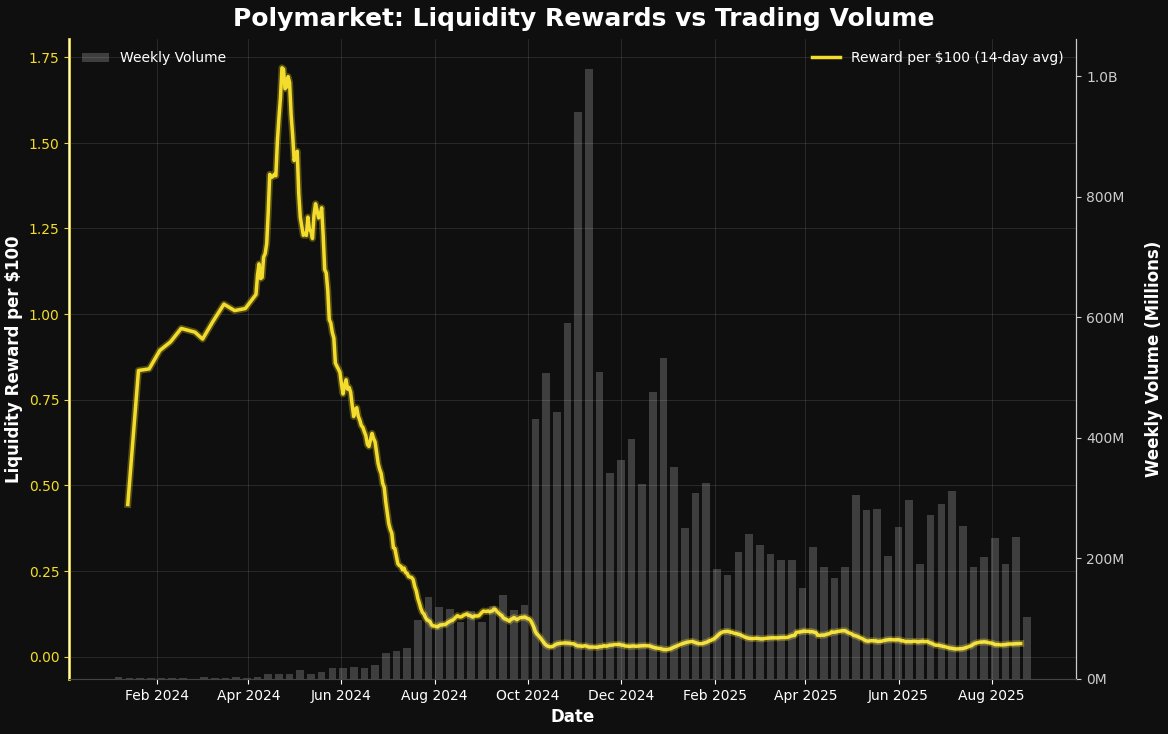
Before the 2024 US election, Polymarket took a risk and decided to give away >$50k per day to its MMs ($1.7 per $100 in volume)
Today, they give $0.025 per $100
Polymarket has burned ~$10M. And in doing so, made prediction markets healthy with rebates close to perp exchanges