@RadPig94@shinobi602 The dialogue is too energetic. It's reused from CE, which had energetic marines. CCE uses the classic marine voices and the Reach marine AI, which is stilted and awkward and always crouch walking.
@FPSthetics Ugly art direction (mostly) and if you're a Halo fan, you've been there done that a thousand times now. Literally no new content outside of a few weapons.
BREAKING: We're suing the U.S. Fish & Wildlife Service over their plan to give away 715 acres of a public wildlife refuge to billionaire corporation Space X.
Americans shouldn't be sacrificing their public lands to subsidize a company owned by the richest man in the world.
@shinobi602 I already did like the art style, and the changes to the Marine's is the nail in the coffin - that's all. Odd, because 343 actually made great Marine AI for Infinite.
@Slonk01 Only watched twice. Noticed that 343 didn't fix up Reach's awful Marine AI, guy is slowly crouch walking away from an elite about a yard away from him lol
It’s deeply odd to me that America is a far less 24/7 hour society today than it was 10, 20, or even 30 years ago. I vividly remember friends from the UK back in 1996 marveling at the fact that in the mid-sized Indiana town where I went college it was possible to buy groceries, clothing, a lawn mower, a snow blower, Lego sets, and bow hunting gear at 3 AM on any given Tuesday of the year. That was peak American Empire, and it’s long gone.
One man in California has spent 57 years recording the sounds of natural places. Much of what he's recorded no longer exists.
His name is Bernie Krause. He started as a folk musician and an early pioneer of the Moog synthesizer. In 1968, he began carrying recording equipment into rainforests, deserts, coral reefs, African savannas, and research sites associated with scientists like Jane Goodall and Dian Fossey.
The Wild Sanctuary archive now contains more than 5,000 hours of recordings and over 15,000 identified species. Krause coined the term "biophony" to describe the collective sound of living organisms in a habitat and helped establish the field of soundscape ecology.
Through thousands of recordings, he observed that healthy ecosystems often partition acoustic space, with different species occupying different frequencies and times of day. On a spectrogram, an intact habitat can resemble a densely layered musical score.
When Krause revisited many of the places he had recorded decades earlier, he found that over half had become silent, severely degraded, or so altered by human activity that their original biophonies could no longer be heard. His archive preserves sounds from ecosystems that have been transformed or lost.
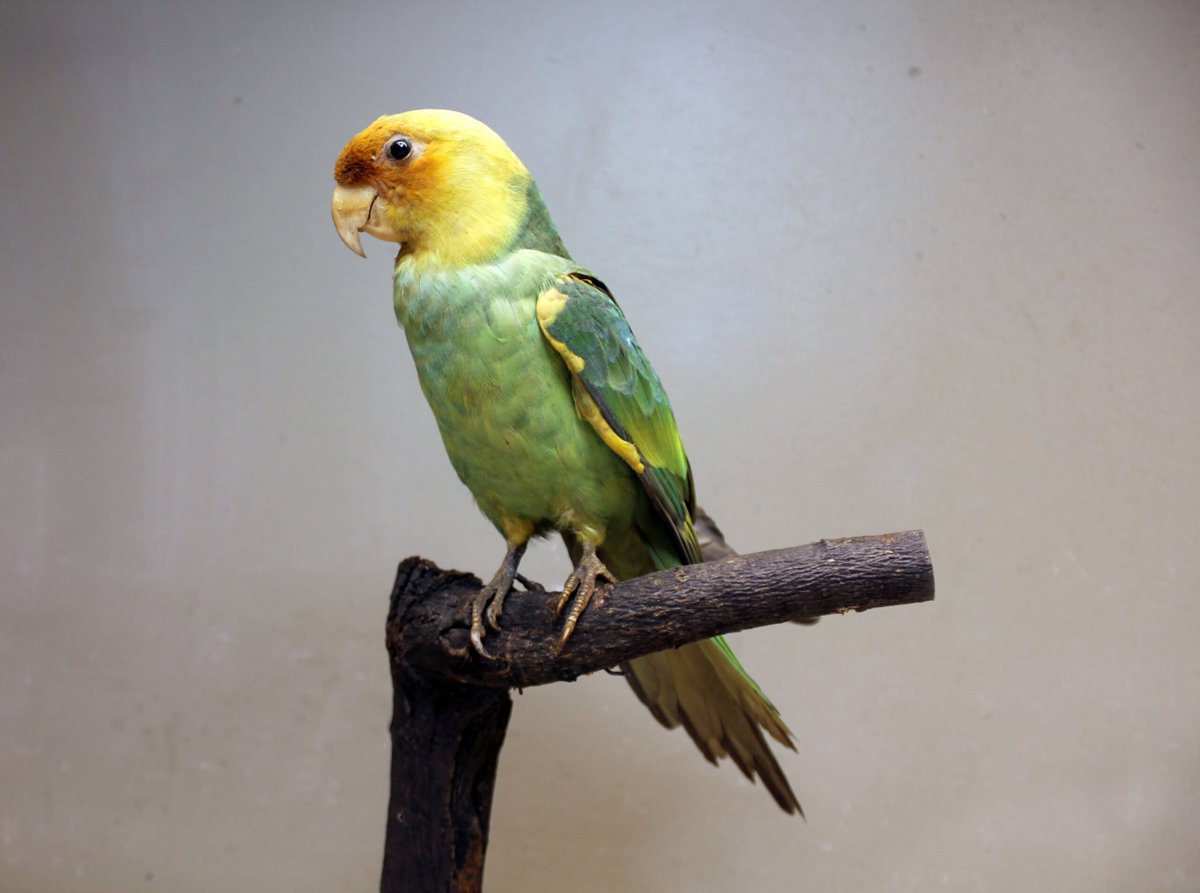
Carolina parakeets were the only parrots native to eastern North America. They had a green body, yellow head, orange face, and flew in noisy flocks across the southeastern US.
They ate the fruit in farmers' orchards, and farmers shot them by the thousands. They had a fatal social instinct: when one was shot, the rest of the flock circled back to "mourn" the dead bird, where they could be shot too. Entire flocks could be killed off in single afternoons.
In 1885, the Cincinnati Zoo bought 16 of them for $40, hoping to breed enough to save the species. The captive breeding program didn't work, and by 1917, only two were left: a male called Incas and his mate of 32 years, Lady Jane.
She died in late summer 1917. The zookeepers said Incas became "listless and mournful" and stopped eating.
On February 21, 1918, Incas was found dead in the morning after a cold night.
It really makes you wonder what the woods would sound like if their flocks still flew overhead.