Remembering Black July
Today marks 43 years since the horrors of the anti-Tamil pogrom of 1983, when thousands of Tamils were killed by Sinhala mobs backed by the then UNP government and state forces. https://t.co/Z35qm2IPfM
I'd rather live in a total authoritarian governance that protects its wards than be part of this pseudo-democracy that is practiced here...
#Democrazy#governmentplaylist
Kindergartens in China are increasingly incorporating hands-on cooking, cleaning, and crafting into their curricula to foster independence, responsibility, and confidence in young children.
Kids as young as 3–4 years old use specialized mini stoves to prepare food, wash dishes, and perform tasks like sewing and farming.
🚨 Chemmani mass grave excavations halted again at 412 remains
Excavation work at the Chemmani mass grave, the largest uncovered on the island, has once again been temporarily halted, with officials planning to resume around 15 July.
The dig has so far yielded 412 sets of skeletal remains, of which 409 have been exhumed, yet the work of identifying any of the dead has still not begun.
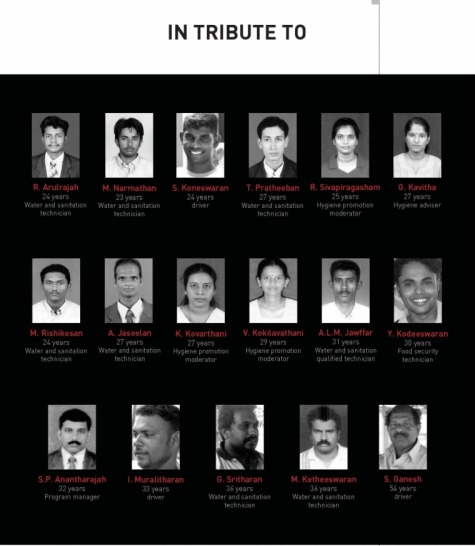
🚨 Twenty years on, Action Against Hunger calls for new Muttur massacre inquiry
Action Against Hunger has called on the Sri Lankan government to open a new investigation into the 2006 Muttur massacre, in which seventeen of its aid workers, sixteen of them Tamil, were executed, urging an end to "decades of impunity" as the killings approach their twentieth anniversary.
In a letter sent to the Sri Lankan president in May, the president of Action Against Hunger, Dr Robert Sebbag, requested an account of the efforts made by Sri Lanka's governmental and judicial authorities to investigate the massacre and bring those responsible to justice, "in accordance with Sri Lanka's international obligations", and asked to meet the president to discuss progress towards "an impartial, transparent and effective investigation into the killing of our colleagues".
"We are deeply concerned that twenty years on there has been no justice for our colleagues," the letter said, adding that the families of the victims continued to endure "the trauma of a decades long wait" for accountability. That the case file remained open, it warned, offered "a dangerous signal that such attacks on humanitarian workers can be perpetrated without consequence".
On World Refugee Day, let's remember a remarkable Indian whose compassion helped thousands rebuild their lives.
When Partition displaced countless families, Dr. RM Alagappa Chettiar stepped up in an extraordinary way — launching an airline to help evacuate refugees and bring them to safety.
But his legacy didn't stop there. From supporting education to inspiring what would later become India's midday meal movement, he believed that opportunity and dignity should be accessible to all.
At a time when millions around the world continue to seek safety and a fresh start, his story reminds us that humanity shines brightest when we choose to help those in need. ❤️🌍
#WorldRefugeeDay #UnsungHeroes #IndianHistory #SocialImpact #HumanityFirst
[RM Alagappa Chettiar, World Refugee Day India, Partition Refugee Relief, Midday Meal Inspiration, Indian Philanthropist Legacy]
In June 1956, Prabhakaran was just a one-year-old.
The same year Sinhala mobs set upon Tamils in the shadow of parliament. Ears were bitten off. Protestors were thrown into a lake.
It was the first, but not last, anti-Tamil pogrom.
The state had already chosen its path.
Shillong | Residents in Shillong expressed anger after traffic restrictions and road closures were imposed during Union Home Minister Amit Shah’s visit for the 73rd North Eastern Council (NEC) Plenary Session.
Commuters reported major disruptions as vehicles were diverted and key routes were restricted as part of heightened security arrangements for the high level meeting. The curbs were enforced around important venues linked to the NEC session.
While authorities said the measures were necessary for VVIP security and smooth conduct of the event, several residents said their daily movement was affected during peak hours.
#Shillong #AmitShah #NEC #NorthEastIndia #TrafficCurbs #PublicAnger
She became a journalist believing the truth mattered — but exposing it became a risk.
From India to the Oslo Freedom Forum, @scroll_in Executive Editor @sharmasupriya reflects on what it means to keep reporting as independent media shrinks, journalists are jailed, and democracy becomes performance. She describes the cost — and exhaustion — of reporting the truth in a country where power depends on silence.
Coconut coir’s astonishing strength in shipbuilding!
Even today, I use coconut fiber to clean our pooja vessels, but this fact left me amazed.
Chola ships were built using the ancient “Tankai Method,” where massive wooden planks were stitched together using strong coconut coir ropes and sealed with natural resins, fish oil and tar.
This unique design gave the ships flexibility. Instead of cracking against powerful ocean waves, the vessels could bend and absorb the force of the sea.
More than 1000 yrs ago, Chola shipbuilders possessed an extraordinary understanding of material science and naval engineering.
They certainly knew how to use iron for anchors, yet wisely avoided excessive metal in the ship structure itself, engineering vessels with natural materials that resisted rust in the salty ocean environment.
vc: Raj files on IG