Observation and prediction: AI is killing the Ad-based Economy, and Crypto will be the winner.
Explanation:
For the past 25 years the internet economy looked like this: Publishers offer content to users for free, because their revenue came from ads shown to users.
This economy is dying because AI is replacing users in reaching for content, and AI doesn’t care for ads.
This will push publishers to charge for their content, and I see two end states, one of which has Crypto as the main winner.
Centralized solution: A single company, or a small number of companies, will be trusted to do the accounting on behalf of Agents and publishers – who accesses which website – and settle periodically (say, monthly). This is much harder than it seems – the agents, users, publishers, are decentralized and globally distributed. Payments must go across borders and satisfy regulatory requirements. Big problem.
Decentralized solution: Using hyper-scaled blockchain technology, agents will pay in real time with micropayments for accessing content. This is a use case that blockchain is well suited for, except for the small issue of how to allow millions of TPS.
> be ledger
> sell a little box so your keys never leave the device
> confirm that "a firmware update cannot extract the private keys"
> 6 months later launch a firmware that extracts the seed and mails it to 3 companies
> get caught
> tweet "technically it always has been possible to extract your keys, you just trusted us not to"
> delete the tweet
> also leak 272,853 customers' names and home addresses onto a hacker forum
> then ship a wallet drainer inside your own software, ~$600k gone
> tell the entire ecosystem to stop touching dApps
> ceo on a podcast: "the only concern is if a government subpoenas us"
> 2026: push an update that decides what your own keys are allowed to do
still call it self-custody
1/4
The next social breakthrough probably won't look like a social app.
We're all looking for the next X, Facebook, or TikTok.
What if that's the wrong framework? 👀
Beautifully crafted piece on "Why Ethereum?" Very powerful. Some quotes:
“The original vision of consortium blockchains – the idea that you have 5 banks or major companies that come together and create their own chain – has been mostly a failure,” Vitalik Buterin explains . “It ends up inheriting most of the disadvantages of centralization and most of the disadvantages of decentralization at the same time.” The problem, as he describes it, is that the first few banks feel like equal founders, but bank number twenty is just joining something its competitors already control. You take on all the engineering cost of a distributed system and get none of the benefits of openness, composability, and credible neutrality that made blockchains worthwhile in the first place.
The single-most important blockchain property is sovereignty (Note: Another way to express "sovereignty" is: credible neutrality + censorship resistance + privacy + security). What made Bitcoin revolutionary was that it was the world’s first sovereign computer platform. Before Bitcoin, all computer platforms belonged to a person, a company, or a government, and they had to obey the will of their owners and the rules of the jurisdiction where they resided. But a sovereign only obeys its own rules, and no single entity could impose rules on Bitcoin. (Note: On Ethereum, builders and users also have far more personal sovereignty than possible on any other large public platform in the world.)
Much of Ethereum’s lead in sovereignty and credible neutrality comes from path dependence that no other blockchain can replicate. Ethereum launched with proof-of-work in 2015 and ran on it for seven years before transitioning to proof-of-stake in 2022. During that period, ownership of the network was distributed through an open 2014 crowdsale and GPU mining that was deliberately kept accessible to consumer hardware. The result was widespread token distribution with no single entity controlling a meaningful fraction of the network (an essential factor in the sovereignty of a proof-of-stake network).
According to Token Terminal’s Ethereum Q1 2026 Report, Ethereum holds 79% of active DeFi loans across the top five chains, 62% of stablecoins, 73% of tokenized funds, and 84% of tokenized commodities.
Erik Voorhees, the founder of https://t.co/q4WHRFuPw2 (the privacy-first AI inference platform with 3+ million users and tens of millions of dollars in ARR), articulated a similar rationale a few days ago "It wasn't even a question for us," Erik replies when asked why he built Venice on Coinbase's Ethereum L2 Base, "The Ethereum ecosystem is the far more authentic, resilient, and robust ecosystem of all smart contract platforms."
Today I published an oped in @coindesk detailing the coming revolution in agentic finance, what it will mean for retail investors, and why it needs to be built on #Ethereum: https://t.co/NT4GFxxGlr
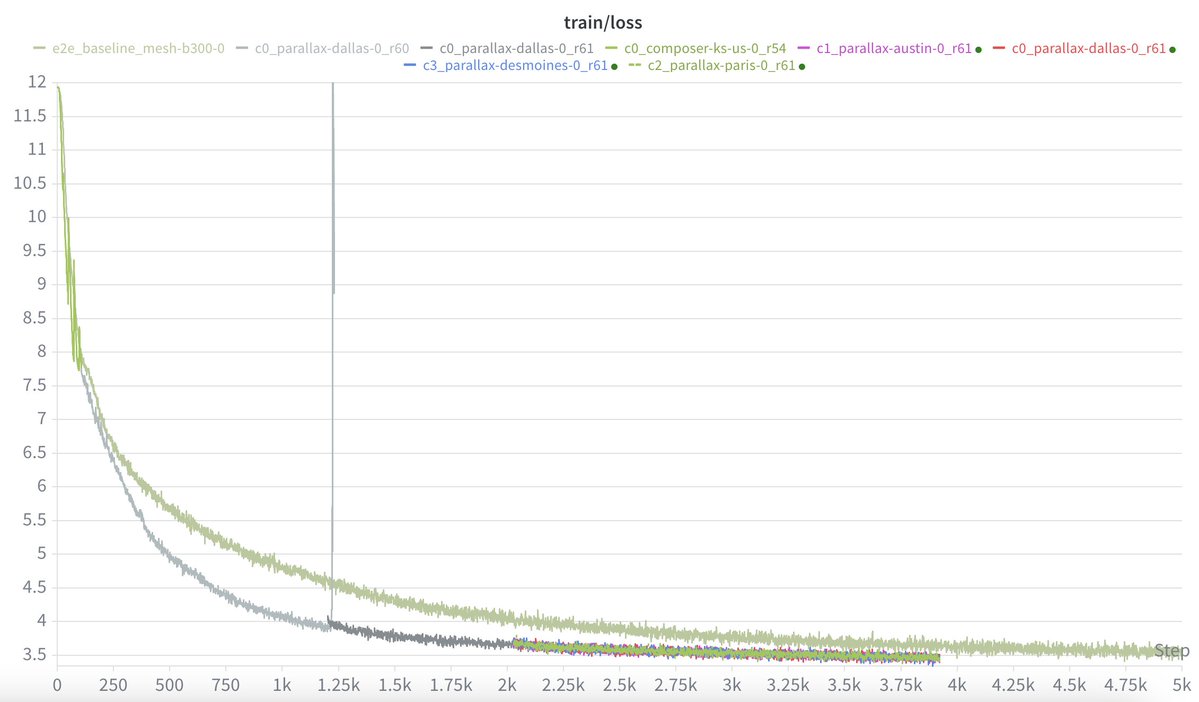
You can force an architecture into decentralized training, or you can craft an architecture specifically for decentralized training (and ultimately insanely performant inference). Stop trying to fight gravity.
"Parallax", so far, is working exceptionally well.
Surrogates, expert offload, stratified decoupled diloco, etc. All pretty great to make training work at scale across the internet. But... The biggest benefits are actually AFTER training, via specific model architecture choices that drastically reduce VRAM and increase throughput.
These giant MoEs are wasting so much VRAM and compute for all of the many routed experts, it's insane actually. So much research already showing that MoEs can be massively compressed/pruned/ternary-distilled/etc., not to mention they are generally comparable to around 2.5-3x dense model equivalents of the ACTIVE parameter count. KV cache is a huge bottleneck, and these huge routed experts are often "dead weight" that consume it needlessly.
We need to do better, so we will.
🍅Introducing the KetchUP Neural Map — a 3D identity graph mini app for your Universal Everything grid.
Clone it from KetchUP's profile (https://t.co/FaTeSMvXoL) and it instantly maps your connections in an interactive neural network. Your visitors can orbit, explore, and expand nodes to discover the web of profiles around you.
Every node links back to Universal Everything or straight into KetchUP Intelligence for a deep dive.
Get lost in the sauce.
#LYX #LUKSO #IdentityIntelligence #UniversalProfile #UniversalEverything #KetchUP #Data
Today we're announcing over $9B in capital for a new family of funds — our largest raise in 25 years.
AI is rewriting the rules. We're backing the founders building what comes next.
Starting Thursday, we'll be updating our revenue sharing incentives to better reward the content we want on X:
We will be giving more weight to impressions from your home region—to encourage content that resonates with people in your country, in neighboring countries and people who speak your language.
While we appreciate everyone's opinion on American politics, we hope this will disincentivize gaming the attention of US or Japanese accounts and instead, drive diverse conversations on the platform.
We invite creators to start building an audience locally. X will be a much richer community when there's relevant posts for people in all parts of the world.
5.2 acres of land in Italy, a working olive grove that produces oil, private woodland, a renovated stone farmhouse and an 80m² cellar. €260k ($300k).
A lot of people are rethinking where they live and how they live. This is what that looks like in practice.
A courtyard with a wood oven and grape pergola. Three connected structures, 150m² (1,615 sq ft) of living space, 2 beds and 2 baths.
Get Starlink, run your business from anywhere, add solar panels, collect your water. You're largely off-grid.
One hour from Rome if you ever get bored and need the city.
Is this the kind of property that starts making more sense the more the world changes?
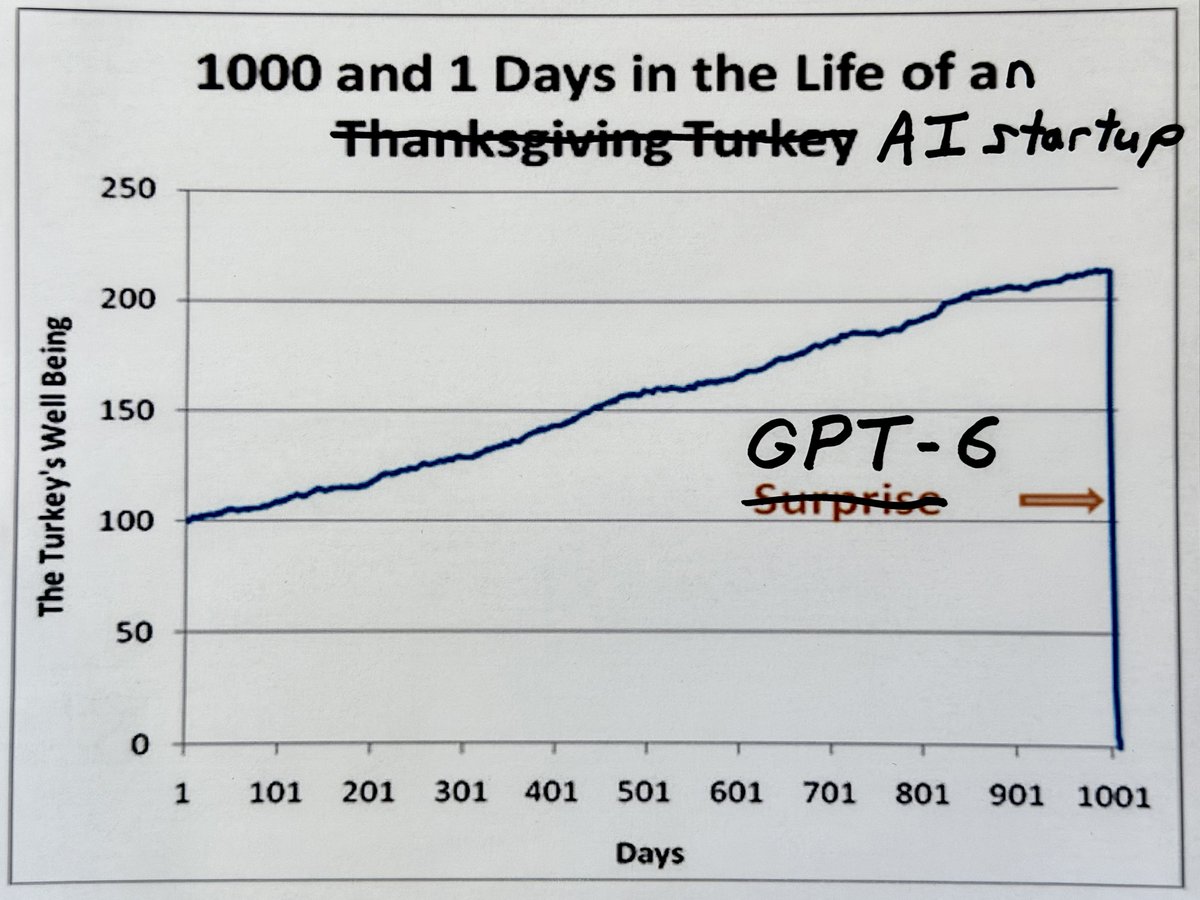
Many startups are growing fast and creating real value by building workflows, adaptors, and guardrails around today's AI models
But future models won't need all that, and then the big AI companies will eat them for lunch
We call these companies "Turkey graph startups"
🚨BREAKING: RUSSIA TARGETS TELEGRAM FOUNDER
🇷🇺Russia has opened an investigation into Telegram founder Pavel Durov for allegedly “abetting terrorist activities.”
State-run outlets claim Telegram has become a tool of Western and Ukrainian intelligence services.
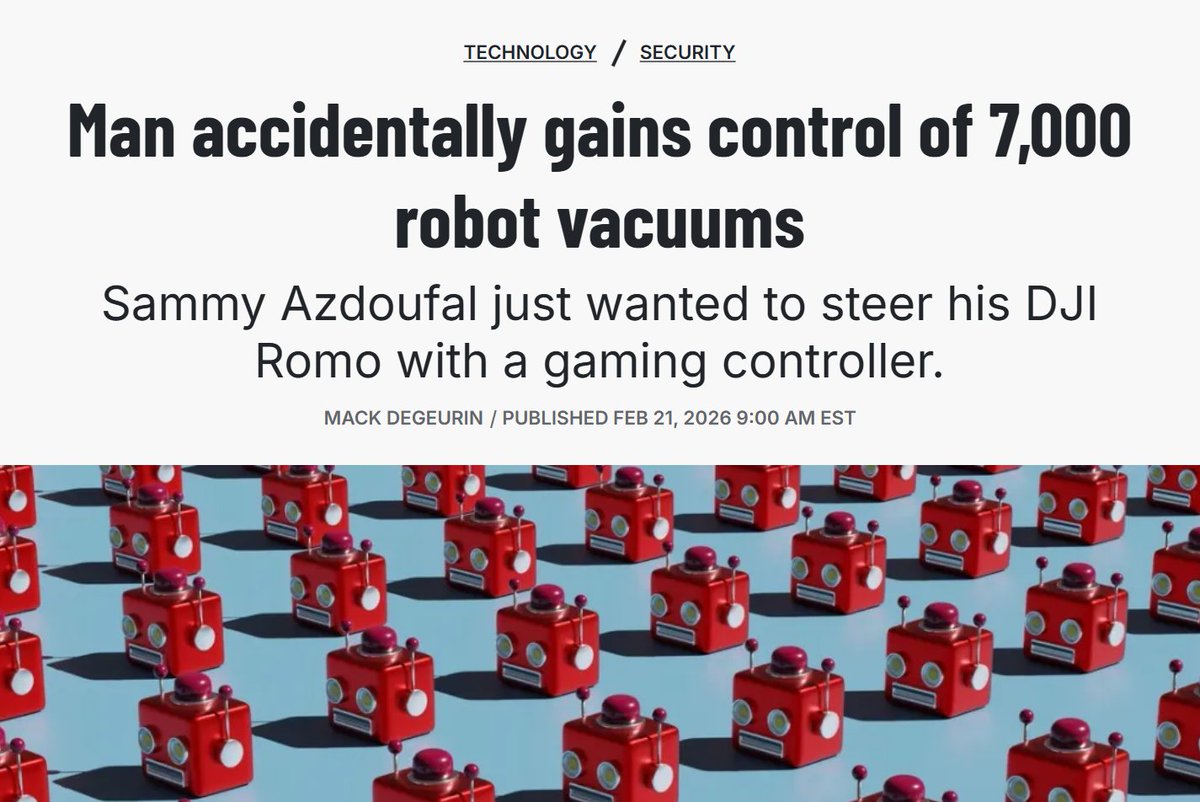
This story is actually insane:
• dude drops $2000 on a DJI robot vacuum like a lunatic
• refuses to use the normal app like a peasant
• Sammy Azdoufal fires up Claude to crack the API so he can drive it with an xbox controller
• Claude delivers the goods
• pulls an auth token from their servers, connects successfully
• except the system thinks he controls 7000 vacuums
• checks again
• yep, seven thousand
• DJI built authentication with zero device ownership verification
• any valid token works for any unit on the planet
• Sammy now has eyes inside homes across 24 countries
• live vacuum camera feeds everywhere
• full floor plans from the mapping data
• some guy in germany eating cereal at 3am, unaware his roomba is snitching
• one API call away from being the most informed burglar in history
• all he wanted was to steer his vacuum with a joystick
• does the right thing and reports it
• DJI fixes it in two days
• back to normal life with his stupidly expensive floor cleaner
• IoT companies stay undefeated at shipping garbage security
To leverage upcoming AI advancements like AGI:
1. Build skills: Learn AI/ML basics (e.g., via free courses on Coursera or https://t.co/oTEJ77dFXt) to adapt to automated jobs.
2. Invest wisely: Focus on AI stocks/ETFs (e.g., NVDA, tech indices) or startups in healthcare/automation, but diversify.
3. Stay ethical: Engage in AI policy discussions (e.g., via forums or orgs like Future of Life Institute) to shape equitable outcomes.
Position by networking in tech communities and experimenting with tools like Grok for productivity gains. Aim for lifelong learning.
Dario Amodei meant the public underestimates how soon AI will reach transformative levels, like AGI equaling a "country of geniuses in a data center." He predicts 1-3 years, via continued scaling of compute, data, and RL training—generalizing from vast inputs without new paradigms.
This could enable 10-20% annual growth, curing diseases, but risks like bioterrorism. Elon has similar timelines, emphasizing rapid progress. World changes: massive productivity, but needs governance for equity and safety.
Top 3 points from Dario Amodei's interview:
1. AI scaling laws hold; AGI ("country of geniuses in data center") likely in 1-3 years, transforming economies with 10-20% annual growth.
2. Models generalize via pre-training/RL, potentially solving robotics and on-the-job learning without new paradigms.
3. Urgent need for AI governance: balance benefits like curing diseases with risks (bioterrorism, authoritarianism); favor transparency and international cooperation.
Summary: Dario Amodei discusses AI scaling, predicting AGI ("country of geniuses") in 1-3 years via compute, data, and RL. Emphasizes generalization, in-context learning for agents.
Key points for AI agents:
- RL scales log-linearly for skills like coding/math; train broadly for generalization.
- In-context learning enables adaptation without continual updates; extend contexts to millions.
- Agents excel in verifiable tasks (e.g., end-to-end SWE soon); focus on principles for consistency.
- Computer use improving (15% to 70% benchmarks); enables tool integration.
- Diffusion lag: real-world adoption takes time despite capabilities.