A 21-YEAR-OLD IN FLORIDA POSTED A 60 SECOND VIDEO SHOWING HOW SHE MAKES $40,000 A MONTH. SHE HAS NEVER SHIPPED A PRODUCT. SHE HAS NEVER WRITTEN AN AD.
She opens her laptop and shows a pink jawline mask on TikTok Shop. It has 57,000 sales.
She doesn't try to source it. She doesn't try to build a brand around it. She just copies the URL.
She pastes the link into an AI tool called PagePilot.
In 60 seconds, the AI builds a full Shopify store. It writes the product descriptions. It generates the customer reviews. It creates the FAQ section.
Then it writes the Facebook ads and generates the creative assets.
She clicks publish. She downloads the ads. She runs them on Meta.
That is the entire business.
She doesn't invent products. She doesn't hire copywriters. She doesn't hire web designers.
She finds what is already selling, lets an AI clone the entire business structure in one minute, and points Facebook traffic at it.
She cleared $40,000 in profit last month without leaving her bedroom.
The internet is full of people spending thousands of hours trying to learn web design, copywriting, and marketing strategy.
She bypassed all of it. She eliminated the human bottleneck.
She isn't building a legacy brand. She is just acting as a highly efficient bridge between a Chinese factory and a Facebook ad algorithm.
Thousands of people are trying to learn how to dropship the hard way.
She realized the hard way doesn't exist anymore. She just clicks copy and paste.
MY FATHER HAS BEEN INVESTING SINCE 1985. HE NEVER LOST MONEY IN A CRASH.
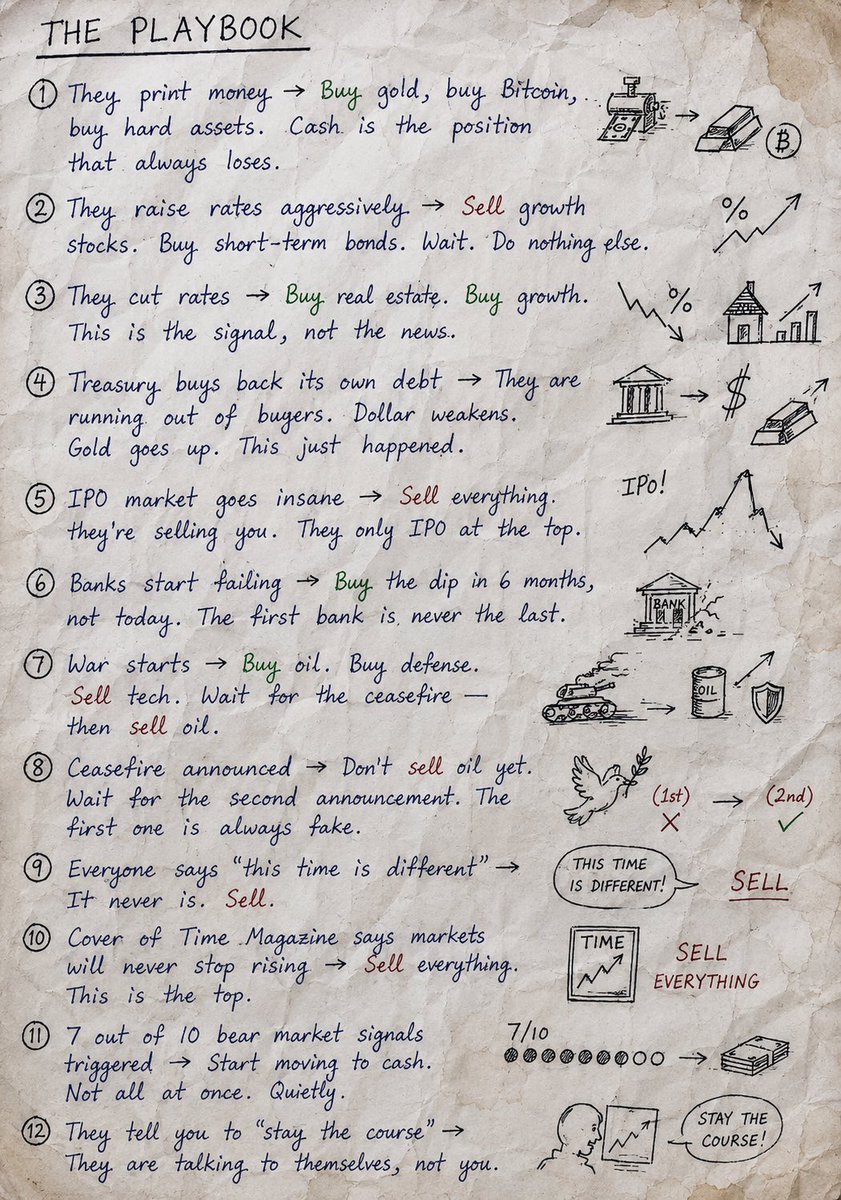
I ASKED HIM WHY. HE HANDED ME THIS.
Most people learn these rules after losing everything:
🚨 1) Treasury buys back its own debt → Dollar weakens. Gold goes up. This just happened.
2) They print money → Buy gold. Buy hard assets. Cash is the position that always loses.
3) They raise rates → Sell growth stocks. Buy short-term bonds. Do nothing else.
4) They cut rates → Buy real estate. Buy growth. This is the signal, not the news.
5) IPO market goes insane → Sell everything they’re selling you. They only IPO at the top.
6) Banks start failing → Wait 6 months. The first bank is never the last.
7) War starts → Buy oil. Buy defense. Sell tech.
8) Ceasefire announced → Don’t sell oil yet. The first one is always fake.
9) 7 out of 10 bear market signals triggered → Start moving to cash. Quietly.
10) Everyone says “this time is different” → It never is. Sell.
11) They tell you to “stay the course” → They are talking to themselves, not you.
40 years. Every cycle. The rules never changed.
Only the story did.
Follow if you want the next page.
We just saw the exact moment a star exploded for the first time ever.
Astronomers have achieved a rare feat: imaging the exact moment a massive star detonated—and the explosion was anything but spherical.
SN 2024ggi, a supernova located 22 million light-years away in the spiral galaxy NGC 3621, was detected a mere 26 hours after ignition. This extraordinarily early discovery allowed researchers to train the European Southern Observatory’s Very Large Telescope in Chile on the event while it was still in its infancy.
Using the technique of spectropolarimetry—which analyzes the polarization of light to reveal geometric structure—the team uncovered a surprising truth: the expanding shockwave was distinctly aspherical, elongated into an “olive” or prolate shape along one primary axis.
This asymmetry means the catastrophic rebound following the star’s core collapse did not propagate uniformly in all directions, directly contradicting the long-standing assumption that the deepest layers of a core-collapse supernova explode spherically.
The progenitor was a red supergiant 12–15 times more massive than the Sun that had exhausted its nuclear fuel, triggering gravitational collapse of its iron core. In most supernovae, the initial shape of this breakout is quickly obscured as the blast wave slams into the star’s outer envelope. Here, however, astronomers captured polarized light signatures of the still-unobscured ejecta, freezing the explosion’s geometry in time.
The discovery carries far-reaching consequences. It strongly suggests that asymmetry is common, if not universal, in the earliest phases of massive-star deaths. Current theoretical models, which often assume spherical symmetry at the core, will need significant revision. Moreover, these distorted explosions could help explain observed peculiarities in supernova remnants, the production of gamma-ray bursts, and the kicking of neutron stars and black holes to high speeds at birth.
By catching a star in the act of dying asymmetrically, SN 2024ggi has given us a vivid glimpse into the violent, chaotic physics that govern the final heartbeat of the universe’s most massive stars.
[🎞️ Artist’s animation of a supernova explosion]
[Unique shape of star’s explosion revealed just a day after detection. ESO, 2025]
Elon Musk literally sat down for a 45-minute talk with Y Combinator that explains how to build world-changing companies better than any business school on earth. This is the advice he gave a room full of young founders:
1. Don't try to build something great. Try to build something useful.
Everyone obsesses over greatness. Musk says that's the wrong target. "I didn't originally think I would build something great. I wanted to try to build something useful. I didn't think I would build anything particularly great. Seemed unlikely, but I wanted to at least try." Aim for useful first. Greatness, if it comes, is a byproduct.
2. When you can't get in the front door, build your own door.
Before Musk started his first company, he tried to get a job at Netscape. "I sent my resume into Netscape and nobody responded. I tried hanging out in the lobby to see if I could bump into someone, but I was too shy to talk to anyone. So I'm like, this is ridiculous, I'll just write software myself." He didn't set out to be a founder. He became one because no one would hire him.
3. He slept in the office and showered at the YMCA.
The origin of his first company was not glamorous. "We couldn't even afford a place to stay. The office was 500 bucks a month, so we just slept in the office and showered at the YMCA." He couldn't afford proper internet either, so he drilled a hole through the office floor and ran a cable to the internet provider downstairs. That was the founder of the future richest man on earth.
4. Keep the chips on the table.
When Musk sold his first company, he received a $20 million cheque. His bank balance went from $10,000 to $20 million overnight. Most people would have stopped. He put almost all of it straight back into his next company. "I kept the chips on the table." He did the same thing decades later, over and over. He hates money sitting idle. Money is fuel for the next mission.
5. Start with the mission, then work backwards to make it a business.
Musk didn't start SpaceX to make money. He went on the NASA website to find out when humans were going to Mars, and there was no plan. So he decided to build one. "There had been no prior example of a rocket startup succeeding. A small chance of success is better than no chance of success." The mission came first. The business model came later.
6. He started SpaceX expecting to fail.
He is brutally honest about the odds. "SpaceX started in mid-2002 expecting to fail. Probably 90% chance of failing. When recruiting people, I said, we're probably going to die, but small chance we might not die." The first three launches failed. The fourth one worked with no money left. "If the fourth launch hadn't worked, it would have been curtains. We made it by the skin of our teeth."
7. Break every problem down to physics.
This is the core of how Musk thinks. "First principles means break things down to the fundamental elements that are most likely to be true, then reason up from there, as opposed to reasoning by analogy." His example is rockets. Everyone priced them based on what old rockets cost. Musk asked what a rocket is actually made of, priced the raw metals, and found the materials were only 1-2% of the historical price. The rest was inefficiency he could attack.
8. When told something takes 24 months, break it down and do it in six.
Last year xAI needed a giant computer to train its AI. Suppliers said it would take 18 to 24 months. "It's like, well, we need to get that done in six months or we won't be competitive." So he broke it into parts. Needed a building, so he found an old factory. Needed power, so he rented generators. Needed cooling, so he rented a quarter of America's mobile cooling capacity. He slept in the data centre and ran cabling himself. It got done.
9. Watch your ego-to-ability ratio.
Musk's single sharpest piece of advice for young founders is about staying honest with yourself. "A major failure mode is when your ego-to-ability ratio gets too high. Then you break the feedback loop to reality." Keep the ego small, internalise responsibility for everything, and stay ruthlessly connected to what's actually true. "You want to close the loop on reality hard. That's a super big deal."
10. Chase work, not glory.
His closing philosophy ties it all together. "It's so hard to be useful. The area under the curve of total utility is how useful you've been to your fellow human beings times how many people. If you aspire to do true work, your probability of success is much higher. Don't aspire to glory, aspire to work."
He was ridiculed for years. The press called him "internet guy attempting to build a rocket company." He agreed it sounded absurd. He did it anyway, because a small chance of doing something useful beat no chance at all.
Here's the thing though....
Musk became the most followed founder alive because everything he does happens in public. The launches, the failures, the talks like this one. The companies made him powerful. The personal brand made his every word travel around the world before he finishes saying it.
We build massive distribution and grow personal brands on X and beyond without our clients lifting a finger.
If you're a founder or VC looking for that kind of exposure, book a call below.
We average 1.5M views a week.
https://t.co/UoXuYlkBQq
🚨 June Jobs Report Out
BLS released the June employment data today:
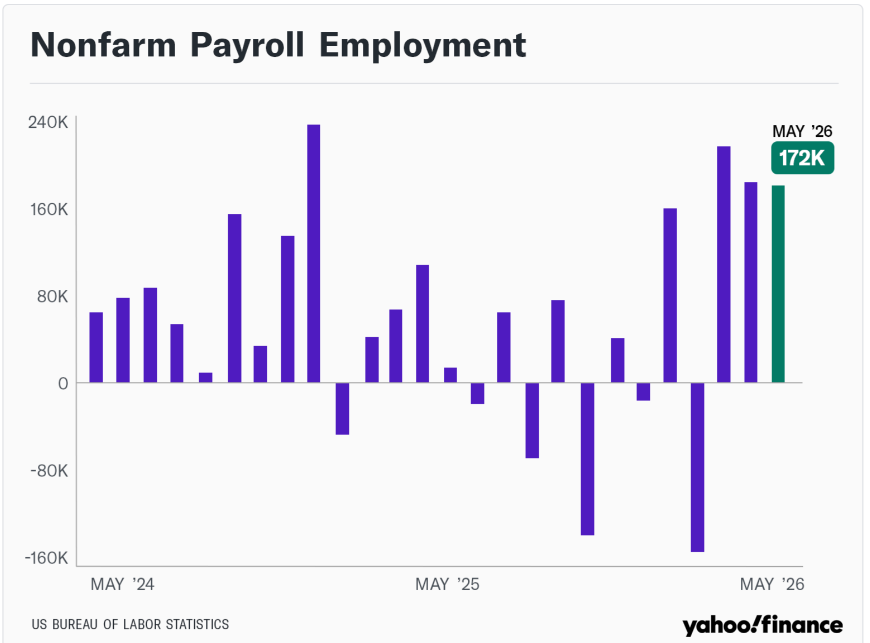
• Nonfarm payrolls expected softer at ~110k–115k (vs May’s 172k)
• Unemployment rate at 4.3%
• Average hourly earnings in focus
Traders watching closely — this data will shape Fed rate cut expectations, dollar strength, bond yields, and risk sentiment in stocks & crypto.
#JobsReport #Fed #Markets
Major Frank Prentice was 18 years old when he dropped over a hundred feet off the stern of the Titanic into a sea full of ice.
He survived. This is what he saw.
Prentice worked in the Purser's office.
He was in his cabin at midships when the collision happened. He describes no chaos, no impact, nothing dramatic:
"It was just like jamming your brakes on my car. There was no great impact you couldn't feel. Just a bit of a shudder and she stopped."
That quiet did not last.
As the ship began to sink, Prentice moved through it.
He helped stewardesses into lifeboats who did not know where to go. He helped a woman named Mrs. Clark with her lifejacket. She did not want to leave her husband. He told her the husband would follow on later.
He would not.
On his way back from the lifeboats, Prentice heard the band. They were playing "Nearer My God to Thee" and singing.
He kept walking.
When the end came, he made his way to the stern. He describes it as quiet up there.
By the time he let go, the ship was nearly vertical. He had been hanging onto a board that read "Keep Clear of Propeller Blades."
At the very last moment, he let go and fell.
"I just missed the propellers on the way down."
The drop was over a hundred feet. The water was packed with ice and chunks of berg.
His watch stopped at 2:20 am.
He was not alone in the water at first. Then he was.
"I gave it a long thought when I was on my own and everybody else seemed to be dead round me."
He had two life jackets and a cushion.
He paddled toward a light he could still see from the rockets the bridge had fired. He reached a lifeboat and climbed in.
Mrs. Clark was already there. She wrapped a blanket around him and tried to keep him warm.
Her husband had drowned.
When asked who was responsible for the disaster, Prentice did not hesitate.
He blamed the bridge. He blamed Bruce Ismay, chairman of the shipping line, for pushing Captain Smith to maintain speed through waters they had been warned were full of ice.
"We had warnings that there was ice. We had it from ships and shore, and we went straight ahead as if there was nothing there in our way."
His verdict was simple:
That ship was thrown away.
Prentice was interviewed decades later.
Asked if the memory still haunted him, he said:
"When I'm alone tonight, I still think a lot about it. Can't help it, can you?"
—
Source: @BBCArchive – The Great Liners (1979)
Everyone should have a faceless YouTube channel that earns $389/day.
Usually, I'd charge $83 for this guide, but today you get it free.
Like + comment 'YT' and I'll send you my exclusive guide 100% FREE.
Must follow me to get this proven guide in DM.
FREE for next 48 hours only.
RIP 9 to 5 jobs. You can easily earn $379/day by doing simple copy-paste work.
Usually, I'd charge $89 for this guide, but today you can get it for free.
Like + comment 'Copy' & I'll send you my guide 100% FREE.
Must follow me to get my guide in DM.
FREE for 48 hours.
If @Walmart doesn’t put out a statement about this you can kiss millions of $$$ goodbye from the Americans who love this country!
We DO NOT tolerate this in America! 🇺🇸
Q1 tonnage to orbit by launch provider.
Once Starship is flying hourly, SpaceX’s mass to orbit will be about 100 times more than everyone else combined, even if they triple their current launch rate.