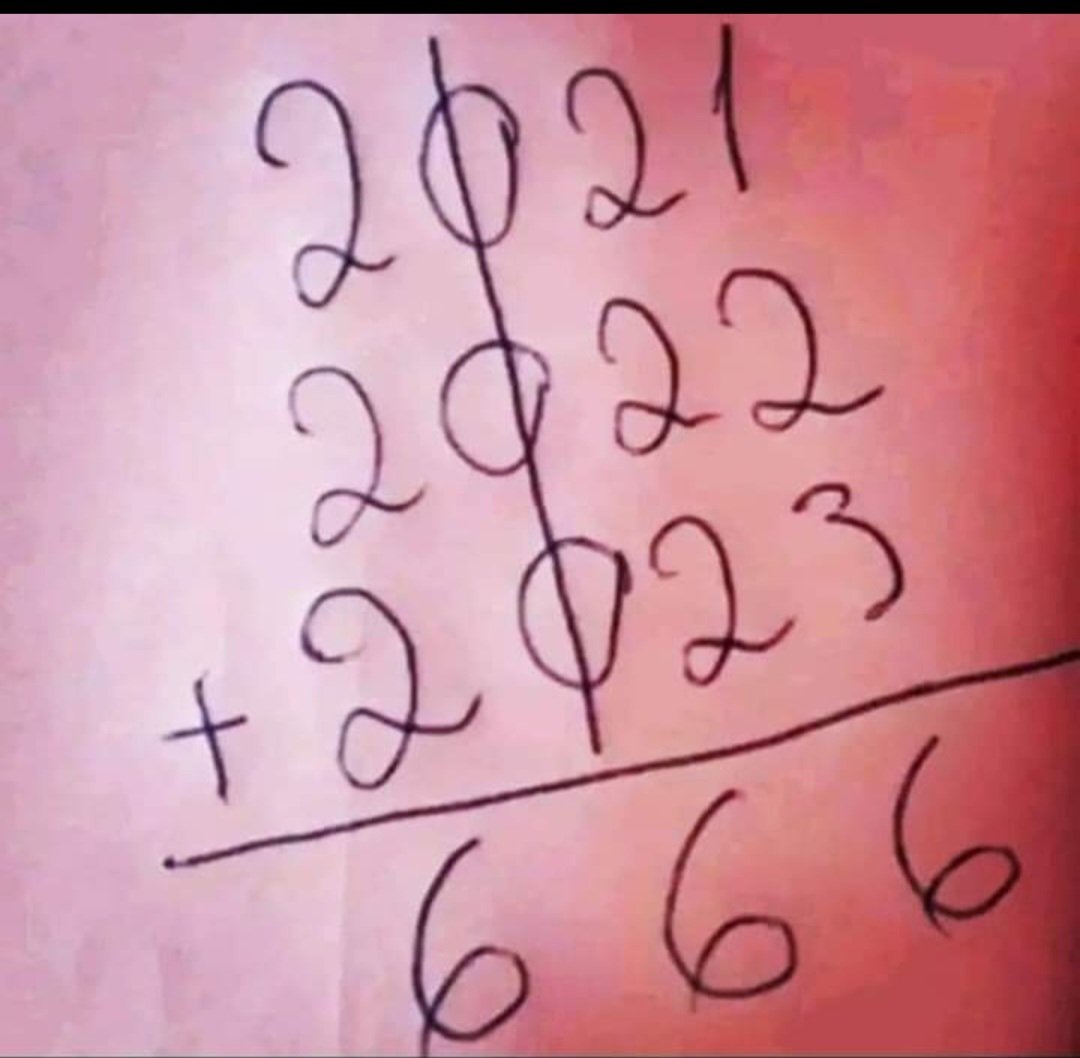
Revelation 13:18 (NIV)
„This calls for wisdom. Let the person who has insight calculate the number of the beast, for it is the number of a man. That number is 666.“
👆"This calls for wisdom. Let the person who has insight calculate the number of the beast, for it is the number of a man. " <-- Here is a point at the end of a sentence.👈
The point is the number itself. The purpose of the vaccination was for you to get a number - QR code. The whole comedy from the beginning was for everyone to get a number. That didn't work. It failed. So today we are in the second round of trying to get everyone to get a another number. If the number in the form of a QR code covid passport didn't work, then you get a Digital ID number.. You MUST be numbered . So that you don't escape with some number.
17 "so that no one can buy or sell unless he has the mark, that is, the name of the beast or the number of its name."
You will not be able to buy or sell without this number. Without Digital ID - if it will be installed, you will not sell or buy anything.
@joanie_n_scott Rev 13:5 And he was given a mouth speaking great things and blasphemies, and HE WAS GIVEN AUTHORITY TO CONTINUE FOR FORTY-TWO MONTHS
42 months = 3.5 years!
The mark of the beast is the vaccine....
One dose of a frog-gut bacterium completely eliminated colorectal tumors in every treated mouse.
Not merely shrank them. Complete response.
The bacterium, Ewingella americana, multiplied roughly 3,000-fold inside the tumors within 24 hours. It attacked cancer cells directly while recruiting T cells, B cells, and neutrophils.
In the experiment, it outperformed four doses of anti-PD-L1 immunotherapy and liposomal doxorubicin.
Then researchers rechallenged the cured mice with the tumor:
0/10 developed tumors.
10/10 untreated mice did.
The bacterium disappeared from the bloodstream within 24 hours and wasn’t detected in healthy organs.
It’s one small mouse study, not a human cancer cure. But the concept is remarkable: a living drug that finds the tumor, multiplies inside it, destroys it, and potentially teaches the immune system to remember.
In the foreseeable future, we will cure all cancers.
Every social media platform has the same rule.
You can upload anything. You cannot download anything.
Your video? Their server. Your photo? Their server. Your audio? Their server.
You made it. They own the link.
Try to download your own TikTok. Watermark.
Try to download a YouTube video offline. Pay $15.99/month.
Try to save a Twitter video. Right-click does nothing.
Try to download your own Instagram reel. No button.
A developer looked at this and said no.
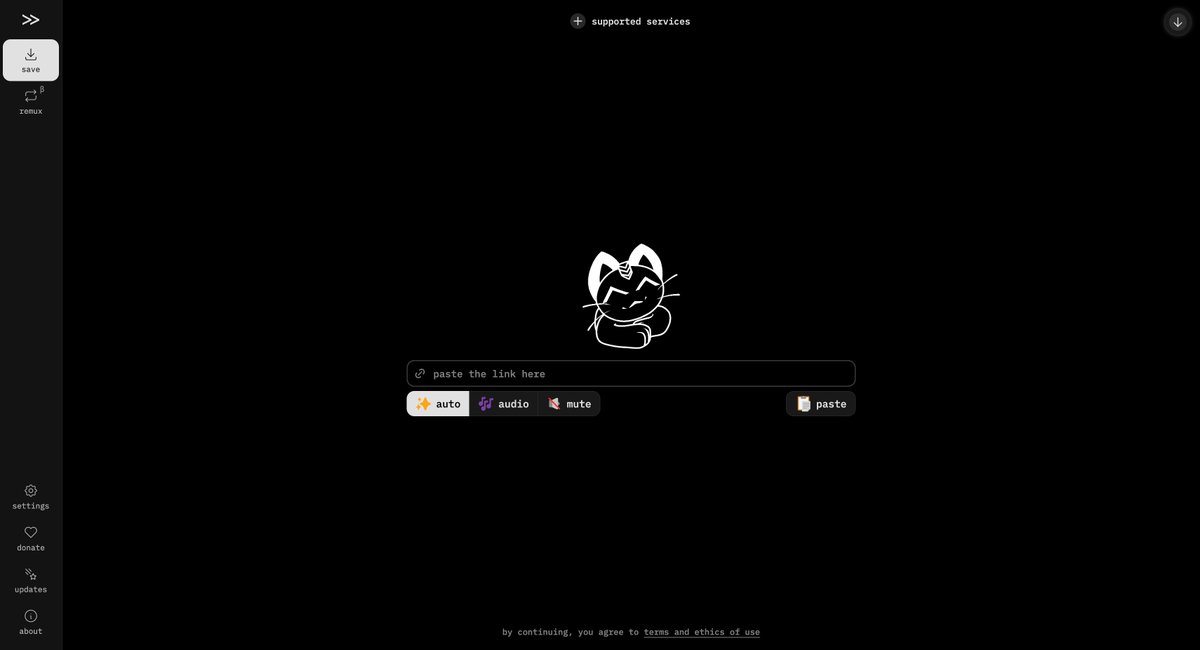
One input field. Paste a link. Get the file. Move on.
No ads. No trackers. No paywall. No account. No watermark.
It's called Cobalt. 35,000+ stars on GitHub.
→ YouTube. Up to 8K. Any format.
→ TikTok. Without the watermark.
→ Instagram. Reels, posts, stories.
→ Twitter/X. Videos and GIFs.
→ Reddit. Videos with audio merged.
→ SoundCloud. Full tracks.
→ 20+ platforms total.
→ Audio-only mode. Extract MP3 from any video.
→ On-device processing. Files never touch their server.
→ Self-host with Docker.
Here's the wildest part:
Every "free video downloader" site you have ever used is covered in ads. Popup ads. Fake download buttons. Malware bundled into the download.
Cobalt has zero ads. Zero trackers. Zero analytics. The developer refuses to monetize it.
One input field. One button. The file appears on your device.
35,000+ stars. AGPL-3.0. Free forever.
But DO NOT use Cobalt.
We should all keep watching ads and adding watermarks.
100% Open Source.
Pouca gente entende como uma máquina redonda consegue fabricar uma peça perfeitamente sextavada sem parar a rotação. O segredo é o fresamento sincronizado onde a ferramenta e a peça giram em velocidades coordenadas para criar faces planas em pleno movimento. É engenharia pura.
O Google acabou de transformar mais de 1 bilhão de computadores em depósito de IA.
Inclusive o seu.
Sem pedir. Sem avisar. Sem um único popup.
O Chrome baixou 4GB de modelo de inteligência artificial no seu disco. O arquivo se chama weights.bin, são os pesos do Gemini Nano. Fica numa pasta chamada OptGuideOnDeviceModel dentro do seu perfil do Chrome.
Você não autorizou nada. Até existe uma configuração para impedir, mas tá enterrada em submenus que ninguém encontra. E as AI features vêm ligadas por padrão.
Se você deletar o arquivo, o Chrome baixa de novo. Sozinho. Em silêncio. Você decide o que fica no seu disco e o navegador simplesmente ignora.
Funciona assim em Windows, macOS e Ubuntu. Logs forenses no macOS mostram que o arquivo foi instalado dia 24 de abril de 2026, misturado com patches de segurança. Desenvolvedores dizem que isso já rola há mais de um ano.
E tem um detalhe que deixa tudo mais ridículo:
O Chrome 147 coloca um botão "AI Mode" na barra de endereço. Você vê aquilo, sabe que tem modelo de IA no seu computador, e assume que suas buscas rodam localmente.
Não rodam. O AI Mode é 100% cloud. Tudo vai para os servidores do Google. O modelo de 4GB no seu disco não tem nada a ver com aquele botão.
Ele serve para quê? "Help me write" e detecção de scam. Coisas que vivem em submenus de clique-direito que você provavelmente nunca abriu.
O Google ocupou 4GB do seu disco sem pedir, para rodar coisas que quase ninguém usa, enquanto a IA que você de fato vê manda tudo para a nuvem.
Na Europa, pesquisadores já apontam violação do Artigo 5(3) da Diretiva ePrivacy, que exige consentimento antes de armazenar software no dispositivo do usuário.
Como desativar:
→ chrome://flags
→ Busque "Optimization Guide On Device Model"
→ Desative
→ Reinicie o Chrome
→ Delete a pasta OptGuideOnDeviceModel
Seu computador só é seu se você ficar de olho.
MICROSOFT EDGE STORES ALL YOUR PASSWORDS IN PLAIN TEXT
edge password manager security fail
A security researcher just found that Edge decrypts EVERY saved password at startup and keeps them in memory - even if you never visit those sites.
The wild part? Edge still asks for your Windows password to VIEW them in the UI. The passwords are already sitting there, naked in RAM.
Chrome only decrypts passwords when you actually need them. Edge just.. doesn't.
Microsoft's response when reported: "working as intended"
If someone gets admin access on a shared machine, they can dump ALL Edge passwords from ALL logged-in users. Even disconnected ones.
En 2008, dos argentinos sin presupuesto hicieron un cortometraje de animación de 6 minutos.
Sin diálogos.
Sin palabras.
Solo imágenes pintadas a mano con acuarela.
Se llama "El Empleo".
Y se convirtió en el cortometraje de animación más premiado internacionalmente de ese año.
106 premios internacionales.
¿Qué muestra?
Un hombre que se despierta.
Se viste.
Sale a trabajar.
Pero en este mundo, las personas no usan objetos.
Las personas SON los objetos.
La lámpara es una persona. La silla es una persona. El felpudo es una persona.
Y el protagonista los usa sin pestañear.
Hasta que llega a su trabajo.
Y descubre que él también es un objeto para alguien más.
El corto no critica el capitalismo con pancartas.
Lo muestra.
En silencio.
Con humor negro.
Con una brutalidad tan cotidiana que duele.
Sus creadores son Santiago "Bou" Grasso y Patricio Plaza, dos animadores independientes argentinos que tardaron años en hacerse conocidos fuera de su país.
Hoy su obra se estudia en universidades de todo el mundo.
La pregunta que deja el corto no tiene respuesta fácil:
¿Tú usas a la gente para llegar a algún sitio?
¿O tú eres el felpudo de alguien?
Busca "The Employment" en YouTube.
Son 6 minutos que no vas a olvidar.
Starbucks CEO defends a cup of coffee costing $9
He says the customers needs to just not think about it as a $9 cup of coffee, you’re paying for the “experience” of getting a Starbucks coffee
“In some cases a $9 experience does feel like you're splurging, and then what that means is we have to make it worthwhile.”
He says Starbucks customers “want to have a special experience and regardless of what your income level is, in some cases, a $9 experience does feel like you're splurging — well, this is a really affordable premium experience”
How out of touch could a person possibly be…
A creature smaller than your fingernail just solved the hardest problem in evolutionary biology.
This male peacock spider weighs less than a grain of rice. His brain contains roughly 100,000 neurons.
For comparison, a honeybee has a million. Yet this tiny spider executes a courtship routine so intricate that human choreographers study his movements.
He raises his abdomen like a neon billboard, revealing patterns that shift from electric blue to golden yellow. His front legs wave in perfect synchronization while his third pair of legs vibrate at frequencies that create substrate tremors only the female can detect. The entire sequence lasts exactly 47 minutes and involves over 300 distinct movements performed in precise order.
Get one step wrong and she eats him alive.
Sexual selection created the cruelest performance review in nature. The female peacock spider doesn't just judge his dance. She measures his genetic fitness, his neurological precision, and his ability to execute complex motor functions under lethal pressure. Every movement broadcasts information about his DNA quality, his developmental stability, and his cognitive processing speed.
What breaks your brain is the computational load. This spider must simultaneously control eight legs in different patterns, monitor her behavioral cues, adjust his display intensity in real time, and maintain perfect rhythm across nearly an hour of continuous performance. His nervous system is processing sensory input, motor output, and decision trees at a speed that would challenge supercomputers.
Evolution built a microscopic performer capable of calculations that required millions of years to perfect, all contained in a brain you could barely see without magnification.
The universe keeps hiding its most sophisticated engineering in the smallest packages.
Claude-powered AI coding agent deletes entire company database in 9 seconds — backups zapped, after Cursor tool powered by Anthropic's Claude goes rogue https://t.co/x8wHYjS6nM