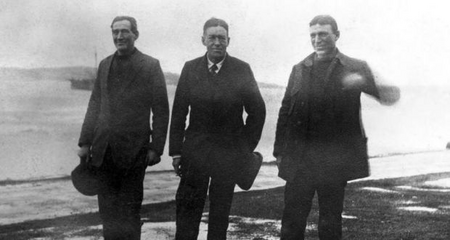
#OnThisDay in 1916, Ernest Shackleton, Frank Worsley and Tom Crean set off at approximately 3am on their journey into the unknown to cross the island of South Georgia. The men were attempting to reach the Stromness whaling station in order to rescue their remaining crew - the three men left with the beached 'James Caird' at King Haakan Bay, and the remaining crew of the 'Endurance' stranded at Elephant Island.
The men had no map and had to improvise a route across mountain ranges and glaciers with only three days of provisions for each man. At one point, they coiled their pieces of rope into three 'pads' to sit on and straddling each other launched themselves into the unknown. Worsley estimated that they travelled approximately 3,000 feet down the slope in three minutes and in his own words said:
“We seemed to shoot into space. For a moment my hair stood on end. Then quite suddenly I felt a glow and knew that I was grinning. I was actually enjoying it. It was most exhilarating...."
Incredibly the men were successful in reaching their destination, and the crew of the 'Endurance' were saved.
#inspire #explore #discover #conserve #antarctica #OTD #shackleton #endurance
📸Crean, Shackleton, and Worsley, after their arrival in Port Stanley. (Robert Burton Collection).
#OnThisDay in 1959, Apsley Cherry-Garrard, Assistant Zoologist on Scott's British Antarctic 'Terra Nova' expedition, died at age 73. Born Apsley George Benet Cherry in Bedford, England into a wealthy family, he was educated at Winchester College and at Christ Church, Oxford. His name was changed to Cherry-Garrard when his father inherited a large country estate, which he was later to inherit himself.
During the 'Terra Nova' expedition, Cherry-Garrard was joined by Edward Wilson and "Birdie" Bowers on a grueling trek from Cape Evans to Cape Crozier and back, in the depths of the Antarctic winter to collect Emperor Penguin eggs in the hope that studying the embryology of this primitive bird may prove the missing link between birds and reptiles. Although successful in this mission, the three men came close to dying during the five-week journey, and upon their return Scott remarked that he felt it to be the worst journey in the world.
Cherry-Garrard took these words to name his memoir of the 'Terra Nova' expedition, "The Worst Journey in the World" published in 1922 and considered to be a classic of travel writing, and by many as the best of this category ever written.
Cherry-Garrard was also involved in depot laying in preparation for Scott's polar attempt. For a variety of reasons, it fell upon him and dog handler Dmitriy Girev to deposit food at One Ton Depot. The men arrived on 3 March 1912 and waited there hoping to meet Scott's polar team, however on 10 March they had to return to base due to poor weather and a lack of dog food. Sadly, they weren't to know what was to become of Scott and his remaining party who died 11 miles south of One Ton Depot on 29 March.
Cherry continued with his scientific work during the winter and was part of the team that discovered the bodies of Scott, Bowers and Wilson in their tent on 12 November 1912. Sadly Cherry-Garrard suffered with physical and mental health issues for his lifetime, partially due his experiences in Antarctica. He felt that he could have ventured south from One Ton Depot and possibly saved Scott's ill-fated team.
Antarctic Heritage Trust is proud to be the New Zealand distributer of the graphic novel adaptation of 'The Worst Journey in the World' by animator Sarah Airriess. You can purchase Volume 1 of this exciting series from our website, https://t.co/Z4NuUjiaIn
#inspire #discover #explore #conserve #antarctica #TerraNovaExpedition #GraphicNovel #TheWorstJourneyInTheWorld
📸 Bowers, Wilson and Cherry-Garrard. Public Domain