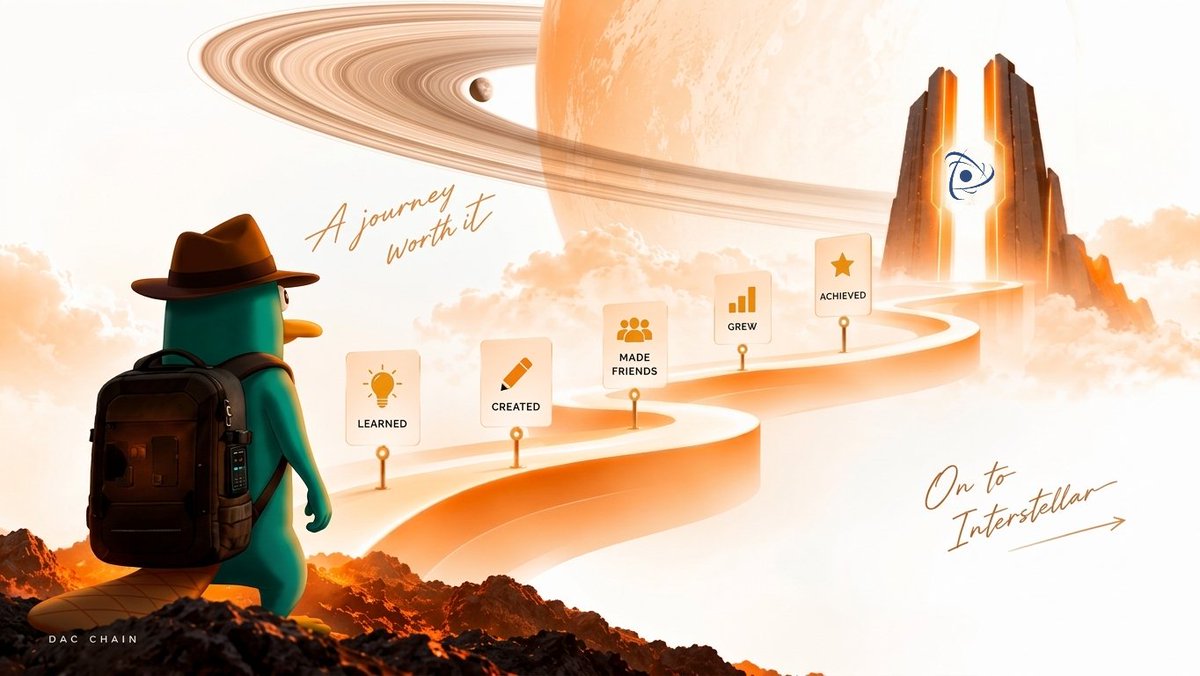
When Inception started, I didn't expect it to become such a big part of my journey.
But as the days went by, I kept showing up on Inception,made contents on X and was active on Discord.
Also I have the early Gold badge and I also completed the 30-day Inception badge.
After 126 days of Inception, this is where I stand:
→ 177K+ QE
→ 70 badges
→ 500+ transactions
→ WARRIOR RANK
→ Got SEAL role on Discord
But Inception wasn't just about QE, badges and transactions for me.
I also learned much more about DAC and its technology, especially topics around quantum security, PoQW, Quantum Entropy and how DAC is preparing for future security challenges.
Spending time exploring the testnet and creating content also pushed me to read more and understand the project better.
Another thing I’m really happy about from Inception is the people I got to meet along the way.
I made a lot of new friends during this journey
@ox_tobiiii, @RehanKhanSafi20@Crypto0xygen and many others who I haven’t mentioned here.
Inception may be complete, but I'm happy with what I achieved during this phase.
Now, I'm looking forward to seeing what comes next with Interstellar.
You already hold USDfr. Should you stake it?
Staking into sUSDfr changes more than your yield.
You gain exposure to variable credit yield, but move to a lower points weighting and a redemption queue with a minimum 21-day waiting period.
The decision comes down to four things:
Yield. Points. Liquidity. Exit flexibility.
Choose the position that fits your strategy.
Your $GGBR now climbs the Gold Karat board.
Hold or stake, then claim your Flakes on Monday. Term stakes earn the most at every level.
Social quests still pay, so no matter how you support, there’s a reward for you.
Pick your quests, earn Flakes, and climb the leaderboard.
Your $GGBR now climbs the Gold Karat board.
Hold or stake, then claim your Flakes on Monday. Term stakes earn the most at every level.
Social quests still pay, so no matter how you support, there’s a reward for you.
Pick your quests, earn Flakes, and climb the leaderboard.
Adding USDfr or sUSDfr to your wallet?
Don’t trust a token name alone.
Open FRV’s Deployed Addresses page, copy the official Ethereum mainnet contract address, and verify it on Etherscan before importing.
A quick address check can prevent a costly mistake.
https://t.co/dP7rjZpHLX
Where does your sUSDfr yield show up?
Not as extra tokens in your wallet.
As Forest Road Vault’s loan book earns interest, the USDfr value of each sUSDfr share can rise.
Check the exchange rate in the FRV app to track it.
Yield is variable, and losses can reduce value.
I’ve been looking into @tastyco_io more, and I think the idea behind it is worth exploring.
TastyCo is bringing real food businesses on-chain, connecting food brands with tokenization and crypto markets.
One thing I like about the concept is that it starts with the business itself. Through operating partners, brands can expand into new markets without having to build and manage their own kitchens everywhere. The partners handle things like kitchen operations, delivery integrations, and day-to-day work.
There’s also a connection between the business activity and the brand tokens. According to TastyCo’s operation model, a defined share of operating flows is used to buy the relevant brand token on the open market, and those tokens are then burned.
And $TASTY has its own role in the ecosystem. It’s used for staking, launch access, trading settlement, and pairing with brand tokens.
Of course, there’s more to it than the token side. Food brands still need customers, good products, and reliable operations. A token alone can’t make a business successful.
That’s why I’m interested in seeing how TastyCo puts this model into practice as the project develops.
For anyone who wants to look into it themselves, these are good places to start:
🔗 https://t.co/7yL1ewpJ4q
🔗 https://t.co/ZkALpkyXxn
🔗 https://t.co/Y76oPKVlBl
Worth keeping an eye on how this develops.
Our capital takes the first loss.
As of 14 October, FRV’s $5 million receivables loan book has $500,000 of curator first-loss capital, equivalent to 10% of that book.
We also deposited 10,000 USDfr into the GROVE coverage reserve on 14 October, funding the second protection layer previously reported as unfunded.
The order of loss absorption:
Curator first-loss capital → staked backstop → depositor principal.
These layers provide a buffer against losses. They do not eliminate risk, and losses beyond the available protection can reach depositors.
The facilities discussed have not experienced a missed payment or default to date. That history does not guarantee future performance.