The impediments to the transformation that AI could wrought will be regulations (or the lack of it) and existing structures/existing ways of working
AI led transformation in our lives will be slow and steady till it is apace
#AI#AGI
Appropriate legislation on decentralisation is super necessary if cryptoAI needs to not go the oligopolistic way. #AGI is as much a revolution as the Internet was , decentralisation keeps it as a mass movement
https://t.co/01BUAvQMq5
Human level intelligence or even better, will be achieved in some sectors earlier. Speech recognition, computer vision et al are already nearly there. In other areas ( for example- clinical trials, logistics and shipping, marine exploration), we are someway away
#AGI#AI
VanEck 🤝10 Crypto Predictions for 2025
Prediction #1: Crypto bull market hits a medium-term peak in Q1, sets new highs in Q4. We project Bitcoin to be valued at around $180,000, Ethereum to trade above $6,000, Solana to exceed $500, and Sui to surpass $10.
Does @OpenAI have a moat !!
If competition is giving its models for free and performance is likely similar, would users pay for @OpenAI’s models. It probably has the best recall amongst normal users, but is that a convincing enough moat
#AI#AGI#LLMs
Training data as a constraint for scalability
AI providers are banking on AI generated synthetic data and data created by reasoning models to obviate this constraint
Will this obviate the data quality and long tail reasoning issues ?
#AI#trainingdata#AGI
Scaling AI is a combination of more layers, more data and more training, all of which needs more processing power…
IOO processing power is the scalability drawback followed by data and training
#AIdata#Training
AI for good ..
Researchers at Stanford are applying #AGI to generate recipes for plant based meat products obviating current trial and error approaches. Plant based meat reduces greenhouse gas emissions
#AIforgood#AGI#ClimateCrisis
Uber doing data labelling and #AItraining … labelling and training is the next vector after #AI data. However good data at source is still god https://t.co/vX02Zn9z9t
How do you live in a world where anything that a human can do, a machine can do better !!
Such a world, if a reality, will need sophisticated governance mechanisms that are socialist and bottoms up. DAOs are the just panacea for such a world
#DAOs#AI
Crypto & AI are a match made in heaven.
Super-computers + Super-networks = 👌
GPUs power AI — the world’s supercomputer that harnesses humanity’s collective knowledge and creativity.
While Crypto enables the creation of open, decentralized networks, laying the foundation for a new internet.
Crypto provides the trustless, permissionless, and secure infrastructure AI needs to stay open and censorship-resistant. It is also a powerful coordination layer for building decentralized networks.
The Crypto x AI convergence sets the stage for entirely new business models to emerge. I am more convinced than ever that this sector will grow exponentially and will be the most interesting area to pay attention to in 2025.
Together, they will reshape how we think about technology and trust.
The key lies in identifying what crypto enables AI to achieve that was previously impossible — that’s the secret sauce.
AI for good
#IBM unveiled the Modeling Urban Growth. It is an open sourced model trained on demographical, geographical, structural and satellite data and predicts where cities will grow, allowing urban planners to map future urbanisation and plan infrastructure
#AIforgood
Large language models (LLMs) are typically optimized to answer peoples’ questions. But there is a trend toward models also being optimized to fit into agentic workflows. This will give a huge boost to agentic performance!
Following ChatGPT’s breakaway success at answering questions, a lot of LLM development focused on providing a good consumer experience. So LLMs were tuned to answer questions (“Why did Shakespeare write Macbeth?”) or follow human-provided instructions (“Explain why Shakespeare wrote Macbeth”). A large fraction of the datasets for instruction tuning guide models to provide more helpful responses to human-written questions and instructions of the sort one might ask a consumer-facing LLM like those offered by the web interfaces of ChatGPT, Claude, or Gemini.
But agentic workloads call on different behaviors. Rather than directly generating responses for consumers, AI software may use a model in part of an iterative workflow to reflect on its own output, use tools, write plans, and collaborate in a multi-agent setting. Major model makers are increasingly optimizing models to be used in AI agents as well.
Take tool use (or function calling). If an LLM is asked about the current weather, it won’t be able to derive the information needed from its training data. Instead, it might generate a request for an API call to get that information. Even before GPT-4 natively supported function calls, application developers were already using LLMs to generate function calls, but by writing more complex prompts (such as variations of ReAct prompts) that tell the LLM what functions are available and then have the LLM generate a string that a separate software routine parses (perhaps with regular expressions) to figure out if it wants to call a function.
Generating such calls became much more reliable after GPT-4 and then many other models natively supported function calling. Today, LLMs can decide to call functions to search for information for retrieval augmented generation (RAG), execute code, send emails, place orders online, and much more.
Recently, Anthropic released a version of its model that is capable of computer use, using mouse-clicks and keystrokes to operate a computer (usually a virtual machine). I’ve enjoyed playing with the demo. While other teams have been prompting LLMs to use computers to build a new generation of RPA (robotic process automation) applications, native support for computer use by a major LLM provider is a great step forward. This will help many developers!
As agentic workflows mature, here is what I am seeing:
- First, many developers are prompting LLMs to carry out the agentic behaviors they want. This allows for quick, rich exploration!
- In a much smaller number of cases, developers who are working on very valuable applications will fine-tune LLMs to carry out particular agentic functions more reliably. For example, even though many LLMs support function calling natively, they do so by taking as input a description of the functions available and then (hopefully) generating output tokens to request the right function call. For mission-critical applications where generating the right function call is important, fine-tuning a model for your application’s specific function calls significantly increases reliability. (But please avoid premature optimization! Today I still see too many teams fine-tuning when they should probably spend more time on prompting before they resort to this.)
- Finally, when a capability such as tool use or computer use appears valuable to many developers, major LLM providers are building these capabilities directly into their models. Even though OpenAI o1-preview’s advanced reasoning helps consumers, I expect that it will be even more useful for agentic reasoning and planning.
Most LLMs have been optimized for answering questions primarily to deliver a good consumer experience, and we’ve been able to “graft” them into complex agentic workflows to build valuable applications. The trend of LLMs built to support particular operations in agents natively will create a lot of lift for agentic performance. I’m confident that large agentic performance gains in this direction will be realized in the next few years.
[Original text: https://t.co/gginTyOgwe ]
I'm building a new startup. Here's my AI team
https://t.co/6tSuA3iQhf - Frontend Engineer
https://t.co/X55zLfPLzS - Backend Engineer
@crewAIInc - Product Designer / Manager
Claude AI - Content Creator
@perplexity_ai / NotebookLM - Researcher
@canva - Graphics Designer
@capcutapp magic tools - Video Editor
Who else should be in my team?
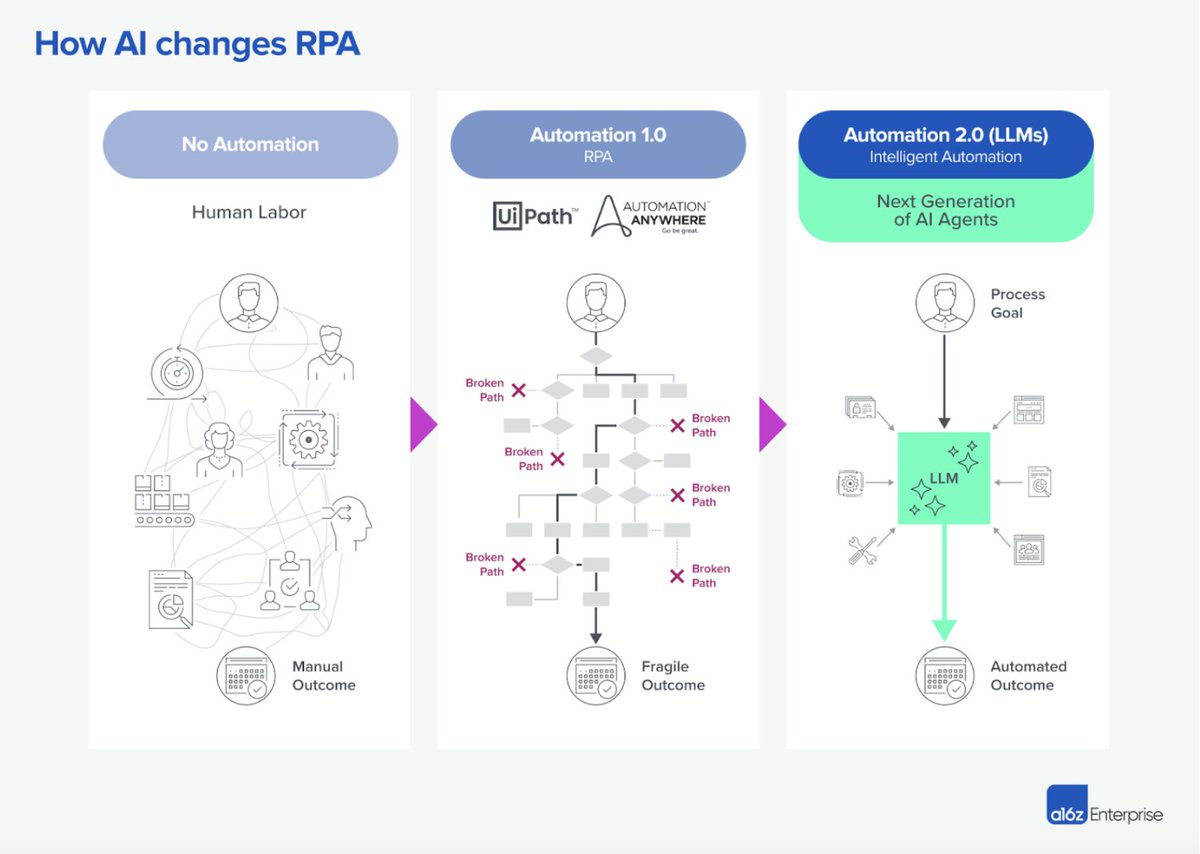
Organisations have done a lot of work to customise and implement #RPA for their unique processes. AI agents, if available earlier, would have obviated that customisation. They would still need a trove of data to learn and do things right but !!
#AI#AIagents
📢 New @a16z thesis: We believe AI will automate operations and eat the world of RPA 🤖
Historically, most ops work couldn't be automated because it was too bespoke and lacked native integrations or APIs, and so was done manually or through imperfect RPA solutions.
With generative AI, intelligent automation through AI agents is now possible. What we believe 👇
We haven’t listened to the podcast yet … on a read however, the summary is super interesting, hence sharing .
AGI will be ready before the guardrails are is one surmise
#claude#anthropic
This is Dario Amodei.
He's the CEO behind Claude, one of the world's most advanced AIs.
Yesterday, in a 5.5 hour conversation with @lexfridman, he revealed our timeline to superintelligence.
Let me save you 5 hours: 🧵
This sorts out the bewildering inability of ChatGPT to advice on current and/or recent facts and events which in turn was due to the lack of concurrency in #trainingdata#chatgpt#LLMs
🌐 Introducing ChatGPT search 🌐
ChatGPT can now search the web in a much better way than before so you get fast, timely answers with links to relevant web sources.
https://t.co/7yilNgqH9T
Crypto makes AI less oligopolistic. AI needs to be so for the AI companies to be interested in adopting and building with crypto. An AI boost for crypto is very much dependent on a crypto boost for AI
#crypto#AI#cryptoai
Not promoting the course… but love the summary of what the course is about, why is it important and how to make it possible
#LLMs#operatingsystems#memorymanagement
New short course: LLMs as Operating Systems: Agent Memory, created with @Letta_AI, and taught by its founders @charlespacker and @sarahwooders.
An LLM's input context window has limited space. Using a longer input context also costs more and results in slower processing. So, managing what's stored in this context window is important.
In the innovative paper MemGPT: Towards LLMs as Operating Systems, its authors (which include the instructors) proposed using an LLM agent to manage this context window. Their system uses a large persistent memory that stores everything that could be included in the input context, and an agent decides what is actually included.
Take the example of building a chatbot that needs to remember what's been said earlier in a conversation (perhaps over many days of interaction with a user). As the conversation's length grows, the memory management agent will move information from the input context to a persistent searchable database; summarize information to keep relevant facts in the input context; and restore relevant conversation elements from further back in time. This allows a chatbot to keep what's currently most relevant in its input context memory to generate the next response.
When I read the original MemGPT paper, I thought it was an innovative technique for handling memory for LLMs. The open-source Letta framework, which we'll use in this course, makes MemGPT easy to implement. It adds memory to your LLM agents and gives them transparent long-term memory.
In detail, you’ll learn:
- How to build an agent that can edit its own limited input context memory, using tools and multi-step reasoning
- What is a memory hierarchy (an idea from computer operating systems, which use a cache to speed up memory access), and how these ideas apply to managing the LLM input context (where the input context window is a "cache" storing the most relevant information; and an agent decides what to move in and out of this to/from a larger persistent storage system)
- How to implement multi-agent collaboration by letting different agents share blocks of memory
This course will give you a sophisticated understanding of memory management for LLMs, which is important for chatbots having long conversations, and for complex agentic workflows.
Please sign up here! https://t.co/XMlBifnwVa