Super interesting!
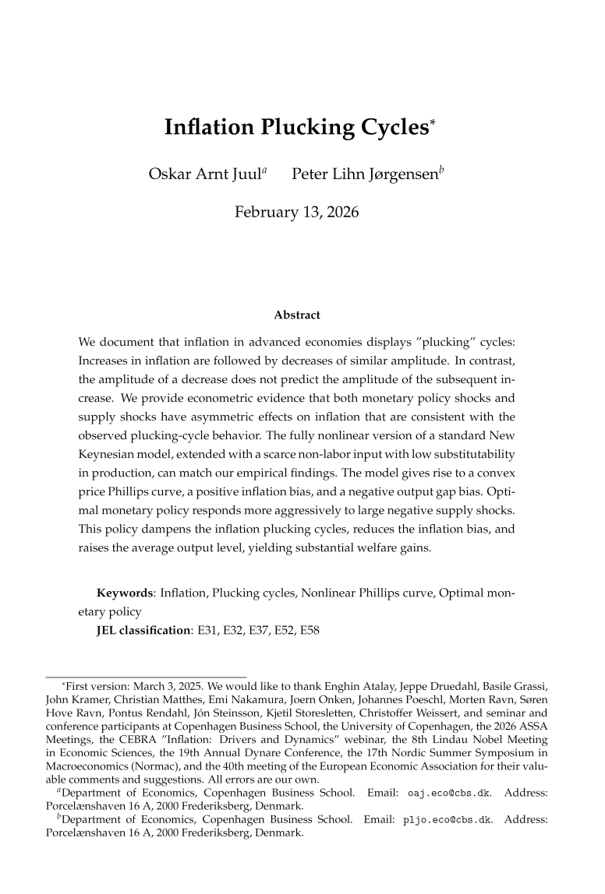
"Inflation Plucking Cycles" by Oskar Arnt Juul and Peter Lihn Jørgensen.
"We document that inflation in advanced economies displays ”plucking” cycles: Increases in inflation are followed by decreases of similar amplitude. In contrast, the amplitude of a decrease does not predict the amplitude of the subsequent increase. We provide econometric evidence that both monetary policy shocks and supply shocks have asymmetric effects on inflation that are consistent with the observed plucking-cycle behavior. The fully nonlinear version of a standard New Keynesian model, extended with a scarce non-labor input with low substitutability in production, can match our empirical findings. The model gives rise to a convex price Phillips curve, a positive inflation bias, and a negative output gap bias. Optimal monetary policy responds more aggressively to large negative supply shocks. This policy dampens the inflation plucking cycles, reduces the inflation bias, and raises the average output level, yielding substantial welfare gains."
https://t.co/hbhfRAyzsX
We've updated the SED 2026 Program
Participants: please check the date/time of your session (minor changes)
Only a few days for Athens!
https://t.co/LEaoMtLn5X
New Article: "Anchored inflation expectations and the slope of the Phillips curve" European Economic Review vol 178, September 2025, 105073
https://t.co/FuBOCw39IZ
#WednesdayMotivation: Stay ahead of inflation trends!
Join us tomorrow, March 27th at 11 AM EST/4 PM CET, for the #CEBRA Inflation Webinar featuring:
🔹 Pablo Guerron (Boston College): Why has U.S. inflation become harder to forecast?
🔹 @peter_lihn (Copenhagen Business School): Inflation Plucking Cycles
🎤 Moderator: Damjan Pfajfar (Cleveland Fed)
🔗 Register now: https://t.co/1ta4f6m1Q8
#Inflation #Economics #Finance #Webinar #Macroeconomics
New paper: ”Inflation Plucking Cycles” (w. @ArntJuul). Inflation displays “plucking cycles:” Increases in inflation are followed by decreases of similar amplitude, while the amplitude of a decrease does not predict the amplitude of the subsequent increase https://t.co/AGB6U4Rxa2