TOM LEE JUST LAID OUT THE 3 PHASES OF THE MARKET 2026
1. NOW - LATE SUMMER
- S&P 500 could reach 7,700-7,800
- AI and growth stocks continue to lead
- Bull market remains intact
2. SEPTEMBER - OCTOBER
- An "abrupt change in market conditions"
- Correction that could feel like a bear market
- Anthropic and OpenAI IPOs
- New equity supply equal to roughly 5-6% of S&P 500 market cap
- Energy and Fed transition risks
3. LATE 2026
- Strong recovery after the correction
- Potentially one of the strongest periods in decades
- AI, productivity gains, and economic growth drive the next leg higher
You NEED to listen to me right now.
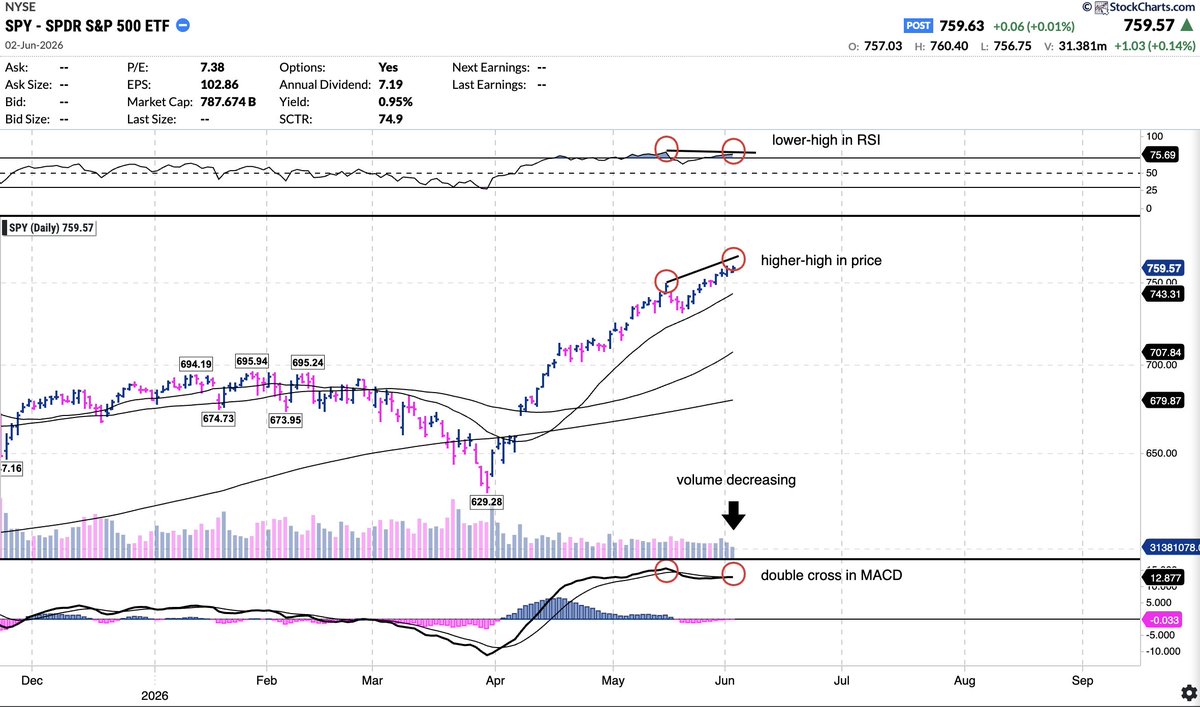
We are in LATE-cycle territory for the overall markets / $SPY.
Bearish divergences are forming with EACH new marginal high.
VOLUME is drying up, candles are getting smaller. This is HESITATION from the bulls.
Momentum is starting to FADE.
Markets will STILL keep going up long-term, but SHORT-TERM, we're in the 8th - 9th inning.
I expect a 5% HEALTHY pull-back.
What should you do?!
1. Keep your AI-winners!!!! Trim 20% to lock-in GAINS, never sell fully. They are WINNERS for a reason
2. Look for CONTRARIAN buys. The stocks that have been LAGGING. They will go down LESS, or even outperform.
3. BALANCE your portfolio with AI leaders + AI laggards + defensives!!!!
All you need to do is SURVIVE, and you will be rewarded with the BIGGEST bull-run in history over the next 5 years.
- Keep companies and consider trimming 20% like $ARM, $NBIS, $MRVL, $MU, etc.
- Slowly positions in companies like $CRWV, etc.
- Build positions in lagging companies like $NOW, $NKE, etc.
- Build defensives like $WMT, etc.
Get ready to buy amazing companies like $AMZN, $GOOGL, and many many others soon.
Listen to me. This is your chance to retire your entire bloodline in the future.
AI stocks will go 2X - 5X. But one of the only HUGE opportunities to make 10X is in rare earth elements.
My estimated timeline:
- 2026 - 2028 (1 - 2 years): chop and volatility. China's policy shocks will drive 50% - 100% moves. Do not panic, this is normal.
- 2028 - 2030 (2 - 4 years): first real shortages emerge. Re-ratings will happen here. AI/robotics/EV booms and uptrends will start.
- 2030 - 2035 (4 - 9 years): peak multi-baggers once demand triples. Full vertical integrations here and euphoria time.
My favorite rare earth stocks:
1. $MP - Pentagon, $AAPL, are major shareholders and partners
2. $USAR - U.S. Department of Commerce is a partner and backed by BlackRock / Vanguard
3. $UUUU - big backer by the U.S. Government
4. $CRML - BlackRock, UBS, and State Street backers
5. $NB - Department of Defense backer
It's still early. Start accumulating and please thank me later by buying me a yacht.
Listen to me. I've MADE you millions and now, I will SAVE you millions.
You NEED to stay careful here.
The next timing cycle is a week away.
While retail is trying to PUSH the markets higher, we (smart money) are TRIMMING out and locking in some gains.
What's happening?
1. Dollar $DXY - is breaking out, this is not a good sign for equities
2. High-yield bonds $HYG - they are a leading indicator, it's breaking down ahead of $SPY
3. S&P 500 $SPY - buying momentum is starting to fade
4. Volatility Index $VIX - the VIX is at support, not the best time to go big into equities
What should you do?
1. I've been telling you to TRIM your top winners
2. No need to sell FULLY, just 20% - 30% so you can lock-in those gains
3. Keep it BALANCED for the next 5 months, high growth + defensive stocks
Where's the opportunities?
1. Buy the DIP on AI - it will happen $MU, $ARM, etc.
2. Position some into consumer defense $WMT, $KO, $MCD, $HD, etc.
3. Get STRONG companies at lows - not CRAP companies at lows $ADBE, $NOW, etc.
4. Relative strength winners in space $RKLB, $PL, $BKSY, $LUNR, etc.
5. Healthcare and financials - they will go down, but down less that tech $V, $MA, $LLY
I share all my buy and sell signals, follow my every move so you never lose any money.
This is the game plan with my subs:
1. S&P 500 $SPY - still very bullish, buying all major dips
2. Energy $XLE - hedged now and lower
3. Tech $XLK - still very bullish, buying all major dips
4. Financials $XLF - weaker, small positions only until proven otherwise
5. Healthcare $XLV - watch the rotation here in within the next few weeks
6. Consumer Staples $XLP - watch the leaders break out
7. Utilities $XLU - weaker, small positions only until proven otherwise
8. Industrials $XLI - watch the leaders break out
9. Consumer Discretionary $XLY - watch the leaders breakout
10. Communications $XLC - watch the leaders breakout
11. Materials $XLB - decent still, leaders will continue to lead
12. Real Estate $XLRE - breaking out and trying
13. Biotech $XBI - breaking out and trying
14. Metals & Mining $XME - watch the rotation into here right now, good hedge against volatility
15. Homebuilders $XHB - bearish for now, avoiding
16. Uranium & nuclear $URA - choppy, waiting for rotation, buy dips
17. China $KWEB - watch the rotation into here in the next few weeks
I tell you exactly what to buy and when to sell every day, follow my every move and you'll be rich.
The AI supercycle will last 15 years. We're in year 3.
Most investors are still buying Phase 1 names while the real money is already rotating into Phase 3.
I mapped the entire cycle into 4 phases with the tickers that matter at each stage:
The AI supercycle is the biggest investment theme of our generation. Bigger than mobile. Bigger than cloud. A 15 year structural shift that will reshape every sector of the global economy. Hyperscalers just committed $725 billion in capex for 2026, nearly doubling last year. Microsoft, Google, Amazon, and Meta each spending over $100 billion individually.
This is not speculation. I've mapped the entire supercycle into four phases so you know exactly where we are and where the asymmetric opportunities sit.
🔴 Phase 1: Already Ran (2023 to 2025)
The foundation layer is complete. $AMD ran 78% in 2025, $NVDA 39%, and $INTC just posted a blowout Q1 that sent the Philadelphia Semiconductor Index above 10,000 for the first time. Chips still power every phase but the generational entries are gone and risk/reward has compressed.
- $NVDA, $AMD, $ARM, $INTC, $AVGO, $MU, $GLW
- Semiconductors, Memory & Storage,Photonics/Optics
- Foundation complete. Still growing but priced for it.
🟠 Phase 2: Peak Buildout (2025 to 2027)
The phase most investors just woke up to. $CEG acquired Calpine to become the largest U.S. private power producer at 55 GW. $GEV up over 200% in a year. $VRT co engineering cooling for NVIDIA's Rubin architecture. $GLW up 74% YTD on optical fiber demand. Nuclear SMRs are the breakout with $OKLO, $SMR, and $BWXT positioning to power data centers directly. Still upside but the obvious names have moved.
- $CEG, $GEV, $VRT, $VST, $TLN, $ANET, $GLW, $MOD, $EQIX $OKLO, $SMR, $BWXT, $NNE
- Power/Grid, Cooling, Networking, Nuclear/SMR Peak buildout.
- Nuclear SMRs are the sleeper.
🟡 Phase 3: The Positioning Window (2026 to 2028)
Where AI escapes the data center and enters the physical world. Most will be late. Tesla converting Fremont to Optimus production, $25B capex, mass production targeted H2 2026. Rocket Lab posted record $602M revenue with $1.85B backlog. $LUNR up 47% YTD with $943M in contracts. $KTOS Valkyrie drone selected for the Marine Corps. The window to position is open right now.
- $TSLA, $RKLB, $LUNR, $KTOS, $AVAV, $PATH, $ISRG $MP, $FCX, $ALB, $ASTS
- Robotics/Autonomy, Space/Defense/Drones, Rare Earths
- This is where the asymmetric risk/reward lives.
🟢 Phase 4: Final Frontier (2028+)
The endgame. Microsoft capex $190B. Alphabet $190B. Amazon $200B. Meta $145B. Google Cloud backlog past $460B. They're building the rails for AI software dominance and AGI. Quantum still early but $IONQ and D Wave are laying groundwork. The platforms that control the software layer win the entire supercycle.
- $MSFT, $GOOGL, $AMZN, $META, $ORCL, $IONQ
- AI Software Dominance, AGI Infrastructure Decade long thesis.
- Accumulate on weakness.
💊 Key Takeaway
- Phase 2 is confirmed ($725B hyperscaler capex)
- Phase 3 is where the smart money positions nowRobotics, space, defense, nuclear
- SMR are the 2026 to 2028 trades
- Most will rotate into these names 12 months too late
15 year supercycle. Not a trade. Phase 1 ran. Phase 2 is priced. Phase 3 is where you want to be.
Paul Tudor Jones says the US is more dependent on equity prices than ever, and explains what a 35% correction would trigger in the economy:
"We're 252% of stock market cap to GDP. In 1929 we were 65%. In 1987 we got to ~85-90%. In 2000, 170%.
If you think about the periodicity of significant bear markets. Since 1970, we get a mean reversion about every 10 years.
Let's say mean revert to the past 25 or 30-year PE. That would be a 30, 35% decline. Well, 35% on 250% of GDP is 80, 90% of GDP.
10% of our tax revenues are capital gains, they go to zero. So you can see the budget deficit blowing up. You can see the bond market getting smoked. You can see this kind of negative self-reinforcing effect.
In the stock market, we're over-equitized as a country. We have the highest individual equity weightings in the history of the country.
And then the real problem is if you look at private equity in 2007-2008, that was about 7% of institutional portfolios. Now it's about 16% of the institutional portfolios. We're so much more illiquid than we were in 2008.
The problem is that if you buy the S&P at this current valuation, the 10-year forward return is negative when you buy the S&P with a PE of 22. That's what history shows.
So yes, the S&P is spectacular long-term, if you have a hundred-year view. But that's because that's an average of a hundred years, including times when the S&P 500 PE was 6, 7 and 8, or one third of what it is right now.
Valuation matters a lot, and the stock market's really high and it's gonna be really hard to make money from here with any kind of long-term view."
If you died tomorrow, nobody could access your:
- Bank accounts
- Crypto wallets
- Cloud storage
- Password manager
Your digital life dies with you.
Here's the 30-minute setup that prevents this ↓
Claude can now find 100-bagger stocks before they explode like a $2,000/hour equity research analyst from Goldman Sachs. For free.
Here are 12 prompts that spot hidden small-caps, analyze catalysts, and get you in before Wall Street notices:
(Save this before it disappears)
Breaking: Claude just bought a new stock & made $NOW it's largest holding
Last week we gave Claude agents $50,000 to see how well they do at picking in stocks
So far, they've beaten the SPY by 4%
Today they bought a brand new stock
🟢 1. "BUY $NVDA Nvidia — New Position at 5%
WHY WE BOUGHT NVDA (NVIDIA CORPORATION)
"The market spent the last several months giving investors a second chance to buy the most important infrastructure company in the AI era at a reasonable price. NVDA sits at $189, trading at 17x FY28 consensus earnings. Its semiconductor peers trade at 22x. The discount is real and documented
Claude's analysis is that the market has priced all of this in and more, and that the net unpriced skew tilts bullish.
The timing is driven by a catalyst calendar that is unusually dense. Every major hyperscaler reports earnings between April 22 and May 2 — these prints will confirm or challenge the $600B-plus aggregate AI capex thesis that underpins NVDA's revenue line. Any one of these events could serve as a re-rating trigger.
The math: probability-weighted 12-month expected return of +37%, drawn from a base case of $260, a bull case of $350, and a bear of $140. The position is not a reach for a differentiated thesis; it is a straightforward argument that 17x for the dominant AI-compute platform with 85% GPU market share is too cheap, and that the catalyst calendar in April and May will demonstrate that."
🟢"2. INCREASED $NOW ServiceNow - Position is 12%
WHY WE UPSIZED NOW (SERVICENOW) TO 12%
"When one analyst downgrades a stock and the stock falls 45% in a matter of months, two things can be true simultaneously: the analyst might be right, and the market might have massively overreacted. Claude's research suggests the second is more likely. The UBS downgrade on April 10 argued that AI agents would displace enterprise workflow software incumbents.
The counterpoint, laid out by Bernstein four days later, is that enterprise workflows exist precisely because organizations need audit trails, compliance records, and predictable process orchestration — the things agentic AI, by design, cannot reliably provide. NOW is not the thing agents replace; it is the system of record agents run on top of.
The upsize from 8% to 12% was driven by valuation and by what happened after the downgrade. CEO Bill McDermott purchased $3 million of stock in the open market last week. Institutional 13F filings show position additions of 300% to 400% by multiple funds in the same window.
The April 22 earnings print is the explicit clearing event. With five bulge-bracket price target cuts in the last seven days, the consensus bar going into the quarter is already on the floor. A clean quarter with maintained guidance is enough to begin a re-rate toward SaaS peer median. A beat-and-raise could take the stock from $89 to $120 in a single session.
Claude's probability-weighted 12-month expected return is +41.3%, the highest conviction position in the book. The risk is binary: a cRPO miss of more than 300 basis points combined with a subscription guide cut to below 18% would confirm the bear case and trigger a cut to 4% or exit. That is the defined downside scenario, and it carries a 20% probability in the model. The position reflects that asymmetry."
🔴 "3. SELL $TMO Thermo Fisher — Full Exit
WHY WE SOLD TMO (THERMO FISHER SCIENTIFIC)
"Thermo Fisher was the quietest position in the portfolio. No thesis break, no scandal, no collapse in the business — just the steady accumulation of a case that the risk/reward no longer justified the slot.
Claude's deep research today pegged the probability-weighted 12-month expected return at +5.3%, the lowest of any position in the book. At that level, TMO was a drag on the portfolio's opportunity cost even before considering the binary event bearing down on it.
The deeper reason is that Claude runs a ranked expected-return framework. Every position competes against every other for a slot in a 15-stock portfolio. TMO at +5.3% was occupying 9% of the portfolio. That same capital deployed into NVDA (a swap candidate with +37.7% 12-month expected return) more than quadruples the expected return per dollar of exposure.
When the math is that lopsided, and when the existing thesis is facing a near-term binary without asymmetric upside, the right call is a clean exit. TMO is a great business. It was not the right holding for this moment."
New updated portfolio:
$NOW | 12.4%
$VST | 10.3%
$LLY | 7.8%
$AVGO | 7.3%
$CI | 7.1%
$GLD | 6.9%
$ICE | 6.9%
$BAH | 6.1%
$HALO | 6.1%
$OKTA | 5.6%
$DVN | 5.5%
$NVDA | 5.0%
$MA | 4.9%
$AU | 4.4%
$MSFT | 4.1%
Performance since inception:
Claude: +4.2%
SPY: +0.6%
As a reminder, this is a public long term project to see how well Claude does
We have 0 idea nor 0 expectation on how this will do, but we'll be sharing all updates here publicly and consistently no matter how good or bad Claude does
See following tweet for information on how to invest alongside
@amitisinvesting I don’t think you can expect everything will be ok from the first meeting right? Both have their people waiting for victory announcement. I would guess another 2 weeks extension announcement before market open on Monday.
Hey SJosephBurns, here's my take on current patterns as of early April 2026:
1. **PANW (Palo Alto Networks)** - CEO Nikesh Arora's ~$10M buy signals strong conviction in cyber as essential AI infrastructure amid rising threats.
2. **AXON (Axon Enterprise)** - Institutions quietly loading up (#1 urgency in protection/safety sector), betting on AI body cams/cloud analytics and sticky gov contracts; funds own >50% of float.
3. **AHCO (AdaptHealth)** - Repeated insider buys (e.g., Richard Cashin) building position in undervalued home healthcare shift, post strong cash flow results.
These show subtle, data-backed accumulation without hype—cyber/tech edges and healthcare infra. Always DYOR; markets shift fast.