$ROOT may start growing revenue 40% YoY in 2027 and onwards. The market has not priced this in.
Here is what is in motion:
1. Hyundai/Kia has been interested in capturing insurance commission sales at point of sale
2. Kia already partners with Wrisk/Allianz in the UK to sell their insurance at point of sale.
3. In the US, Hyundai/Kia through Hyundai Capital America, has selected Root Insurance (beginning in 2025) as their Insurance partner
4. Hyundai has trademarked their own insurance label, "Hyundai Secure+" to sell insurance in the US.
5. The Root website confirms that Hyundai Secure+ is a Root powered product. Their website also shows pages for Kia Secure+ and Genesis Secure+ products, which are brands under Hyundai Capital America.
6. Hyundai has been hiring this summer for job roles that include people to align incentives with dealers to sell an in-house branded insurance product, as well as technical roles for backend digital integration with a product like insurance.
These facts establish with strong confidence that Hyundai Secure+ is a Root Point of Sale dealer product. The next step is figuring out what kind of policy sales and revenue growth this would bring to Root.
1. Hyundai Capital America works with 1,800 dealerships, which include 825 Hyundai dealers and 772 Kia dealers.
2. HCA sales in 2025 included, 901,686 Hyundai vehicles, 852,155 Kias, and 82,000 Genesis. For a total of 1.836 Million Vehicles.
3. Wrisk/Allianz which currently does POS car insurance in the UK, have achieved attach rates ranging from 4% to around 11%.
4. Root already partners with Carvana for Point of Sale in the US, and have an attach rate of somewhere around 12.5%.
5. Carvana sold 596,641 cars in 2025. That's about 75,000 in new policies at a 12.5% attach rate to Root.
Okay now the math. Dealers will convert at somewhat lower levels than Carvana. We have Wrisk as a baseline at 4-11%. Let's look at 3 possibilities. We will use Hyundai Capital America's 1.8M vehicle sales number:
- bear case 5% attach rate = 90,000 new policies a year
- base case 7.5% attach rate = 135,000 new policies a year
- bull case = 10% attach rate = 180,000 new policies a year
With Carvana already at about 1/4 of new policies at est 75,000 per year, Hyundai may increase new policies sold by Root by about 50% per year.
And these are all brand new cars. Which means high value comprehensive policies. Not cheap policies for older cars that are liability only.
$ROOT could start growing revenue at 40-50% YoY in 2027 with this program active, even without targeting direct growth.
Right now is the calm before the storm. Based on the job description postings from HCA, this is nearing the phase where dealer implementation is on the horizon.
Screenshot from Root's website below.
Unfortunately, as is the case on X, and for human behavior, most people only get interested in a stock after the share price doubles.
I think people should get excited now, while there is potential uncertainty and lack of knowledge around specifics of the Hyundai partnership pre-launch.
Once all the facts are widely publicized, the alpha is gone, and the share price may capture much of the upside.
When $ROOT goes after new policy types, their growth potential might surprise people
By going after the partner channel, their new products can become quickly available to all of their partners.
Root is active with 15,000 independent agents and 4,000 approved agencies.
They can appoint an agent in under 24 hours, and appoint 20 agents a day. That's almost 2,000 new agents every quarter.
They also embed within popular apps.
Currently, over half of $ROOT's new policies are sold through the partner channel, and around half of those are coming from the independent agent channel.
Whenever $ROOT goes live with a product, they can go live with those 15,000 agents and partners.
This is the partnership distribution advantage at work.
🚨🚨🚨 $ROOT Hyundai Alpha 🚨🚨🚨
New job role at Hyundai Capital America
Job is responsible for "developing and executing the Region's insurance growth objectives through dealer conversions to the branded F&I (finance and insurance) product.
What is their branded insurance product?
Hyundai Secure+, powered by Root.
Where is it headed?
To dealerships for conversions.
AKA, a point of sale offering like Carvana.
THIS IS HUGE!
This is the $ROOT confirmation we've been waiting for!
$ROOT will officially be the white label product of Hyundai, just like they already are for $CVNA!🔥🔥🔥
Did you know this about $ZM?
- $7B in Net Cash
- P/S = 5.71
- P/E = 14.84
There's no hype around $ZM right now, and the weekly chart looks as follows...
Maybe something to consider while others are chasing the latest thing.
Up 18% on my LEAPs, which I bought 10 days ago.
it is an unwritten rule of life that after every prolonged period of hardship and uncertainty, there is going to be a period when you are going to achieve quantum leaps across multiple areas of your life. the only requirement is that you do not give up on yourself.
@apnmrev@0xlelouch_ I think product has always been the easy part. It’s just even easier now. The hard part has always been selling. That hasn’t changed.
$ZETA is at $19
Wave 5 target is exactly $100
Thesis is unchanged
$PLTR was my Christmas gift when I shared it at $7…it went to $220, exceeding all expectations
$ZETA can 5 X with ease by just following the standard movement of price action
@realroseceline Really appreciate the value you continue to provide. This is coming from a $ZETA investor (largest position at the moment). Can’t wait to read your book!
$ZETA vs $TTD
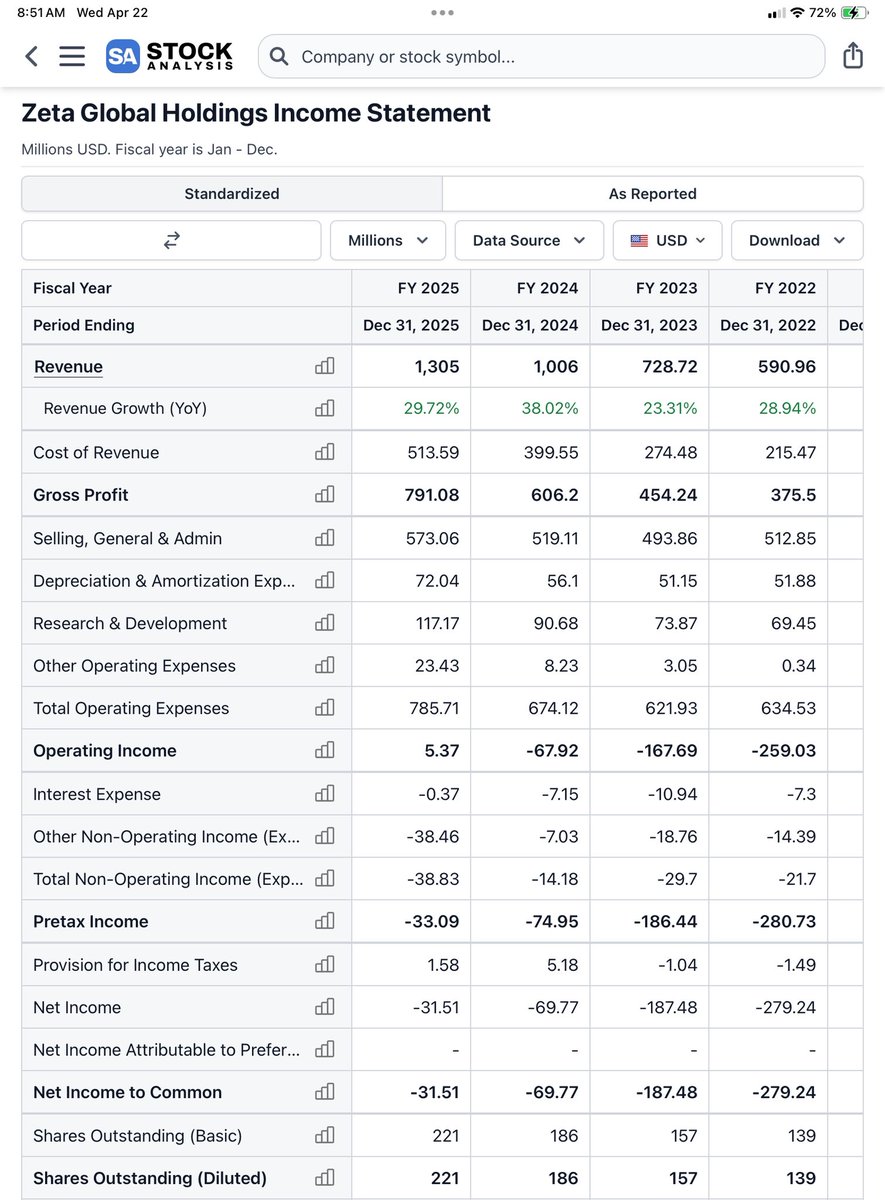
I compared the income statements of $TTD & $ZETA and not surprisingly $TTD is clearly a much better business because $TTD is bigger, more profitable, more efficient, superior margins, less dilutive, and grows organically. $ZETA is growing, but it is still fighting its way toward profitability while issuing a lot more stock.
$TTD did $2.9b of revenue in 2025 versus $1.3b for $ZETA. So it is already more than twice the size. But what really matters is that $TTD turned that scale into $2.3b of gross profit and $589m of operating income, while $ZETA generated $791m of gross profit and only $5m of operating income. That is not the same quality of business at all.
You can see it in the margin immediately. $TTD gross margin is ~80%, which is elite. $ZETA is ~60%, a missive difference. A business with nearly 80% gross margins has much more room to absorb costs, invest, and still produce strong earnings power.
$TTD converts gross profit into real operating profit. Operating margin was roughly 20% while $ZETA operating margin was about 0.4%, basically breakeven. So even though $ZETA finally got slightly positive at the operating line, it is nowhere near the level of profitability $TTD has already reached.
The expense structure also favors $TTD. SG&A $TTD was $1.2b against $2.3b of gross profit, while $ZETA spent $573m of SG&A against only $791m of gross profit. In other words, far more of $ZETA’s gross profit gets eaten up just to run the business. That makes the model less powerful and less scalable.
The dilution difference is also massive. $ZETA shares went from 139m in 2022 to 221m in 2025. That is about 59% dilution in just three years. $TTD basic shares went from 487m to 488m over the same period, basically flat. Albeit they did buy back shares. That alone is a huge point in $TTD favor because it means more of the economics are actually accruing to shareholders instead of being spread across a rapidly growing share count.
That matters even more when you look at net income. $TTD earned $443m in 2025 and has been strongly profitable for many years now, rising from $53m in 2022 to $179m in 2023 to $393m in 2024 to $443m in 2025. $ZETA still lost $31m in 2025, though that is much better than the $279m loss in 2022. So yes, $ZETA is improving, but $TTD is proving its model at scale while $ZETA is still trying to prove it.
Now, to be fair to $ZETA, its revenue growth has actually been faster. It grew 30% in 2025, 38% in 2024, and 23% in 2023. $TTD grew 19% in 2025, 26% in 2024, and 23% in 2023. So if someone wanted to argue for $ZETA, the case would be that it is earlier in the curve and still has more runway to improve margins. That is the bull case. But right now that is still a projection, not the current reality.
The problem is that $ZETA growth has come with a much weaker earnings profile and much heavier dilution. So even if the top line looks attractive, the shareholder outcome is not nearly as good. Growth is nice, but growth while issuing a lot more stock and barely earning anything at the operating line is much less impressive than slower growth with real profitability and more stable share count.
If I were reducing this to one sentence, I would say $ZETA looks like a promising but still unproven operating model, while $TTD is already a scaled elite business. That does not automatically mean $TTD is the better stock at every price and obviously valuation always matters. But if you are asking which business is better from a numbers perspective, it is $TTD by a mile because $TTD is already demonstrating the thing investors hope $ZETA one day becomes.
1/2 👇
Interesting, @realroseceline . When you say they don't break it down, you're talking about the growth that $ZETA's customers are experiencing from using $ZETA, correct? Whether they are spending more with $ZETA because it is helping them acquire new customers versus just sell more to existing customers, right?
Is that breakdown something that's commonly reported by ad platform companies? Just trying to learn, as $ZETA is my biggest position at the moment, and this is something I actually never thought about.
What’s impressive about $ZETA is it started collecting consumer information and training its AI in 2017.
Back then it wasn’t obvious $ZETA's customer intelligence would replace the old way of marketing when brands placed ads across the Internet and hoped the right person would see them.
$ZETA's results (242 million individual consumer profiles in the US and 550 million worldwide) speak for themselves.
Another customer intelligence company could start collecting first-party data similarly to $ZETA.
But.
You can buy GPUs, but you can’t buy time.
$ZETA is simply 8 years ahead in training its AI.