It's hard to overstate how much of an outlier California is for its slow vote-counting relative to literally any other state or almost any other industrialized democracy.
Everyone can see that other states do accurate and fair vote counts that are substantially complete within hours of polls closing. California has chosen a stupid system and should change the system.
I bucked all advice from my friends (and resisted my conservative bias) and decided to fully trust the Times journalists.
As they left my home they asked that I not talk to any other outlets and I insisted then and repeatedly over the following weeks that I would keep my word and only share this story with them.
But then the weeks dragged on. They kept coming back to us saying the editors needed more. I needed to go on the record (okay). We need more screenshots (okay). I met every bench mark they set, eager to provide more sources or evidence as needed.
After the story went up I began to ask them … wait, where are the stories from the other women? Where are their accusations of sexual assault? Why am I the focus? Why are there 11 paragraphs dedicated to detailing my work history (more than has been published about Graham’s by far)?
Why does it say “nobody could corroborate” when I offered them sources that COULD corroborate?
Why did they include an out of context quote from a friend joking “do not call Graham” after I called off my wedding? (Because she knew I would never).
Where were the screenshots they’d said they would use? Or the mention that I’d supported local democrats and that most of my family (and husband) are liberal?
The editors said it was too much, they explained.
The Times also failed to include any mention that I DID confide in multiple friends through the years that Graham had been abusive — long before he was running for office. Those friends confirm they told the Times so.
It dawned on me that this really was a set up all along. The journalists I trusted who convinced me to share a story I never wanted to tell methodically delayed and twisted this into a gift to the Platner campaign. Violating the trust of his victims. Shattering the trust I placed in them with the most vulnerable story of my life.
And at the end of my call with them I reluctantly accepted their insistence that this was still a powerful story and that I had done a brave thing. And I thanked them for all the hard work they had put into it.
Still fawning after all these years.
What's more crazy is this is how the system is designed.
California INTENTIONALLY does not count ballots for weeks. And I think it explains the state's broader dysfunction.
Basically, California's voting rules are designed to maximize accessibility at all costs. ALL costs.
Ballots can arrive after Election Day. Signatures can be fixed if they are unclear. Provisional ballots get individually reviewed. Every edge case gets its own process.
And California doesn't trust technology or automation to solve these problems. Signatures are manually reviewed. Voters are contacted when issues arise. Humans review and re-review exceptions. The system is designed around minimizing the chance that a single valid ballot gets rejected.
Other countries count tens of millions of votes in hours, not weeks. They aren't using magic. They simply make different tradeoffs. They rely more on technology, set stricter deadlines, tolerate fewer exceptions, and accept that no system can perfectly accommodate every conceivable scenario.
California makes the opposite choice.
And it's the same philosophy that shows up in housing, infrastructure, permitting, schools, and government generally: endless process, endless exceptions, and worse results.
Only 10% of Californians have voted compared to 40% at this time in 2018. They don’t like the three frontrunner options. @MattMahanSJ is the right leader for this moment.
California elections are next week (June 2), here’s my voting guide.
As usual, the ballot is way too long and asks voters to decide things no normal person should be expected to know. I did my best to figure it out.
My basic lens: competent government, housing abundance, public safety, fiscal discipline, better schools, and less performative politics.
TL;DR:
Governor: Matt Mahan
Lt. Governor: Josh Fryday
Secretary of State: Shirley Weber
Controller: Herb Morgan
Treasurer: Eleni Kounalakis
Attorney General: Rob Bonta
Insurance Commissioner: Patrick Wolff
Board of Equalization, D2: Sally Lieber
US Representative, D11: Scott Wiener
State Assembly, D17: Matt Haney
Superior Court Judge: Phoebe Maffei
State Superintendent: Josh Newman
Board of Education: Phil Kim
Props:
A: Yes
B: Yes
C: Yes
D: No
Statewide races
Governor: Matt Mahan
He’s the most pragmatic, execution-focused candidate in the race, and the only candidate (of 61) that I really like. California needs someone smart and pragmatic who has dealt with stuff that matters: homelessness, permitting, public safety, and budgets. Mahan has done a great job as Mayor of San Jose and is the governor California needs.
On the others:
Katie Porter is sharp, but insufferable and a bit performative... We have enough political theater. We need a governor who can run the state.
Tom Steyer is economically illiterate in the way rich progressives often are. He favors a wealth tax, which would be a disaster for California. We already have a narrow, volatile tax base that depends heavily on high earners, capital gains, and founder outcomes. A wealth tax would push more mobile capital, founders, and investors out of the state, potentially reduce tax revenue, and make the budget more fragile. It feels good to some people politically. It is terrible policy.
Xavier Becerra also worries me. He feels like an old-school machine politics candidate who has held jobs with no evidence that he can actually run things well. California has a serious insurance crisis, and I don’t trust him to handle it. When asked for his plan, he said he would "tell insurers they can’t raise rates." But if you treat insurers as villains that can simply be forced to write policies at politically convenient prices, you don’t get cheaper insurance. You get fewer insurers, more non-renewals, less availability, and more risk dumped onto the state. That is already part of the problem.
He also does not strike me as an effective executive. His time in the Biden administration was widely viewed as underwhelming, and California is too big and too broken to hand the job to a default partisan résumé candidate.
If the general election ends up as Becerra or Steyer vs. Steve Hilton, I would vote for Steve Hilton. I don’t like Hilton’s style, and if Trump endorses him, he’s probably toast in California. But Hilton has genuinely good ideas and is at least thinking about the right problems: housing, affordability, energy, schools, and government failure. He would be a better candidate than Becerra or Steyer.
Lieutenant Governor: Josh Fryday
The race for backup governor doesn't really matter much TBH. Fryday and Tubbs are both smart and pro-housing, I could vote for either of them. Fryday has the idea to build housing on the vast amount of developable land that universities and state agencies sit on top of. Let's do it!
Secretary of State: Shirley Weber
This office oversees elections, business filings, campaign and lobbying disclosures, and state archives. Weber is the incumbent and seems fine.
Controller: Herb Morgan
You could make a reasonable case for Malia Cohen. She seems to have done an okay job, and she will probably win. But I prefer Morgan because he seems more focused on audits, waste, and fiscal discipline.
The mark against Cohen for me: when she ran last time, she said she would audit state homelessness spending. That still hasn't happened.
Cohen is not bad, I just think Morgan is the better vote.
Treasurer: Eleni Kounalakis
She has private-sector experience and has actually built housing. The treasurer’s office touches debt, infrastructure finance, housing finance, and the state’s balance sheet.
Two things I especially like: she wants to hold California’s debt-service-to-General Fund ratio at or below 6%, and she wants to publish a public “California Balance Sheet” dashboard. Make the state’s finances more legible and harder to hide behind accounting fog.
Attorney General: Rob Bonta
He’s fine. I don’t love everything about him, but he is going to win, and I don’t see a better option here.
Insurance Commissioner: Patrick Wolff
This is sneakily one of the most important races on the ballot... California’s insurance market is in real trouble. Homeowners are losing coverage, premiums are rising, and wildfire risk is making the system harder to sustain. The next Insurance Commissioner needs to understand insurance as a market, not just as a political talking point.
Wolff is really smart, knows insurance well, and thinks about the problem from a market perspective. He is also a chess grandmaster, which is not a qualification by itself, but does suggest a certain kind of analytical mind.
Please vote for him.
District / local races
Board of Equalization, District 2: Sally J. Lieber
Honestly, I’m not even sure why this role still exists in this form. It has a weird, random set of responsibilities, and I don’t think voters should be electing people to this office.
That said, Lieber seems to have done a fine job, and I don’t see a strong reason to replace her.
US Representative, District 11: Scott Wiener
Listen, I don’t love everything about him. I disagreed with his AI regulation approach, and I think he sometimes has the standard Sacramento instinct to regulate first and ask questions later.
But this race is not close for me.
Saikat Chakrabarti is an economically destructive populist. He supports a wealth tax, backed Prop D with $500K of his own money, and seems far too comfortable with the idea that San Francisco can tax its way out of dysfunction. That is exactly the wrong lesson to take from the last decade. SF does not need more anti-business symbolism. It needs more housing, more jobs, cleaner streets, better schools, and a government that can execute.
Connie Chan is also not the answer. Her record is too NIMBY and too aligned with the old SF politics that got us into this mess. She has opposed or slowed housing, resisted streamlining, and was opposed to the recall of Chesa Boudin. She represents less housing, higher rents, and more veto power for neighborhood obstructionists.
Wiener is imperfect, but he has been genuinely pro-housing, pro-transit, and pro-abundance when those positions were politically hard. That matters. He is the best choice in this race.
State Assembly, District 17: Matt Haney
He’s good and unopposed.
Judge of the Superior Court: Phoebe Maffei
To be honest, both candidates seem fine. You could just as easily make the case for Alexandra Pray. They are both experienced.
State Superintendent of Public Instruction: Josh Newman
This is another important one. Newman has good ideas, including learning from the “Mississippi Miracle,” focusing on basic literacy, and being open to school choice.
I also strongly agree with him that we should not be electing this position at all. It should be appointed... voters do not have enough bandwidth or information to evaluate this role!
Board of Education: Phil Kim
His top goals are student outcomes and safety. He also voted to bring algebra back. It is insane that this was even controversial, and even more insane that it passed narrowly. He was on the right side of it.
SF Props
Prop A: Yes
This is the Earthquake Safety and Emergency Response Bond. It authorizes $535 million in bonds for seismic upgrades and emergency response infrastructure.
I hate spending money, and I especially hate when people pretend bonds are free - they are not! The city says this won’t raise tax rates, but that does not mean it has no cost. Taxpayers are still committing to repay principal plus interest. In this case, the estimated repayment is about $933 million over 26 years for a $535 million bond.
That said, bonds are probably the best way to fund long-lived emergency infrastructure. Earthquake safety, fire response, and emergency facilities are exactly the kind of things that can justify debt financing. I haven't been able to figure out if we REALLY need it but I'm going to say it's important enough that I'm ok paying for it.
Prop B: Yes
I don’t feel strongly about this, but it fixes a weird quirk in our law. San Francisco has a two-term limit for mayors and supervisors, but it is written as a limit on successive terms. So you can serve two terms, do something else for a while, and then come back.
Two terms should probably mean two terms.
Prop C: Yes
This is a very slight adjustment to San Francisco business taxes. It helps small businesses while raising rates on larger businesses to partially offset the cost.
The main reason I care is that Prop C is that it's a foil to Prop D. Both change the same tax code, so if Prop D passes but Prop C gets more votes, then Prop C gets enacted instead.
Stupid California politics, but here we are. Vote yes on C.
Prop D: No
Saikat and Bernie Sanders call this the “CEO tax,” but that’s misleading. It’s really a business tax, mostly through the gross receipts tax, with the rate tied to executive-to-worker pay ratios. It would raise some tax rates by roughly 800%.
This is emotionally satisfying to some, but would be economically destructive. It could cause companies to shift jobs, headquarters, or revenue out of SF. Companies that stay may hire less, pass costs to customers, or avoid expanding here.
The revenue may also get tied up in court, while businesses face years of uncertainty.
SF needs more companies choosing to be here, not another reason to leave. Vote No on D.
---
It took me a long time to research all this. The fact that voters are expected to have an informed view on every race and measure is part of the problem. California has too many elected offices, too many ballot measures, and too little accountability... but here we are, so vote for the least crazy path toward a more functional state, please!
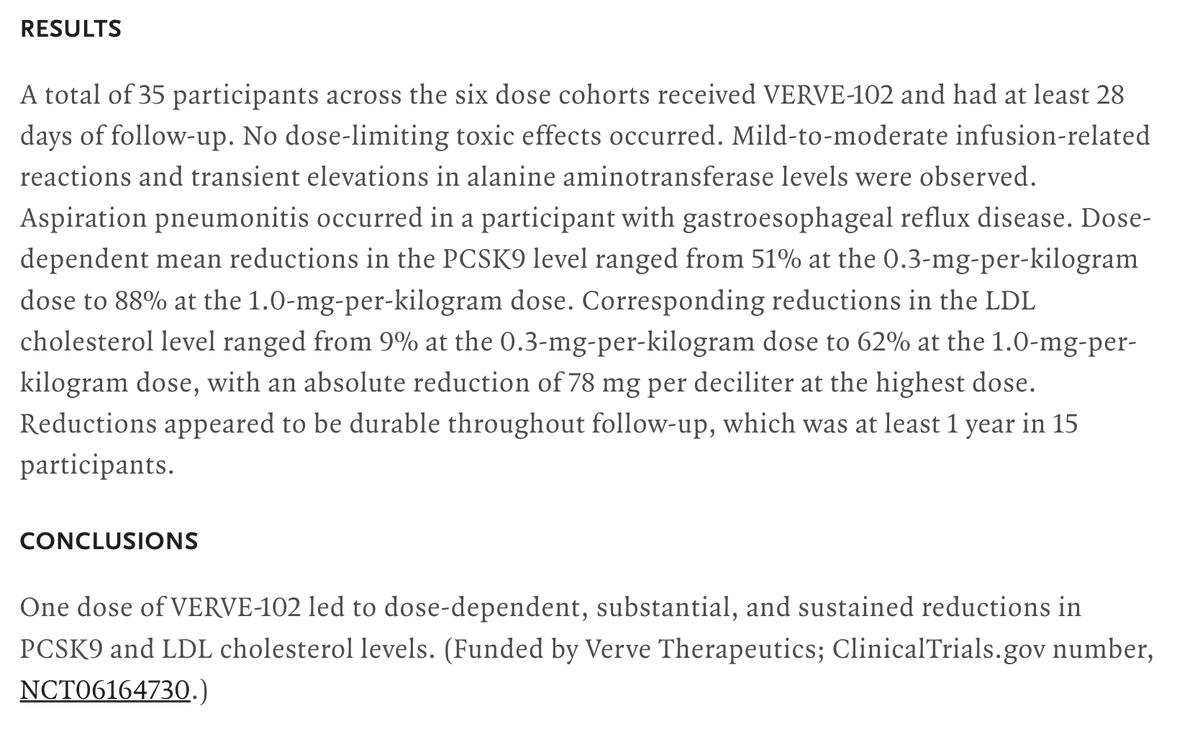
One injection, 62% lower LDL - permanently. Gene editing for cholesterol is here.
.@cremieuxrecueil is correct. Besides GLP-1 antagonist like Ozempic or, more recently, Retatrutide, this is probably the next breakthrough that is almost impossible to put into words.
Verve Therapeutics (Eli Lilly) just published Phase 1 results for VERVE-102 in the NEJM.
It's a single-infusion base-editing therapy that inactivates PCSK9 in the liver. At the highest dose, PCSK9 dropped 88% and LDL cholesterol fell 62%. Reductions held for at least a year.
35 patients with familial hypercholesterolemia or premature coronary artery disease. No dose-limiting toxicities. Main side effects: mild infusion reactions and transient liver enzyme elevations.
Still Phase 1, still small, no cardiovascular outcome data yet. But the proof of concept for permanent, one-shot LDL reduction via gene editing is real.
This is an absolute game changer and im not exaggerting.
Elevated LDL cholesterol is responsible for an estimated 4.4 million deaths every year worldwide and remains the single biggest modifiable driver of cardiovascular disease, the leading cause of death globally.
Becerra’s rivals should just do everything they can to get him more interviews and have as many voters watch as possible. All you have to do is watch him talk for longer than 30 seconds to realize he’s nothing but an empty suit.
I point out to @XavierBecerra that CA has the nation's highest poverty rate, gas prices, housing costs & most homeless people.
"Are Democrats in charge of this state doing a good job?"
"We could do better, no doubt. But we are the 4th largest economy in the world."
Is there a specific policy change he'd make as Governor?
"We'll get things done..."
He says he'll "build more housing."
More: https://t.co/PoaniKK8QH
It's astonishing that establishment Democrats are backing Becerra instead of @MattMahanSJ. Becerra has no new ideas, speaks in generalities, and will continue the dysfunction of Sacramento.
it is kind of bizarre that Becerra is regarded as the moderate Establishment Democrat in the race when his "freeze all homeownership insurance rates via magic" plan is by far the most reckless Slopulism I've seen in a race dripping with it
you’d have to be steeped pretty far in confirmation bias to believe this is some intrinsic property of putting computers in buildings rather than evidence that some construction company sucks
OK, look. Obviously, racism is bad. But if we give any nonwhite American a free pass to commit any crime for fear that punishing them would ignite a racist backlash, this country will fall apart.