Most technology breakdowns don’t show up as system failures.
They show up in how people work around them.
These patterns are usually signals, not mistakes.
What could some of thee patterns look like?
#Hotel#Hospitality#Resort#LuxuyrResort#Tech#HotelTech #OperationalTechnology #HotelOps #ResortMarketing
When technology struggles in hospitality, the problem is rarely the tools themselves.
Most resorts aren’t short on systems.
They have CRMs, PMSs, booking engines, marketing platforms, operational tools, and reporting layers.
On paper, everything that’s “needed” is already in place.
What’s usually missing is a foundation that allows those systems to work together with intention.
Foundational technology isn’t about adding more software. It’s about creating the conditions where the software you already have can actually support the experience you’re trying to deliver.
That foundation starts with: Data ownership.
If guest and operational data is defined and controlled by vendors, the resort loses flexibility. Decisions become constrained by product boundaries instead of guided by guest reality. Ownership doesn’t mean building everything yourself. It means deciding how data is structured, how it’s accessed, and how it can evolve over time.
Next is: Identity.
In hospitality, identity is rarely unified by default. A guest exists in reservations, dining, spa, activities, marketing systems, and staff notes. Without a shared way to connect those records, every system sees a different version of the guest. Foundational work defines how identity is resolved and how history persists across touchpoints and stays.
Then there’s: Connection.
Many resorts have integrations, but integration alone doesn’t create understanding. Moving data between systems without shared meaning often increases noise instead of clarity. Foundations establish how context flows, what information is relevant in which moments, and how systems stay aligned as things change.
Equally important is: Trust.
When multiple systems can answer the same question differently, teams stop relying on any of them. A strong foundation makes it clear which sources are authoritative, how conflicts are resolved, and how freshness is maintained. Confidence in the data is what allows teams to move quickly without second-guessing.
Finally, there’s: Architecture.
Hospitality operations are not uniform. Seasonality, service philosophy, staffing models, and guest mix all vary widely. A composable foundation allows technology to adapt to the resort instead of forcing the resort to adapt to rigid systems. It creates room to evolve without constant rework.
None of this is visible to the guest.
But all of it determines whether technology feels supportive or obstructive, flexible or fragile, personal or generic.
Modernizing hospitality doesn’t start with choosing tools.
It starts with deciding what needs to be owned, how systems should work together, and what the experience requires underneath the surface.
That’s the work that makes everything else possible.
When conversations about AI start, the instinct is often to jump straight to tools.
Which platform.
Which feature.
Which vendor.
I usually start somewhere else.
Before you introduce AI into guest-facing or operational workflows, there are a few foundational areas that matter far more than the technology itself.
Here are the places I would look first.
1. How guest data is owned and accessed
Before AI can support experience, it needs a clear picture of the guest. That means understanding where guest data lives, who owns it, and how easily it can be accessed across teams and systems. Fragmented or vendor-owned data limits everything that comes after.
2. Whether guest identity is unified across the resort
A reservation is not a guest. Neither is a loyalty profile or a dining record. Preparing for AI requires a unified view of guest identity that spans stays, experiences, and time. Without that, AI will always be working from partial context.
3. How context moves between systems and teams
AI amplifies whatever handoffs already exist. If context doesn’t carry cleanly from system to system, or from one team to another, AI will inherit those gaps. Understanding how information flows today is critical.
4. What information is trusted and kept current
AI doesn’t know what’s outdated unless it’s told. Preparing for AI means knowing which sources are authoritative, how often they’re updated, and how conflicts are resolved. Freshness and trust matter more than volume.
5. Whether the architecture can adapt to the resort
Every resort operates differently. Seasonality, staffing, service philosophy, and guest mix all matter. A composable architecture allows AI capabilities to be introduced without forcing the operation to conform to a rigid system.
None of these steps involve choosing a tool.
They involve understanding the foundation you’re building on.
When that foundation is clear, AI becomes a powerful accelerator.
When it isn’t, AI simply moves confusion faster.
You can work with great software.
You can bring in experienced implementers.
You can rely on partners for ongoing support....
But none of that replaces the need to understand what you’re actually building.
In hospitality, technology only works when it’s designed around the reality of the resort. The guests you serve. The way your teams operate. The moments that matter most across the experience.
Vendors *Can* bring important capabilities. They provide platforms, components, and expertise that no single resort should try to build alone.
But the foundation those capabilities sit on still has to be intentional.
Someone has to decide how guest data is owned and structured.
How identity is defined across stays and experiences.
How systems connect in a way that reflects how the resort actually works.
That work can’t be outsourced to a product.
And it can’t be solved with a one-size-fits-all implementation.
It requires stepping back, understanding the whole picture, and designing a foundation that vendors can plug into rather than dictate.
If experience is the goal, that responsibility has to live inside the organization.
#Hotel #Resort #Hospitality #HotelTech #LuxuryResort #ResortTech
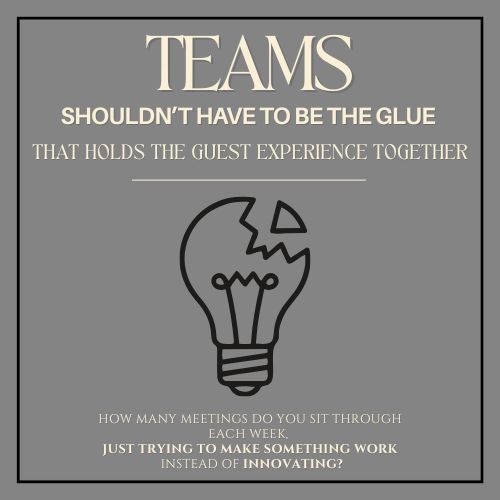
When teams become the system:
One of the clearest signs that understanding has been outsourced in hospitality, is how much work your team does to compensate for it.
In hospitality, people are constantly filling in gaps.
How many meetings have you and your team sat in just trying to make something work?
A front desk agent pieces together context from multiple screens.
A concierge double-checks details because the system doesn’t quite line up.
A manager relies on memory instead of data because it’s faster than searching.
Most of this effort is invisible to guests.
And that’s exactly the problem.
When systems don’t carry context forward, people do. They become the glue holding the experience together. Not because they’re careless or resistant to change, but because they care about getting it right.
Over time, that takes a toll.
Teams lose confidence in the tools they’re supposed to rely on.
Processes slow down in moments that should feel effortless.
Personalization depends on who happens to be on shift.
None of this shows up in a demo.
From the outside, everything looks implemented. The platforms are live. The integrations exist. The dashboards are full.
But inside the operation, understanding is fragmented. And when understanding is fragmented, responsibility becomes unclear.
So people step in.
They remember details the system doesn’t.
They ask questions the workflow skips.
They make judgment calls without full context because it's quicker then finding the info they need.
That’s not empowerment.
That’s compensation.
The strongest hospitality organizations don’t ask their teams to work around the system. They design systems that support the way teams actually work.
Systems customized to their team, and their hotel, not a one size fits all solutions that you get stuck in.
Because when understanding is owned and shared, people can focus on creating the moments that matter, instead of holding everything together by hand.
If you like this content, and want to hear me dive deeper on these topics, please subscribe to my newsletter: https://t.co/20C1qs9DLe
#Hospitality #Hotel #AI #HotelTech #HotelMarketing #Resort #Luxury #GuestExperience #EmployeeExperience
One of the most expensive mistakes I see in hospitality technology is the belief that responsibility can be outsourced.
Not intentionally.
And rarely out of negligence.
It usually shows up as optimism.
A new platform promises better personalization.
A vendor claims to “handle” data, AI, or guest insight.
A tool is purchased with the hope that outcomes will follow.
And for a while, it feels like progress.
But outcomes don’t come from tools.
They come from understanding.
Understanding your guests.
Understanding your operations.
Understanding how context should carry across systems, teams, and moments.
When that understanding lives outside the organization, progress becomes fragile. Decisions depend on vendors. Clarity depends on integrations you don’t control. And when something breaks or feels off, it’s hard to know where responsibility actually sits.
In hospitality, this shows up slowly, and builds over time.
Teams rely on systems instead of shared context.
Employees become the glue holding fragmented information together.
Guests repeat themselves more often than they should.
Personalization starts to feel performative instead of natural.
None of this is caused by bad intent or bad technology.
It’s caused by outsourcing the work of understanding.
Vendors can provide tools.
They can support execution.
They can even accelerate what’s already clear.
But they can’t own your guest relationships.
They can’t define what matters across your experience.
They can’t decide what context should persist and what shouldn’t.
That responsibility belongs to the organization.
Especially now, as AI becomes more embedded in discovery, operations, and guest engagement. AI will move quickly, but only within the boundaries of what it understands. If that understanding is fragmented or externally owned, the results will reflect that.
The organizations that get the most value from technology aren’t the ones chasing the most tools. They’re the ones that take ownership of their foundations.
They know who their guests are.
They know what information they trust.
They know how context should travel.
Everything else builds on that.
You can outsource software.
You can’t outsource understanding.
#Hospitality #Hotel #HotelTech #AI #HotelSoftware #EmployeeExperience #GuestExperience #Resort #LuxuryResort
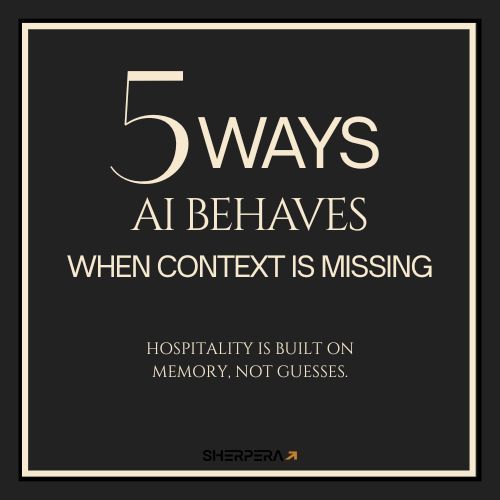
One of the most frequent frustrations we hear about AI is that it’s inconsistent. Sometimes it’s incredibly impressive. Other times, it sounds confident but still gets key moments/things wrong.
This discrepancy isn't about bad models or immature technology. It comes from a fundamental difference between how people and AI respond when information is incomplete.
Understanding that difference is essential if we want AI to support real guest experiences instead of undermining them.
1. AI doesn’t sense uncertainty
Humans slow down when something doesn’t feel complete. We hesitate, ask follow-up questions, or verify assumptions. AI doesn’t feel that hesitation. If information is missing, it doesn’t recognize the gap unless it has been explicitly designed to do so.
2. AI treats partial information as sufficient
If guest history, preferences, or context are fragmented across systems, AI doesn’t know it’s seeing only part of the picture. It assumes what it can access is the full truth and proceeds accordingly.
3. AI can’t tell the difference between “unknown” and “irrelevant”
When information isn’t visible, AI doesn’t know whether it was intentionally excluded or simply unavailable. That distinction matters in hospitality, where silence often means “we don’t know,” not “it doesn’t matter.”
4. AI resolves ambiguity instead of flagging it
Humans recognize when a decision depends on missing information. AI resolves ambiguity by making the best possible guess with what it has. The output may be polished, but the underlying understanding can still be incomplete.
5. AI doesn’t slow down when the stakes are higher
Whether the decision affects a dinner recommendation or a safety-sensitive activity, AI responds with the same confidence. Without context to signal risk or importance, it can’t adjust its behavior.
The key thing to remember is that AI isn’t human. It doesn’t reason through gaps, infer intent, or fill in missing information the way people naturally do. When the information it’s given is incomplete, outdated, or fragmented, the output will reflect that. Not because the tool is broken, but because it’s working exactly as designed.
What AI is genuinely powerful at is scale and speed. It can process large volumes of information quickly, surface patterns, and respond instantly across many moments at once. But it can only do that well when the understanding behind those responses is clear, connected, and current.
AI is a tool. A very capable one.
And like any tool, the outcome depends on how it’s guided and what it’s given to work with.
If want to hear more about this topic in-depth, follow my newsletter: https://t.co/uwiqTzwX7U
Yesterday I touched briefly on what I consider the black and white portrayal of AI.
The idea that it either works or it doesn’t. That it’s good or bad.
And how the one variable in all of this is humans. We have to know how to use the tool.
One thing that often gets overlooked when discussing the “tool” of AI is where it's understanding actually comes from.
AI doesn’t generate understanding on its own. It doesn’t comprehend context or recognize nuance the way people do. Everything it produces is based on the information it has access to and how that information is organized. It's easy to converse with it from our perspective, we reason, we contextualize etc... But it doesn't think that way. It doesn't THINK at all! Which is a huge perception change from what most people would like to believe.
So how does this relate to hospitality?
In hospitality, that information or context rarely lives in one place.
Guest history sits in one system.
Reservations in another.
That one "hospitality" software you can't seem to escape own some.
Operational knowledge in documents, inboxes, and people’s heads.
Policies and procedures spread across tools that may or may not be current.
Each of these sources exists for a reason. Individually, they can make sense.
Collectively, they create a fragmented picture. Our brains can comprehend, and band-aid this info together but AI can't
When AI is introduced into this environment, it inherits that fragmentation.
It doesn’t know which source carries more weight.
It doesn’t know what’s outdated.
It doesn’t know what’s missing.
It simply works with what it can see.
That’s why AI can sound confident while still being wrong!!!
Not because it’s malfunctioning, but because it’s operating without a complete or structured understanding of the situation it’s meant to support. It only knows what it sees.
Humans are good at navigating this kind of complexity. When something doesn’t feel right, we slow down. We ask clarifying questions. We rely on experience and judgment to fill in gaps.
AI doesn’t have that instinct.
For AI to support guest-facing engagement and internal operations in a meaningful way, it needs more than access to information. It needs clarity around how that information fits together.
What’s relevant.
What’s authoritative.
What’s historical versus situational.
What context should carry forward, and what shouldn’t.
Without that structure, AI will continue to feel inconsistent. Not because the tool is unreliable, but because its understanding is incomplete.
This is especially important in hospitality, where experience depends on shared context and continuity across teams, systems, and moments.
If we want AI to support the work rather than complicate it, we have to start by being more intentional about what we’re asking it to understand.
And understand ourselves, that we aren't talking to or working with a human.
Like any other tool AI can be extremely powerful when used in the proper way, otherwise it can just cause headaches.
If you like this content, and want to hear me dive deeper on thee topics, please subscribe to my newsletter: https://t.co/fpzqGnvl2v
#Hospitality #Hotel #Resort #AI #HotelTech #LuxuryResort #HotelMarketing #HotelSales #GuestExperience #EmployeeExperience
Had a late start to work today. I live in NY, and we got over 34 inches of snow last night. I spent a good part of my morning plowing and shoveling, and once I finally sat down with a cup of coffee, I started my usual LinkedIn scroll.
I came across a post that reminded me of something I see often in conversations about AI.
The discussion around AI tends to be very black and white.
Good or bad.
Success or failure.
When AI works, people describe it as impressive.
When it doesn’t, they describe it as unpredictable and are quick to hate on it.
What doesn’t get talked about nearly as much is everything in between.
Or the reasons why those outcomes happen in the first place.
In hospitality especially, AI often feels inconsistent not because the technology itself is unreliable, but because it’s being asked to operate without a complete understanding of the situation it’s meant to support.
AI, the information behind it, and the tools themselves are remarkably consistent.
The variable is the human.
AI doesn’t experience context the way people do. It doesn’t infer intent. It doesn’t use instinct or judgment to fill in gaps the way a person naturally would.
It depends entirely on what it can see, what it can connect, and what it’s allowed to trust.
That’s why AI isn’t really good or bad on its own.
It magnifies whatever it’s given.
When the underlying understanding is clear, AI can help teams move faster, handle more complexity, and deliver experiences that would be difficult for humans to manage alone, or would take them a lot of time.
When that understanding is fragmented or incomplete, AI doesn’t correct for it. It amplifies it.
The gaps become more visible.
The mistakes become more obvious.
And those moments are usually what get shared and criticized.
"See, I told you AI is unreliable or bad!"
Instead of realizing that the negative outcome of this use was possibly relating to that own person's error in use.
What’s important to recognize is that AI isn’t reasoning through uncertainty the way a person would. It isn’t slowing down to ask clarifying questions or applying common sense to fill in missing context.
It’s operating exactly as designed.
When used correctly it can magnify a person's strengths, talents, and uniqueness!
When use incorrectly though, you get those mistakes that people love to jump to LinkedIn to post about.
This week, I want to spend some time unpacking what AI actually needs in order to work well in hospitality, and why so many frustrations trace back to human understanding, not machine failure.
Because AI doesn’t just change how work gets done. It reveals how clearly we understand the world we’re asking it to operate in.
#Hospitality #Hotel #AI #HotelTech #HotelMarketing #Resort #Luxury #GuestExperience #EmployeeExperience
I took this picture while walking along the San Antonio River Walk.
It’s a place where history and modern life don’t compete with each other.
The river has been here long before the city grew up around it, shaping how people gathered, moved, and lived. Over time, the city evolved. It became busier, louder, more dynamic.
The river stayed.
Today, it cuts through a very modern, energetic city. Restaurants, hotels, music, and movement surround it. The river carries the memory of the place while allowing everything around it to evolve.
What I’ve always found compelling about the River Walk is how natural that continuity feels.
You don’t need signs to explain it.
You don’t need instructions to enjoy it.
You don’t need to understand its history to feel its presence.
That’s a lesson hospitality can learn from.
The most memorable experiences don’t come from constant reinvention. They come from knowing what should persist as other things evolve.
When the underlying structure carries history and context, guests don’t have to orient themselves or fill in gaps. They can just be present.
A great representation of how the history and foundation of a place can flow strongly through a brand, while the world modernizes and grows around it.
In places like this, it comes from flow.
From continuity.
From foundations that don’t interrupt the moment.
And moments that support, honor and grow around the foundation, rather than destroy it.
#Hotel #Hospitality #Resort #Experience #LuxuryResort #LuxuryHospitlaity #HotelTech #GuestExperience
One of the hardest things to build in hospitality is memory.
Not individual memory.
Organizational memory.
Historical memory.
The ability for a place to understand who a guest is, what they value, and how they’ve engaged over time without needing to start from scratch at every interaction.
Most organizations assume this breaks down at the front line.
In practice, it usually breaks down much earlier.
When guest data lives in separate systems, no single view ever feels complete. Each tool holds a piece of the story, but none of them own it end to end.
So people compensate.
Employees rely on notes, handoffs, and personal recall to bridge gaps. Guests repeat themselves, not because they expect perfection, but because they’ve learned continuity isn’t guaranteed.
Over time, this erodes confidence on both sides.
What’s often missed is that this isn’t a volume or personalization problem. It’s an ownership problem.
When guest identity and history are effectively owned by vendors instead of the resort, memory becomes fragmented by design. Context is trapped inside tools that weren’t built to share it freely.
That makes continuity fragile.
True organizational memory only emerges when there’s a unified, historical understanding of each guest that persists across stays, outlets, and interactions.
Not a snapshot of that guest and their current stay.
A timeline of them, and their entire history with your hotel.
When that foundation exists, employees stop reconstructing context.
Guests stop reintroducing themselves, over, and over, and over again.
And technology starts holding the answers to employee's questions.
One unified location where ALL their answers reside.
The most personalized, and longest lasting moments are usually the smallest ones.
I checked into a hotel recently where nothing stood out.
There was no small talk about systems.
No explaining what I had already entered online.
No moment where I felt like I needed to help connect the dots.
The person at the desk didn’t hesitate. They didn’t bounce between screens or ask clarifying questions that suggested something hadn’t lined up.
They already knew why I was there.
They knew if I had, or haven't stayed with them before.
The interaction was brief, unremarkable, and easy.
What struck me later is how often guests end up filling in the gaps instead.
We repeat details.
We clarify preferences.
We answer questions the system should already be able to answer.
Not because anyone is doing a poor job, but because the experience relies on the guest to be the glue between disconnected tools.
When that happens, the work shifts outward.
Employees compensate by double-checking.
Guests compensate by explaining.
The experience still functions, but it carries friction that shouldn’t be there.
The best experiences don’t ask anyone to compensate.
They don’t feel optimized or impressive.
They feel complete.
I’ve been reflecting on how much of hospitality "experience" should really be about removing the need for guests and teams to bridge those gaps themselves.
#Hotel #Resort #Hospitality #LuxuryHospitality #LuxuryResort #ResortMarketing #HotelTech #AI
As we head into a new year, I’ve been thinking a lot about why I do the work I do.
I’ve spent most of my career focused on experiences. How they’re designed. How they’re felt. How small moments add up to something people remember long after they’ve left.
But the experiences that shape us most don’t happen at work.
They happen on the quiet walks, the shared trips, the everyday moments with the people who know us best.
Most of my moments have happened with my wife, my partner of almost 35 years.
Forever happy to have her by my side, and to have her be my inspiration for continuing to create moments for others.
Grateful for the year behind us, excited for the one ahead, and especially thankful for the people who make the journey worth it.
#Hospitality #Hotel #Unforgettable #GuestExperience #EmployeeExperience #Resort #LuxuryResort #LuxuryHospitality
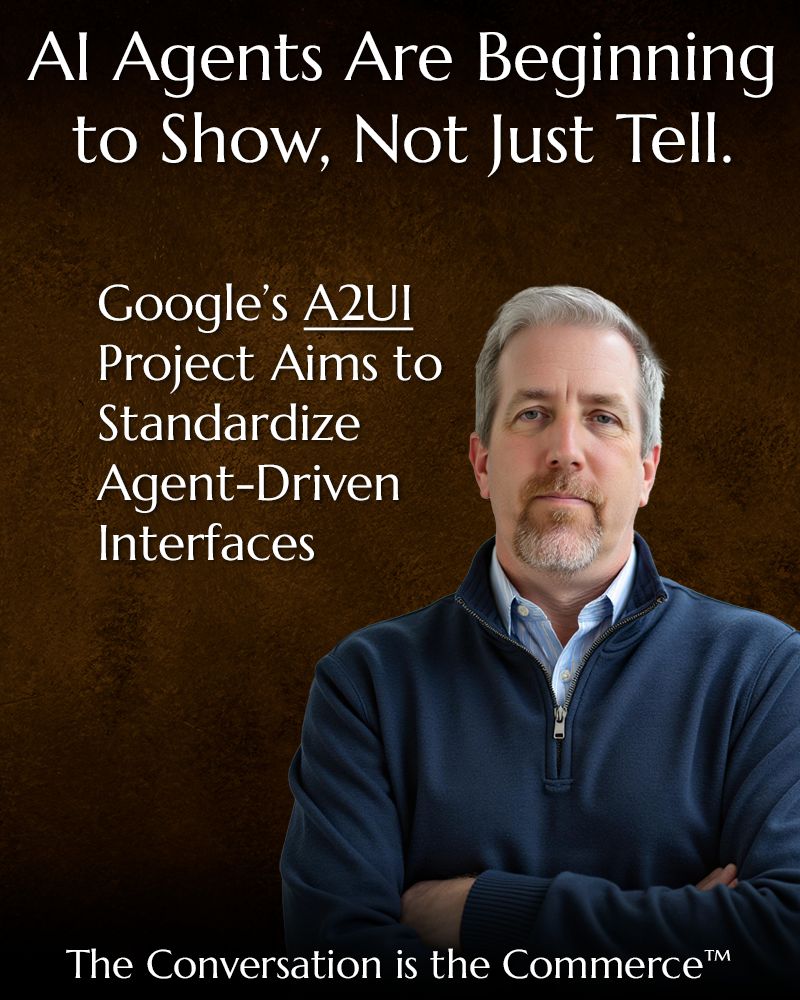
Earlier this week, I shared a short post about Google’s move toward AI-generated visual interfaces and what that could mean for hospitality.
At the time, I kept it brief. But given the announcement Google made shortly after at NRF around its Universal Commerce Protocol, I want to slow down and talk more thoughtfully about what’s actually happening here and why it matters.
Google is formalizing a future where discovery, decision, and transaction all happen inside a conversation. This is all taking place inside an AI-mediated experience that can understand intent, present options, and complete a purchase without sending the user somewhere else.
In other words, conversational commerce is no longer theoretical. It’s being wired directly into the world’s largest discovery platform.
What’s important to understand is that this doesn’t change what guests want. It changes how they get there.
Guests have always wanted clarity. Confidence. Relevance. Ease.
What’s changing is the interface.
Instead of searching, clicking, comparing, and navigating multiple sites, guests increasingly ask a question. They refine it. They react to what they’re shown. And they decide.
That entire journey is collapsing into a single interaction.
Google’s announcement makes that explicit. AI agents won’t just surface answers. They’ll be expected to act. To present options visually. To understand availability and pricing. To complete transactions on the guest’s behalf.
And here’s the part that matters most for resorts.
AI can only represent what it can understand and access.
If your resort’s information isn’t structured clearly, consistently, and in a way machines can trust, you won’t just rank lower. You won’t meaningfully participate in the conversation at all.
This is why conversational commerce isn’t a marketing problem. And it’s not a channel problem.
It’s a foundation problem.
Many resorts still rely on systems that were designed for static websites and fixed journeys. Information is scattered across platforms. Guest history is fragmented. Availability, policies, and experiences live behind interfaces that weren’t built to be accessed conversationally.
When that’s the case, AI hesitates.
And when AI hesitates, it defaults to sources that don’t.
This is why OTAs are often represented more confidently inside conversational discovery today. Not because they’re better brands, but because their data is structured, consistent, and accessible in ways AI systems can work with.
The implication for hospitality isn’t that every resort needs to rush toward the same tools Google is enabling. The implication is that the underlying readiness gap is being exposed.
Conversational commerce doesn’t reward creativity alone. It rewards clarity.
Clarity of offerings.
Clarity of availability.
Clarity of policies.
Clarity of context.
And over time, clarity of guest understanding.
This is also where I think a lot of the conversation gets slightly misframed.
This shift isn’t about speed for the sake of speed. It’s about confidence.
When an AI system presents your resort as an option, it’s vouching for you. When it completes a transaction, it’s taking responsibility for that recommendation.
That only happens when the system can trust the information it’s working with.
Which brings us back to foundations.
Resorts that will perform well in this next phase aren’t chasing conversational interfaces. They’re investing in structured data, unified information layers, and architectures that allow guest context and inventory to be exposed cleanly and responsibly.
They’re separating data from rigid platforms. They’re designing for composability. They’re preparing for change rather than betting on a single solution.
Google’s announcement doesn’t create urgency out of nowhere. It confirms a direction that’s been forming for a while.
Discovery is becoming conversational.
Commerce is becoming conversational.
And confidence is becoming the differentiator.
This is exactly why we started talking about these shifts earlier in the week. Not to be early for the sake of being early, but to focus on the parts that actually matter once the headlines fade.
The interface will keep changing.
The question for hospitality is whether the foundation underneath is ready to support it.
Conversational commerce has been, and continues to reshape how guests discover, compare, and choose resorts.
This isn’t just about chat interfaces or automation. It’s about how well your systems can support intent-driven discovery and decision-making inside AI-powered conversations.
The resorts that will continue to perform well during this evolution aren’t chasing tools. They’re focusing on foundations: structured data, clear ownership of information, and systems that can adapt as interfaces change.
This carousel breaks down 4 reasons preparation matters now.
If AI can’t confidently answer on your behalf, it sends the guest elsewhere.
I always find these shifts are easier to understand when I can tie them back to something I’ve experienced directly. So today I wanted to share a quick story.
About ten months ago, I started working with a resort group that came to me with a clear objective.
They wanted to take real steps toward automating and modernizing the technology across their four resorts. Operational efficiency was the priority.
Alongside that, they mentioned something else. A slow, steady dip in sales that they couldn’t quite explain.
Leads were consistent.
Marketing activity hadn’t changed.
Ad spend was stable.
On paper, nothing looked wrong. But the numbers were drifting.
We spent the early months doing the unglamorous work. Reworking operational systems. Cleaning up data. Aligning how information flowed across properties and departments. Building a %100 customized foundation that could actually support where they wanted to go.
Conversational commerce wasn’t the immediate focus.
But as we went, we also addressed how their resort showed up when guests started asking questions inside AI. How information was structured. How clearly intent could be understood. Whether an agent could confidently answer, compare, and guide a guest without sending them elsewhere.
Schema. Structured data. Clear signals. Consistent answers.
Making the resort legible to the systems guests are increasingly using to plan and book.
What surprised them wasn’t that things improved.
It was where they improved first.
Before any major changes to their marketing strategy. Before new campaigns. Before big guest-facing initiatives.
They saw a noticeable shift in sales and revenue tied directly to those conversational commerce improvements.
Same demand. Same guests.
Different outcome.
When your resort is properly represented, can be trusted by AI, guides the guest, and surfaces the right options at the right moment, friction drops out of the journey, and your resorts visibility is transformational.
This is the part many resorts miss.
Conversational commerce isn’t a shiny add-on. It’s becoming part of the booking surface itself. And if your data isn’t structured, connected, and trustworthy, the conversation moves on without you. Or your resort isn't even shown as an option.
Not because your resort isn’t great.
But because it wasn't chosen as an answer.
That’s why this work matters now. Even when it’s not the original priority.
The infrastructure for AI to generate visual interfaces on the fly is being built right now. Here's what that means for hospitality.
Instead of a clunky ack-and-forth conversation to book a spa appointment, imagine the agent presenting a visual interface.
Photos. Pricing. Available time slots. A "Book Now" button.
One interaction. Done.
But here's the thing: the agent can only show what it has access to.
Rich, structured data? Compelling visual presentation.
No structured data? A text summary while your competitor gets the photo carousel.
Same AI. Same guest. Different outcome.
Your data strategy just got more important.
If you want to learn more read the article here: https://t.co/W93BppJG3A
To subscribe to my weekly newsletter: https://t.co/EKFYhbkRJJ
When every improvement depends on stitching systems and information together, progress slows no matter how good the team is.
That’s not an execution issue. It’s architectural. How does this affect you and how do you fix this?
Here’s how that architecture shows up in day to day life.
Teams spend more time coordinating than creating.
Guest context gets lost between departments.
Personalization resets instead of building.
Decisions take longer because no one fully trusts what they’re seeing.
From the outside, it can look like complexity. Inside, it feels like constant compensation. Smart people doing the right things, but working harder than they should to deliver the same outcomes.
Over time, this becomes normal.
Workarounds feel responsible.
Extra meetings feel necessary.
Manual checks feel like good leadership.
But what’s really happening is that people are compensating for systems that were never designed to share context cleanly. Guest history lives in fragments. Each platform knows something, but no one sees the whole picture.
That fragmentation limits more than efficiency.
It limits growth, because every new initiative depends on someone else’s roadmap.
It limits personalization, because the guest exists in pieces instead of as a whole.
It limits innovation, because teams are constrained by what the architecture will allow, not what the experience requires.
So how do you actually fix this?
Not by buying another “one-size-fits-all” platform that promises to solve everything.
That approach is often what created the problem.
These platforms tend to work well for a narrow set of use cases, but they do so by owning your data, defining your workflows, and locking your future into their interpretation of hospitality. Over time, data gets trapped, integrations become brittle, and progress slows again.
The real work starts by freeing your data.
That means separating guest information from the applications that currently hold it. Reservations, dining, spa, golf, group sales, marketing, loyalty. All of that data already exists, but it lives across systems that weren’t designed to persist context or share history.
Freeing your data doesn’t mean ripping everything out. It means creating a resort-owned central layer where guest identity, history, and preferences can be unified and governed on your terms.
"Composable"
This is what a true universal picture of the guest looks like.
Not a single profile built for marketing.
Not a record limited to one department.
But a shared, evolving understanding of who the guest is:
-How long they’ve been coming
-How they engage across the property
-What they value over time.
When that foundation exists, everything else gets easier.
Personalization becomes consistent because it’s grounded in shared history.
New experiences can scale without starting from scratch.
Teams operate with confidence instead of reconciliation.
Innovation stops feeling fragile.
You’re no longer stitching systems together at the edges. You’re building on a core that already understands the guest.
That’s the difference between managing complexity and outgrowing it.
Not by chasing the next promise, but by building a foundation that can actually support where you want to go.
If you like the way I think about hospitality, and want to hear more; Subscribe to my newsletter where I explore topics like this more deeply: https://t.co/WOgOICJwDM
For a long time now, I’ve been using the phrase “a universal picture of the guest.”
I realize that can sound abstract, so I want to explain what I actually mean by it.
A universal picture of the guest is not a single system.
It’s not a dashboard.
And it’s not a marketing profile.
It’s the ability for a resort to recognize a guest consistently across every touchpoint, every department, and every stay, using the same underlying understanding of who that person is and the history they bring with them.
That picture includes: how long they’ve been a guest, how often they return, the room types they prefer, restaurants they frequent, spa or golf experiences they’ve booked, group events they’ve hosted, and the preferences they’ve shared over time.
Most resorts don’t have this today.
Instead, they have fragments.
Reservations know one version of the guest.
Marketing knows another.
Spa, golf, dining, group sales, and operations each hold pieces of the story. None of them are wrong. They’re just disconnected.
That disconnect is where friction is born.
When teams don’t share context, guests repeat themselves. Experiences reset instead of building. Long-time guests are treated like first-time visitors, and preferences expressed in one area never show up in another.
Over time, people adapt.
Workarounds become routine.
Manual checks feel responsible.
Teams compensate for gaps that shouldn’t exist.
This is why universal data isn’t about more data. It’s about shared, trusted information that flows where it’s needed, without forcing people to reconcile or guess.
When a resort has a true universal picture of the guest, a few things change.
Experiences stop feeling episodic.
Past stays matter. Preferences carry forward. Interactions build instead of restart.
Teams gain confidence.
They trust what they see and focus on care instead of coordination.
Personalization becomes natural, because the information is already there.
And this matters far beyond AI.
AI just exposes the gaps faster.
Every future initiative depends on the same foundation. Personalization. Automation. New guest journeys. Operational efficiency. Growth across properties.
If guest data isn’t owned, connected, and governed by the resort, progress slows and innovation narrows.
I’ve seen this pattern across industries for decades. The organizations that move forward aren’t chasing tools. They’re investing in foundations.
A universal picture of the guest isn’t about perfection. It’s about alignment.
When it exists, guests don’t have to think.
Teams don’t have to compensate.
And the experience finally feels whole.
That’s when hospitality does what it’s meant to do.