Podcast by father and son exploring 8 bit gaming technology. Featuring Boulder Dash and yours truly.
Reaction playthru and interview at https://t.co/aGXCr3xo8u ;
Full interview at https://t.co/GzHLsD6HzE;
Full episode at https://t.co/sHZrfKg8O5
@keenanisalive Let S=0 be the eqn of the projected silhouette. If P is silhouette plane and Q is the cutting plane, let L=0 be the projection of P intersect Q. Then the eqn of the projected ellipse E is S+kL^2=0 for some k. E and S are in double contact. You still have to solve for k.
@TimBrzezinski@geogebra This is due to the converse of Pascal's theorem. Opposite sides of a hexagon are parallel and meet on the line at infinity. So the vertices of the hexagon lie on a conic. https://t.co/wsHfjAPert
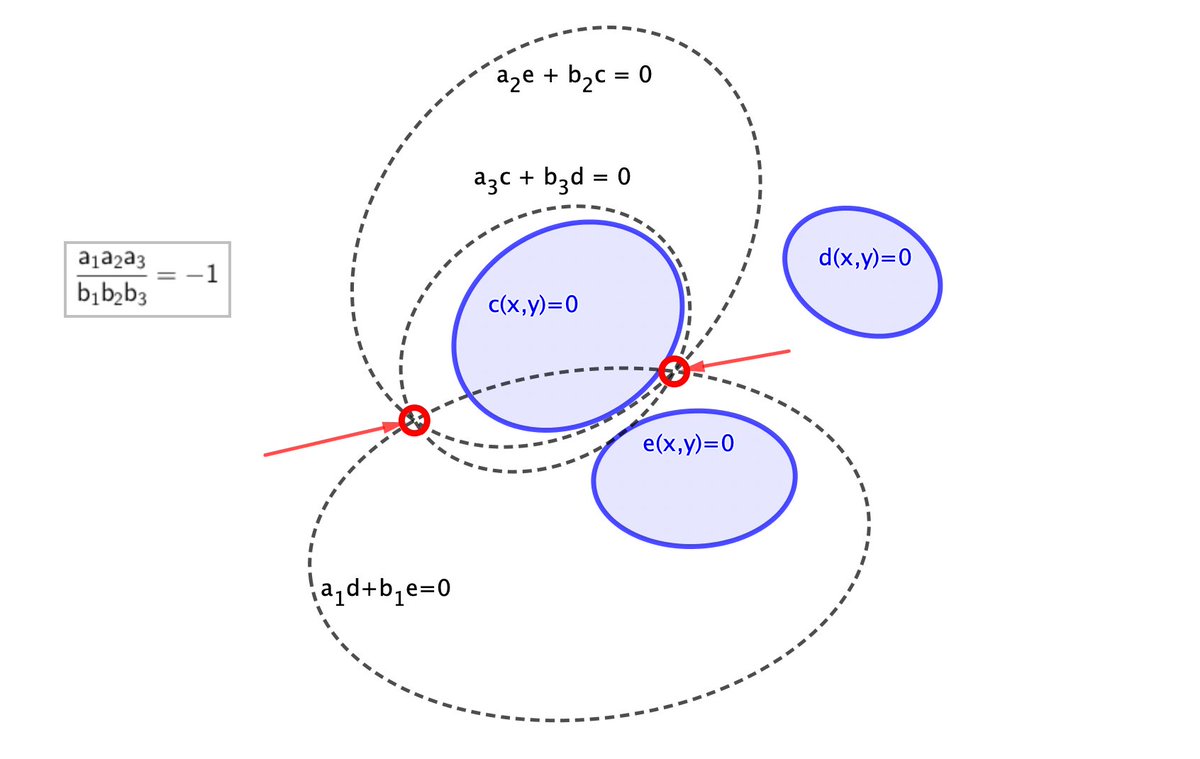
2/ (Actually, they intersect at 4 points, two of which are complex.) This is a generalization for conics of Menalaus' and Ceva's Theorems, which concern points and lines.
1/ For 3 (blue) conics c(x,y)=0, d(x,y)=0, and e(x,y)=0,
their weighted combinations (black, dashed lines)
c'(x,y)=a₁d+b₁e=0
d'(x,y)=a₂e+b₂c=0
e'(x,y)=a₃c+b₃d=0
are also conics.
If a₁a₂a₃ = -b₁b₂b₃ then c',d',e' are concurrent - they intersect at two points.
@MatthewArcus@theAlbertChern Yes, using the dual version of Carnot works - I think it's more or less a one line proof. See Hatton, https://t.co/q0fqajgWM4, especially sin() formula on pg 188.
@MatthewArcus@theAlbertChern Using Carnot's Theorem for Conics and Steiner's Ratio Theorem you can show that the rays are tangent to a conic, and concurrence follows from that. The intersections of the rays with the triangle sides lie on a conic as well.
@ilarrosac@Rodrigo16294896@GallinPeter Use search terms "mixtilinear", "incenter" to find many more sources, including wikipedia and mathworld articles.
@ilarrosac@Rodrigo16294896@GallinPeter According to Yiu, L. Bankoff coined the term "mixtilinear" to describe these circles in Crux Mathematicorum v9(1983) pg 2-7. On pg 4 he shows that the incenter is the midpoint of the contact chord.
https://t.co/0qi7ayMXUZ
@MatthewArcus From the same book https://t.co/unpMo3dGxS: pgs 198-199 discuss how a conic determines an involution on a line, real vs imaginary double points, etc. The same author wrote another treatise titled "The Theory of the Imaginary in Geometry"
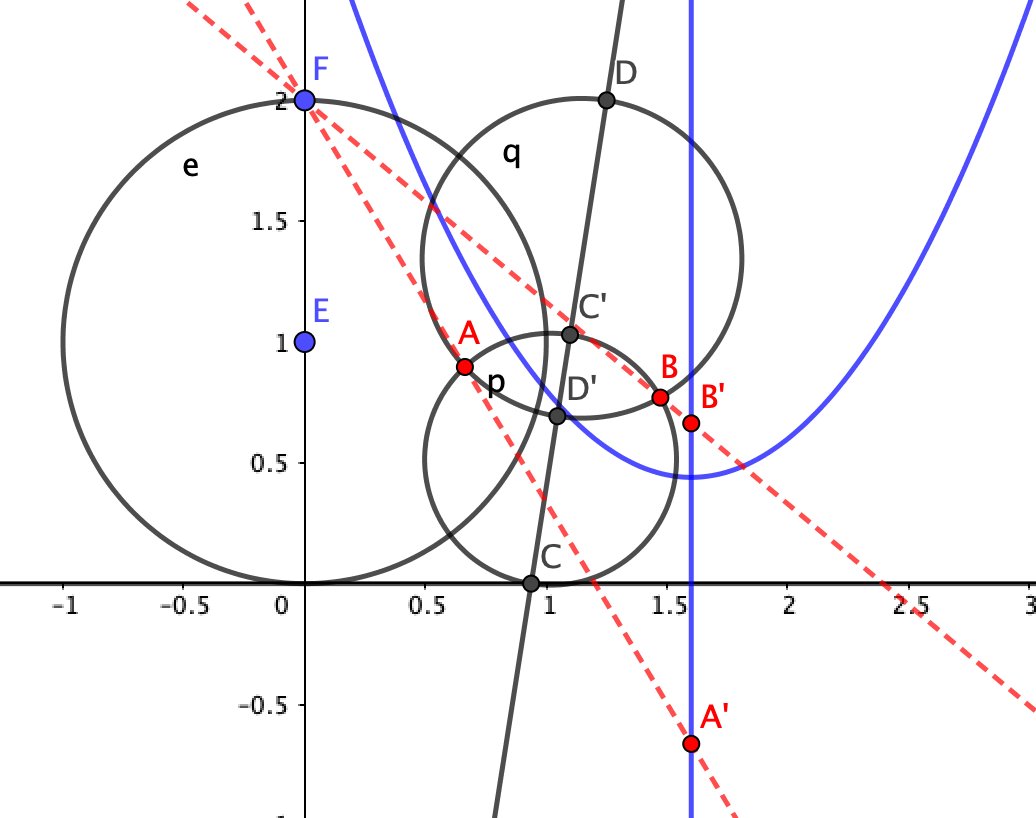
@MatthewArcus A bit tough to explain a tweet, but when there is no intersection the involution has "imaginary" fixed/double points A and B. See figure at bottom of pg 95 of https://t.co/Ar1epCPElz. In figure below, the involution is defined by CC' and DD' and A,B project to roots A',B'
@MatthewArcus Using the setup at https://t.co/2r47pREt5A, in the complex case the roots are the intersection of the lines FA,FB with the axis of the parabola. Let me know if you want more detail, or a geogebra demo.
@MatthewArcus Yes. The construction you gave breaks down when the roots become complex, because the line no longer intersects the circle. If you're familiar with the involution induced on a line by a conic, the points of intersection can be replaced by the fixed points of the involution.