🇺🇸 Dear U.S. Leaders 🇺🇸
We owe it to the firefighters, police officers, and EMS personnel who sacrificed their lives on 9/11 and to every first responder who puts their life on the line today to provide the most capable and resilient emergency communications network possible.
FirstNet was born from the lessons of 9/11, with a mission to ensure that communications failures never again cost lives when every second matters.
Today, AT&T and AST SpaceMobile are working to take that mission to the next level, bringing space-based broadband connectivity directly to ordinary mobile devices, from the most remote corners of America to major cities where terrestrial networks may be disabled by disasters or emergencies.
I call on our elected officials to do everything within their authority to support and accelerate the deployment of this critical satellite infrastructure.
This is about more than technology. It's about honoring the heroes of 9/11, protecting those who protect us, and ensuring that when disaster strikes, no first responder and no American in need is left without a lifeline.
Our first responders deserve nothing less. 🇺🇸
@FirstNet@ATT@AST_SpaceMobile@FCC@SenatorFischer@SenatorLujan@SenTedCruz@SenatorCantwell@RepHudsonNC@AbelAvellan@scottwisniews
$ASTS - I’ve owned AST for 4 years.
Market turmoil like this forces you to question your thesis, recheck your DD, and ask the hard question:
"Am I wrong?"
I went back through it all.
Conclusion: The thesis is stronger than ever. So is my conviction.
Know what you own.
$ASTS $T: @ATT to Webcast Fireside Chat with John Stankey at the @UBS Global Media and Communications Conference on Dec. 8
Fireside chat begins at 8:15 a.m. ET and will be available live and for replay on the AT&T Investor Relations website
https://t.co/LxfmnkGIPv
$ASTS: Our rock star head of regulatory, Jennifer Manner, might have decent connections at the NTIA to inform her view of a prompt grant 😁
Jennifer Manner served as Senior Advisor for Space and Satellite Policy at the National Telecommunications and Information Administration (NTIA) beginning in 2024. She worked within NTIA's Office of Spectrum Management, advising on satellite communications and spectrum policy.
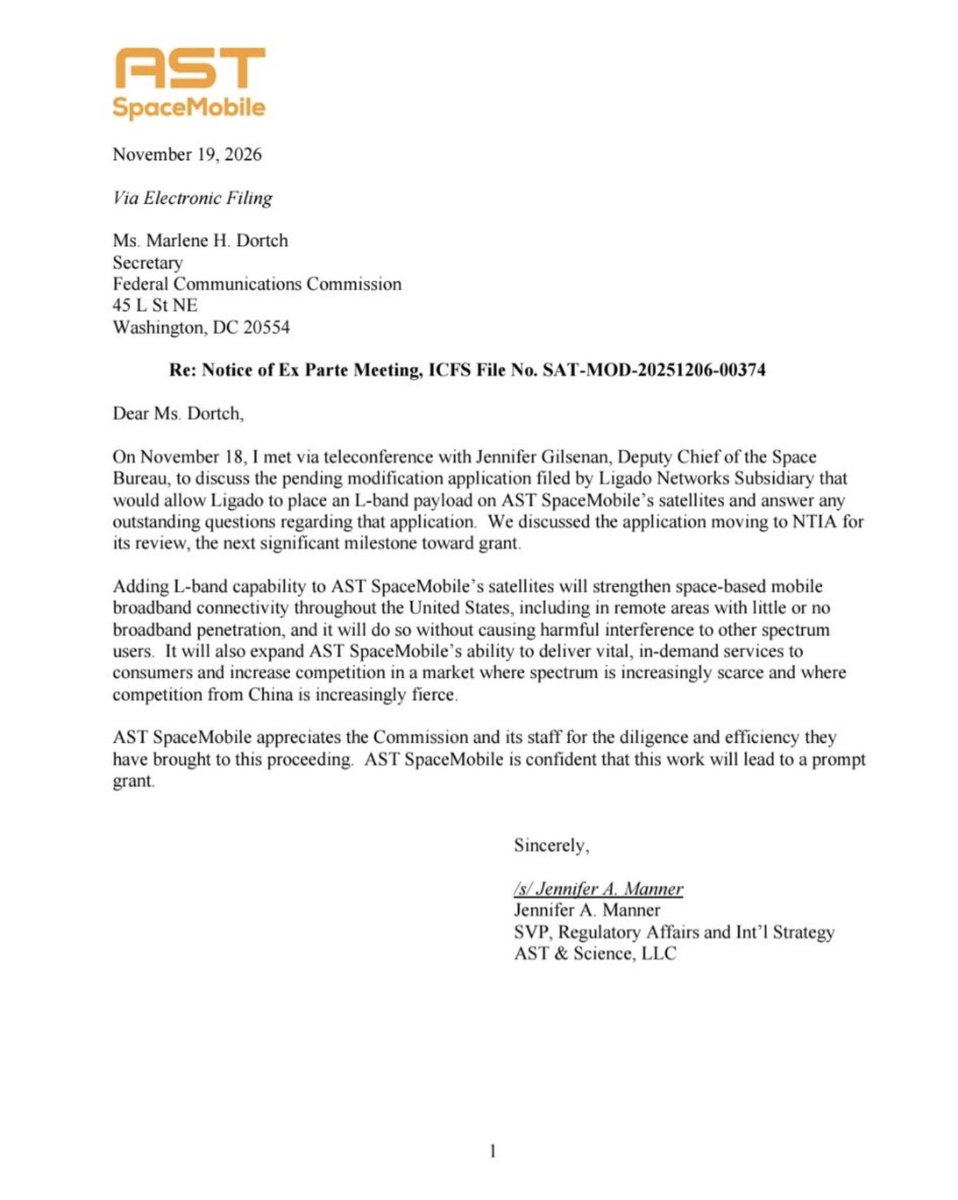
$ASTS: 🚨 FCC IN FINAL STAGES OF REVIEW FOR LIGADO MODIFICATION APPROVAL
In an FCC ex parte filed today, AST SpaceMobile revealed that it met yesterday w/ Jennifer Gilsenan, Deputy Chief of the FCC Space Bureau, to discuss moving its Ligado L-band application to NTIA review, described as “the next significant milestone toward grant.” This suggests the application is advancing through the FCC’s review process and approaching the final stages of regulatory coordination.
Even more bullish is the language from AST’s SVP of Regulatory Affairs, Jennifer Manner: “AST SpaceMobile is confident that this work will lead to a prompt grant.” Very confident statement to put on the public record following a meeting w/ senior FCC leadership.
Stay Focused™️
On the eve of the 70th anniversary of the establishment of diplomatic relations between the Republic of Bulgaria and the Grand Duchy of Luxembourg, ESM Managing Director @pierregramegna honoured to receive Galab Donev, Deputy Prime Minister and Minister of Finance of the Republic of Bulgaria alongside His Majesty King Simeon II, the last King of Bulgaria and former Bulgarian Prime Minister, at the European Stability Mechanism.
ESM Chief Financial Officer @kaanev and ESM Chief Operating Officer Yana Djoneva were pleased to join Pierre Gramgena in welcoming distinguished and fellow Bulgarian guests, Metodi Metodiev, Deputy Minister of Finance, @HristoDikanski, Deputy Minister of Foreign Affairs, Natalia Uzunova, Ambassador Extraordinary and Plenipotentiary of the Republic of Bulgaria to the Kingdom of Belgium and the Grand Duchy of Luxembourg, as well as Ambassador Henri Schumacher, Secretary General, @MFA_Lu in Luxembourg.
This evening's celebratory soirée and cultural programme were particularly meaningful in the context of Bulgaria's recent accession to the euro area and the ESM, which gives the country the backing of the euro area’s permanent financial safety net, while also giving it a seat in decisions that help safeguard financial stability across the euro area.
📷: @peterlindmark
#ESMeuro
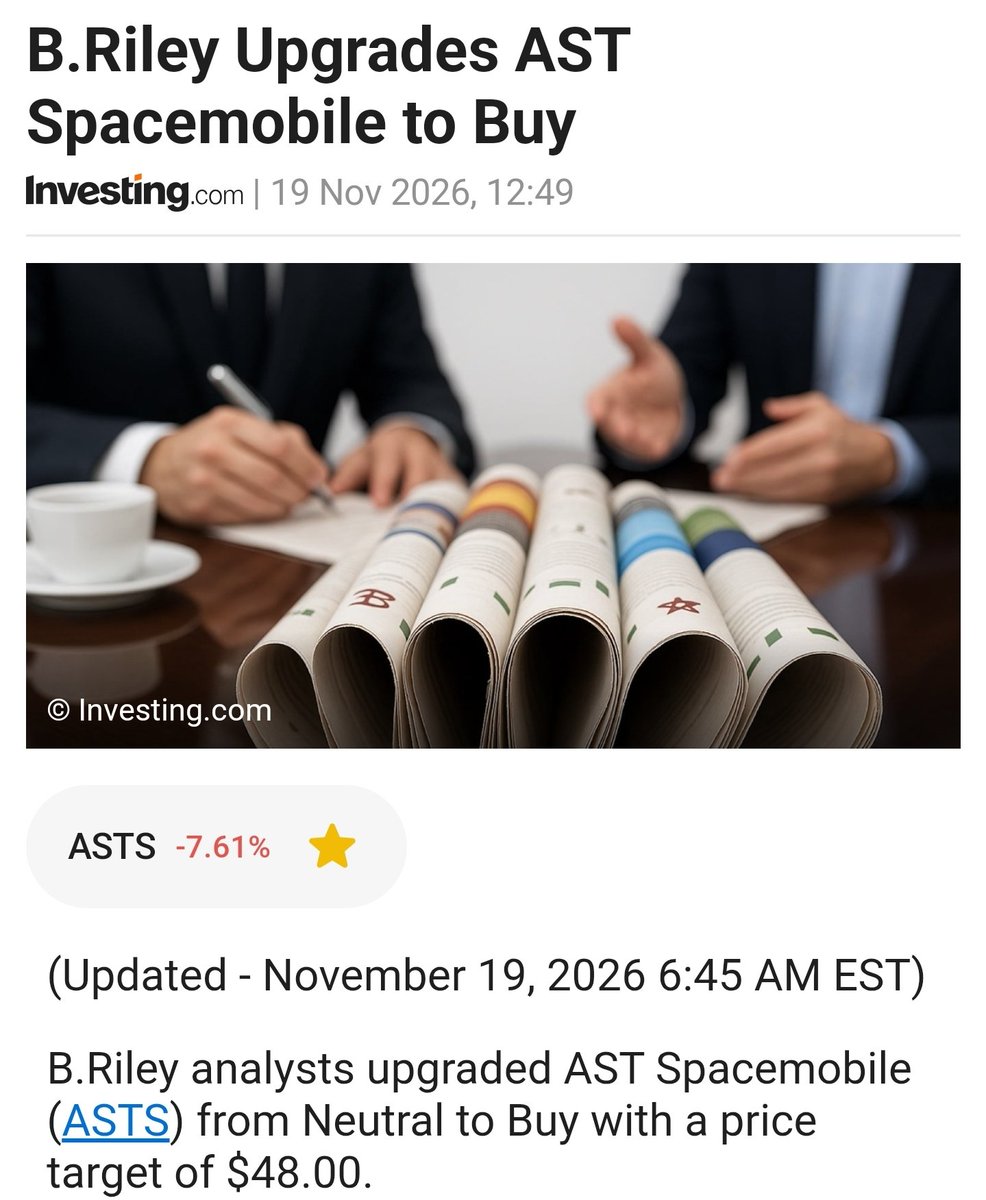
$ASTS B Riley PT $48 upgrade to BUY
B.Riley analysts upgraded AST Spacemobile (ASTS) from Neutral to Buy with a price target of $48.00.
Analysts comment "We upgrade AST SpaceMobile (ASTS) from Neutral to Buy, maintaining our $48 PT (89% above $25.49 close on 11/18). Shares are down 55% from our 10/1 downgrade at $57.04 (vs. a 3.3% decline in the ^RUT), we believe with investors now pricing in many of the capital commitment and constellation deployment fears underlying our prior action, as well as new fears regarding its rocket development partnership with Firefly Aerospace (FLY — Buy, $54 PT), as outlined in our Miranda Rights…ASTS Bets on Blacklift and ensuing Risks Abound as ASTS Embarks on Rocket Development Journey reports. We already assessed added rocket development risk in the latter report, lowering our price target from $65 to $48. With ASTS shares now at $25.49, however, we see a much improved risk-reward equation and also think investors are overlooking potential fruits of successful rocket development, not to mention other positive catalysts that could come into the picture, including: more non-dilutive sovereign funding as we’ve seen with Japan; and, potentially capital-light spectrum resource access, perhaps in conjunction with the new U.S. MNO partner JV which we believe was established to help stave off SpaceX (SPCX — Not Rated) threat. To be sure, risks remain myriad, and rockets are hard—as we’ve seen recently with both New Glenn and even United Launch Alliance’s (ULA) Vulcan, where the Boeing and Lockheed Martin JV’s’s 11/15 return-to-flight (and its 40-satellite Amazon Leo payload) ended abruptly ~10 minutes after liftoff with low booster performance, now grounded indefinitely for anomaly investigation—but our call here is that much of that risk is priced in, including after a period of rocket aspiration digestion."
$ASTS | @AST_SpaceMobile | Lourdes O. Montenegro, Head of Regulatory Affairs Europe | APSCC | ITU panel | From ITU Rules to National Licences
Lourdes, AST, which do you use? Do you use terrestrial or satellite or both? How do you approach this?
So AST, Space Mobile, actually uses a multi-spectral strategy. So our satellite constellation is highly configurable. It can use and reuse spectrum from as low as 698 Megahertz to as high as 2.5 Gigahertz.
So service links can use either IMT, low band spectrum and mid band spectrum, and also mobile satellite spectrum. So that if you look at it from a multi-spectral perspective, it's very important to have that kind of flexibility to allow operators to give that service from a multi-spectral strategy perspective. So for D2D IMT, there are already existing solutions.
There are already countries who have implemented how to license D2D. So an example in APAC, for example, you have Australia, which has already indicated that D2D operations can be accommodated within existing spectrum licensing arrangements. So an example of how, for example, the UK, they give an MNO license variation.
So our partner Vodafone gets a license variation to allow them to use 900 Megahertz for space services. So that's a very simplified approach where you actually use the existing regulation, you allow the license variation, and then you deal with the fact that for D2D services, you're using mobile devices. So then you have to look at license exemption for the mobile devices, class licenses, instead of traditional licensing for specific equipment.
So there are already national authorities who have already gone ahead of international frameworks to allow these kinds of license variations. So that's also very important. But another important thing to stress is that for mobile satellite spectrum, there is already an international framework in place that is well recognized, has a long history, and is well used, and many countries have their own national licensing frameworks as well for mobile satellite spectrum.
So for MSS, you don't need a new regulatory framework because that framework basically already exists. So in a way, if you look at it from a partnership model, it actually simplifies regulatory requirements because if the satellite operator is partnering with an MNO, in our case for example AST, the MNO partner holds the customer relationship. Traffic is routed through the MNO network.
It's landed regionally or nationally, at least the traffic. So that satisfies your security, national security requirements, customer requirements, etc. So there are already a lot of existing regulations in place and you just need to repurpose, adapt, and allow license variations.
$ASTS Many decision makers do not understand the technology behind the AST solution.
The bent-pipe design keeps all the heavy lifting on the ground inside European MNO networks.
The satellites act mainly as a relay: bent-pipe. Signals are processed and routed into mobile operator networks on the ground using standard RAN gear such as AirScale. This is the setup used by the Vodafone AST Satellite Connect Europe joint venture, which emphasizes European ground stations and operator control of data.
Nokia’s AirScale gear (and the AI-RAN upgrades already on the roadmap) is what actually processes the traffic, so sovereignty, control and the customer relationship stay with the telcos.
Ground ops sit with the MNOs on Nokia AirScale, so the data and control never leave Europe. Telcos with AirScale + AI-RAN plans should be very happy with this setup.
$ASTS | AST SpaceMobile | Satellite Connect Europe
In the near-to-medium term, through 2030, Europe is unlikely to fully manage commercial broadband Direct-to-Device services to standard smartphones without US constellations such as AST SpaceMobile. Native European capacity remains limited, IRIS² arrives later and is differently scoped, launch constraints are real, and European industrial players lack a proven operational equivalent to AST’s large-aperture BlueBird approach. This is consistent with the ESPI brief’s “borrowed bandwidth” framing.
Can Europe manage without US constellations like AST SpaceMobile?
Low probability for full commercial broadband D2D in the next several years.
Europe has solid satellite heritage (Eutelsat, SES, Hispasat) and native IoT constellations (OQ Technology, Sateliot), but commercial broadband D2D to unmodified phones is currently underpinned by American systems.
Satellite Connect Europe (SCE) — the AST SpaceMobile / Vodafone JV, further backed by Orange and Telefónica — is the leading European pathway. It relies on AST’s satellites (bent-pipe/relay architecture: data processed on the ground in MNO networks, which helps with data sovereignty). Ground stations in Europe are being built. Commercialisation targets around 2026 - 2027, subject to regulation. Trials and agreements already cover multiple countries.
Europe’s major MNOs (DT, Orange, Telefónica, Vodafone) have explored a joint bid for 2 GHz MSS spectrum. They plan European ground infrastructure and control functions but explicitly do not intend to build their own constellation; they need a satellite partner. AST (via existing SCE ties) is the most natural fit. Starlink faces stronger sovereignty objections.
Alternatives such as SES’s collaboration with Elveo (Lynk + Omnispace) or Equatys (Viasat/Space42) exist but are earlier-stage or differently scoped. Without US space infrastructure, Europe would face multi-year gaps in ubiquitous broadband-class coverage, resilience, and mass-market services. Messaging/IoT can scale sooner; full voice + broadband D2D cannot.
Managing “without” US assets would require accepting delayed or limited services, or accelerating a native programme that does not yet exist at AST’s maturity.
IRIS² realistic operational timeline
First launches: 2029, with great uncertainty due to launch constraints. Progressive operational connectivity services from 2029. Initial government services expected in 2030.
Constellation size: 348 satellites (330 LEO + 18 MEO) after the August 2026 implementation agreement, which also raised the cost to €15.6 billion. SpaceRISE (SES, Eutelsat, Hispasat) leads. Manufacturers include Airbus (early LEO platforms), Aerospacelab (majority of LEO), Thales Alenia Space (payloads), and OHB (MEO). SES has secured launches for its IRIS² MEO elements (targeting by 2030).
https://t.co/bPQlRVTFC9
They said with confidence ASTs satellites would fail. That their design was ”bad”.
I did the math on their design choices and said they would work.
I said their satellite design was wise.
👉 From first principles👈
Now they say ASTs rockets will fail. That their design is ”bad”.
Let’s now do the math on rockets.
I say again their choices are wise.
👉 From first principles👈
🧶🐈⬛
1/
$ASTS: 🚨 AST NOTIFIES FCC THAT IT PLANS TO BEGIN INTERNATIONAL SERVICE IMMINENTLY
On November 13, AST SpaceMobile formally notified the Commission that it will begin international direct-to-cell operations “imminently” with its MNO partners. More importantly, AST certifies that ALL necessary national regulatory authorizations have ALREADY been secured in the countries identified in its filing.
Cc: @CaptainScuzzy
Well, some good news. It appears we have a launch date coming soon since we have movement of Batch 3 at Astrotech.
I will say no more, but once again, the sensing capabilities of #Spacemob are the inspiration for why the US Spaceforce has selected $ASTS for the SB-AMTI program 😘
If new information comes to light that invalidates the above, I will say so. But it's looking good.