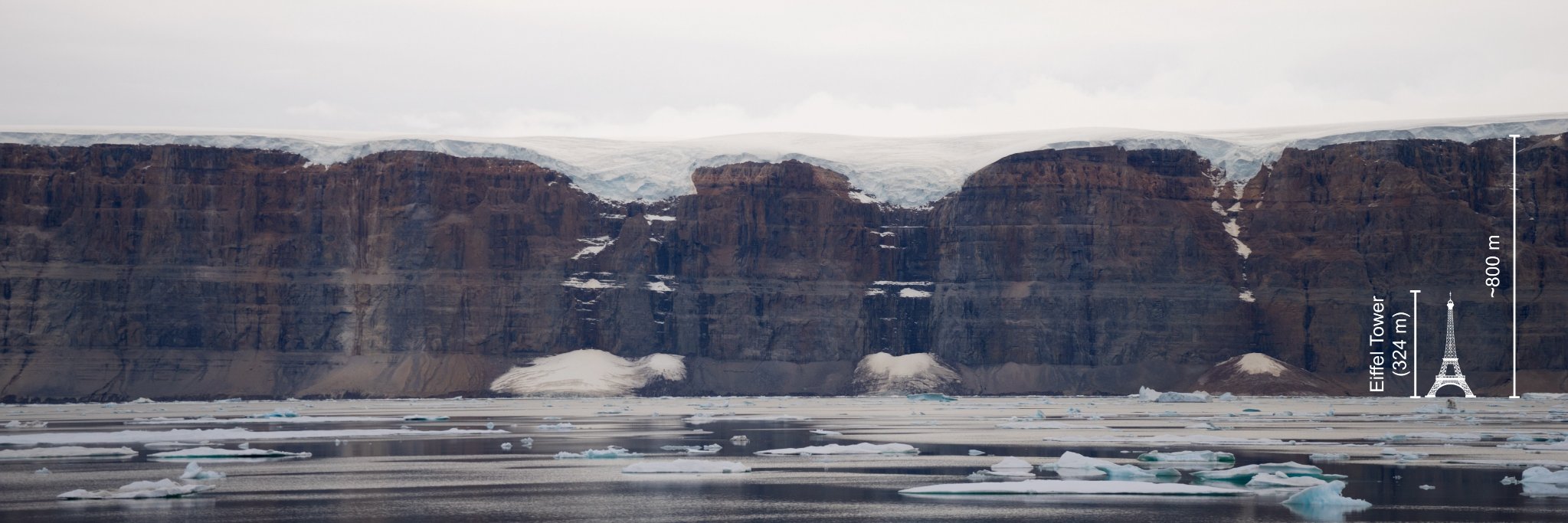
New science from the #Petermann2015 science expedition! Years of detailed analysis have allowed the reconstruction of glacier changes over thousands of years. This is crucial information for understanding current behaviour and predicting future changes.
Results keep pouring in from the #Petermann2015 expedition. This great new publication led by @Mreusche_ examines the history of the vast Petermann and Humboldt glaciers in NW Greenland. https://t.co/noUkIftnZ8
Why isn't Greenland's Petermann Glacier collapsing like Antartica's Larsen B ice shelf? A close look at the lakes that sit atop floating ice. via @AliBanwell https://t.co/7q5NF7J5XI
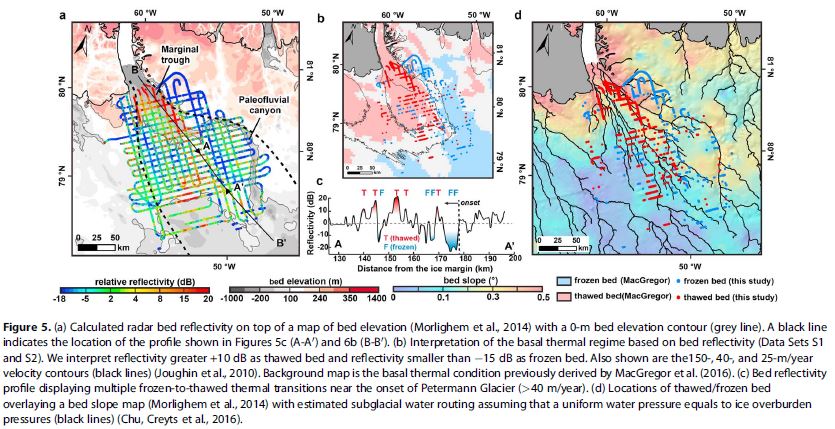
The area where ice streaming initiates at Petermann Glacier is not constrained by either geothermal features (i.e. NEGIS) or a pronounced subglacial trough (i.e. Kangerdlugssuaq). Consequently the onset zone may migrate in future as thermal conditions change.
New research from Petermann Glacier. Winnie Chu and colleagues used radar data and numerical modelling to investigate subglacial conditions at the onset of the glacier. https://t.co/T5BzsIISPq
Their results show a complex pattern of frozen and thawed bed conditions near the head of the glacier. The onset of glacier flow is controlled by both local meltwater production and lateral injection of meltwater from other areas.
Beautiful new bathymetry data from the #Petermann2015 expedition in a new paper: https://t.co/Xstd2ZyjLY. Seafloor geomorphology reveals the glacial history of Petermann Glacier. Photos: M. Jakobsson & B. Eriksson from @Stockholm_Uni
My first first author paper is out today. Big thanks to @AliBanwell and Doug. We look at the evolution of surface lakes on Petermann Glacier's floating tongue over the 2014-16 summers. @GeoSci_UChicago@scottpolar https://t.co/EI7mS9YI1o
Interesting results from Petermann Glacier being presented at #EGU18 today. Investigating how the glacier responds to massive calving events. https://t.co/OkU4vZV1J2
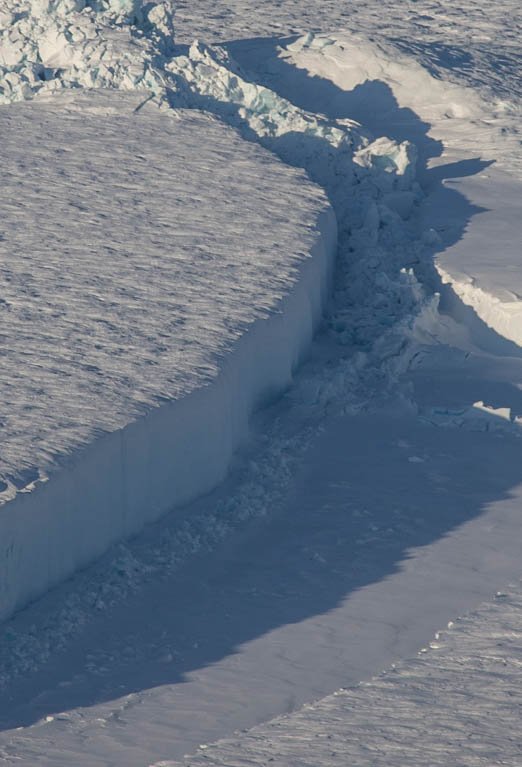
Stunning photo of the Petermann Glacier calving front by @NASA Operation IceBridge Project Scientist, Nathan Kurtz.
Best of luck in Fairbanks, #IceBridge, and keep up the good work! 🤗🤗
@PaulCarfoot The figure is adapted from Johannessen et al. (2013) Atmospheric and Oceanic Science Letters. https://t.co/qq8CLyNlhe The red line approximates the recent advance.
@PaulCarfoot Looking at only the last five years is fundamentally flawed. Petermann Glacier has a floating tongue. Glaciers like this have large but infrequent calving events and periods of slow advance between calving. The long-term trend shows the magnitude of recent retreat.
The warmth in N #Greenland is related to the synoptic low pressure system bringing large amounts of #snow to the E coast - #surfacemassbalance shows large accumulation yesterday
Meanwhile SW Greenland is in the deep freeze...
https://t.co/Ftg0fkkwJc
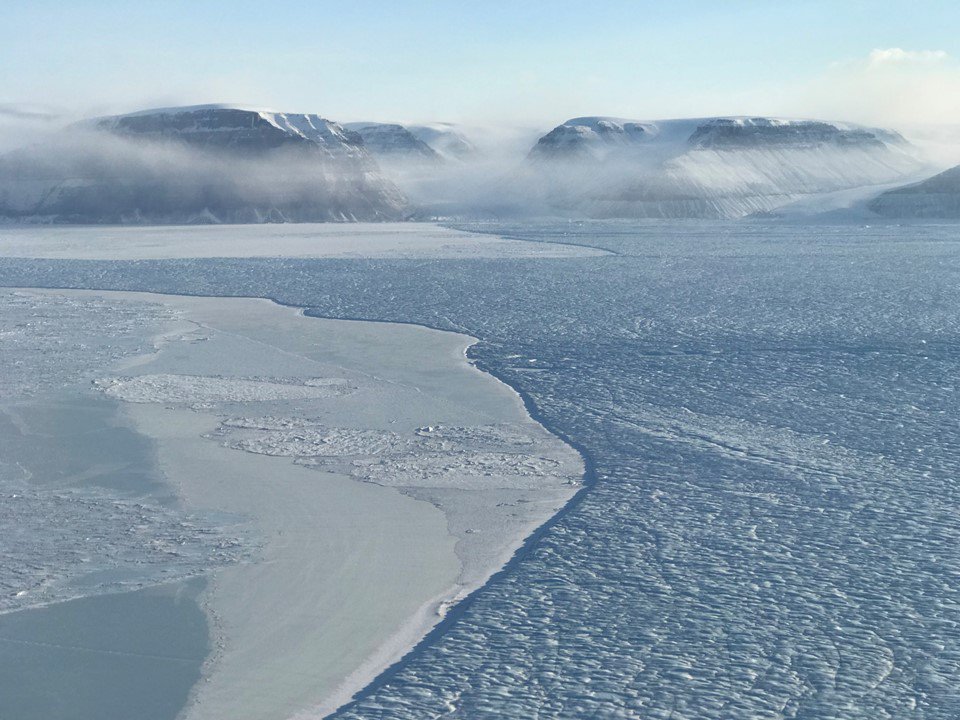
Very strange things also going on offshore northern #Greenland (close to Cape Morris Jesup - lower left). A large sea ice fracture and consequently an area of open water has formed. Offshore winds likely playing a role.
Visual from @NASANPP #VIIRS: https://t.co/v26USjGpJr
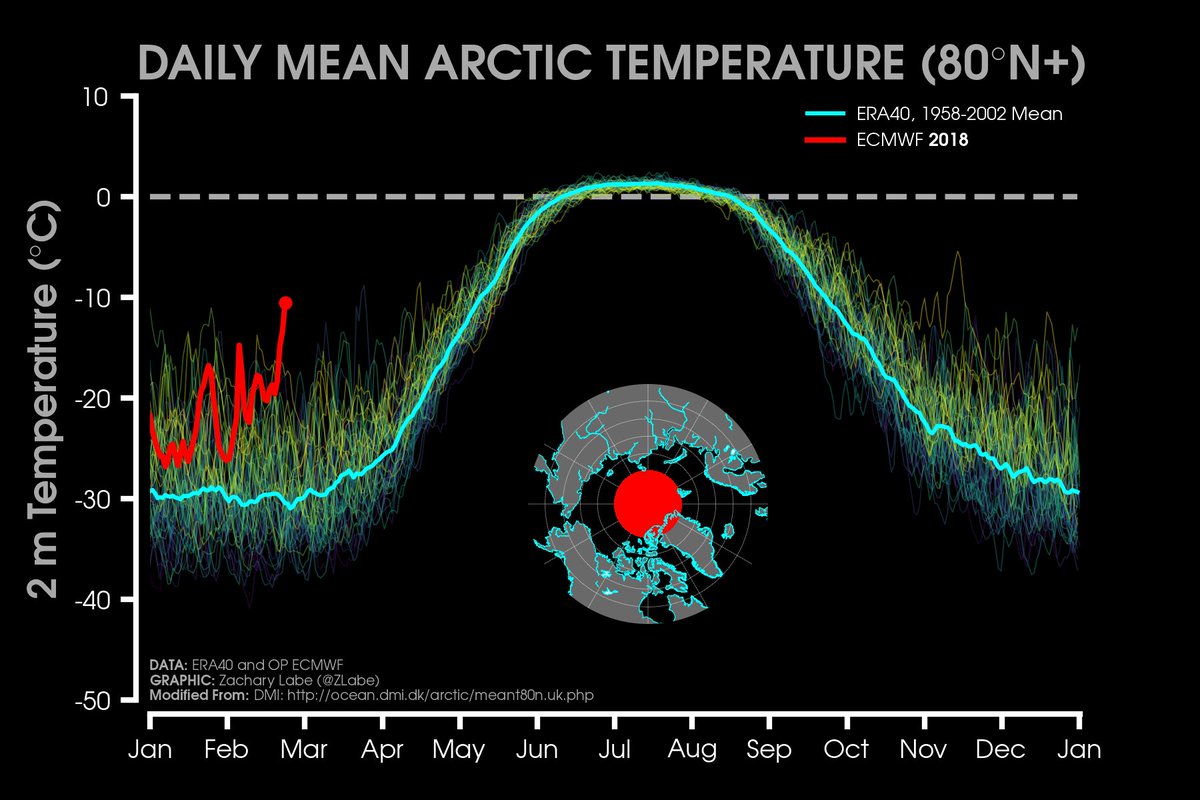
Wow... truly a remarkable event ongoing right now in the #Arctic.
Current temperatures well above previous years in February (>80°N latitude)! Average temperature is the bright blue line (https://t.co/kO5ufUWrKq).
Sea ice around Northern Greenland is highly mobile and fractured at a time of year when it is normally frozen solid. Especially interesting that Nares Strait is not blocked. https://t.co/6Rx9k2VyPq