@peternmitchell@JulianWaller Jünger's carefully composed recounting of his literal and metaphorical baptism under fire is not just one of the best military memoirs of all time. The death wrought by the Great War (of men, societies, etc.) becomes the starting point for his long journey to understand Life.
The last time (3 years ago) my wife and I tried to watch a movie on the TV, we were interrupted by our 4 y/o son hopping down the stairs saying: "Wow! What are we doing?" He then perched on the couch between us and said, "I'm a grown-up!"
We've watched movies on a laptop in our bedroom ever since.
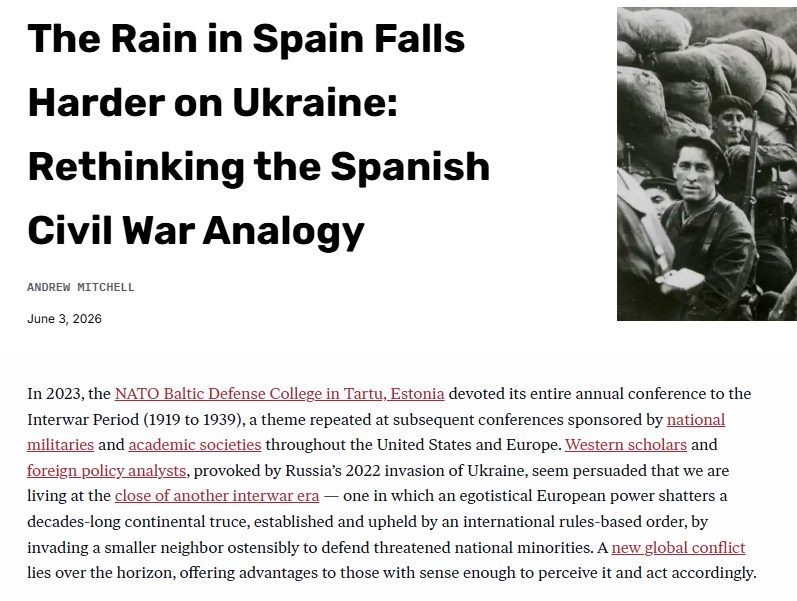
The Rain in Spain Falls Harder on Ukraine: Rethinking the Spanish Civil War Analogy
Despite the ref to Dugin (OK, my hobby horse), this from @humoredhumanist in @WarOnTheRocks is a clever warning vs shoehorning today's war into a handy historical analogy
https://t.co/Z6Jg0gfi79
Margaret Mitchell back at it with this incredible examination of the evolutionary opportunism of the apex predators of the American South:
Grandma Fontaine fanned herself with her palmetto leaf and went on briskly: "I don't approve of the match any more than you do but I'm practical and so are you. And when it comes to something that's unpleasant but can't be helped, I don't see any sense in screaming and kicking about it. That's no way to meet the ups and downs of life. I know because my family have had more than our share of ups and downs. And if we folks have a motto, it's this: 'Don't holler--smile and bide your time.' We've survived a passel of things that way, smiling and biding our time, and we've gotten to be experts at surviving. We had to be. We've always bet on the wrong horses. Run out of France with the Huguenots, run out of England with the Cavaliers, run out of Scotland with Bonnie Prince Charlie, run out of Haiti, and now licked by the Yankees. But we always turn up on top in a few years. You know why?"
She cocked her head and Scarlett thought she looked like an old, knowing parrot.
"No, I don't know, I'm sure," Scarlett answered politely. But she was heartily bored, even as she had been the day when Grandma launched on her memories of the Creek uprising.
"Well, this is the reason. We bow to the inevitable. We're not wheat, we're buckwheat! When a storm comes along it flattens ripe wheat because it's dry and can't bend with the wind. But ripe buckwheat's got sap in it and it bends. And when the wind has passed, it springs up almost as straight and strong as before. We aren't a stiff-necked tribe. We're mighty limber when a hard wind's blowing, because we know it pays to be limber. When trouble comes we bow to the inevitable without any mouthing, and we work and we smile and we bide our time. And we play along with lesser folks and we take what we can get from them. And when we're strong enough, we kick the folks whose necks we've climbed over. That, my child, is the secret of the survival." And after a pause, she added: "I pass it on to you."
The old lady cackled, as if she were amused by her words, despite the venom in them. She looked as if she expected some comment from Scarlett but the words had made little sense to her and she could
think of nothing to say.
Excerpt: "To overcome the fear of death is at once to overcome every other terror, for they all have meaning only in relation to this fundamental problem. The forest passage is, therefore, above all a passage through death. The path leads to the brink of death itself—indeed, if necessary, it passes through it. When the line is successfully crossed, the forest as a place of life is revealed in all its preternatural fullness. The superabundance of the world lies before us. Every authentic spiritual guidance is related to this truth—it knows how to bring man to the point where he recognizes the reality. This is most evident where the teaching and the example are united: when the conqueror of fear enters the kingdom of death, as we see Christ, the highest benefactor, doing. With its death, the grain of wheat brought forth not a thousand fruits, but fruits without number. The superabundance of the world was touched, which every generative act is related to as a symbol of time, and of time’s defeat. In its train followed not only the martyrs, who were stronger than the stoics, stronger than the caesars, stronger than the hundred thousand spectators surrounding them in the arena—there also followed the innumerable others who died with their faith intact."
@JulianWaller@HumoredHumanist It is a deep meditation on being a moral and honorable man in a world that scoffs at honor and morality while the author is also wrestling with his inner journey from stoic agnostic to Christianity (eventually culminating with his conversion to Catholicism)