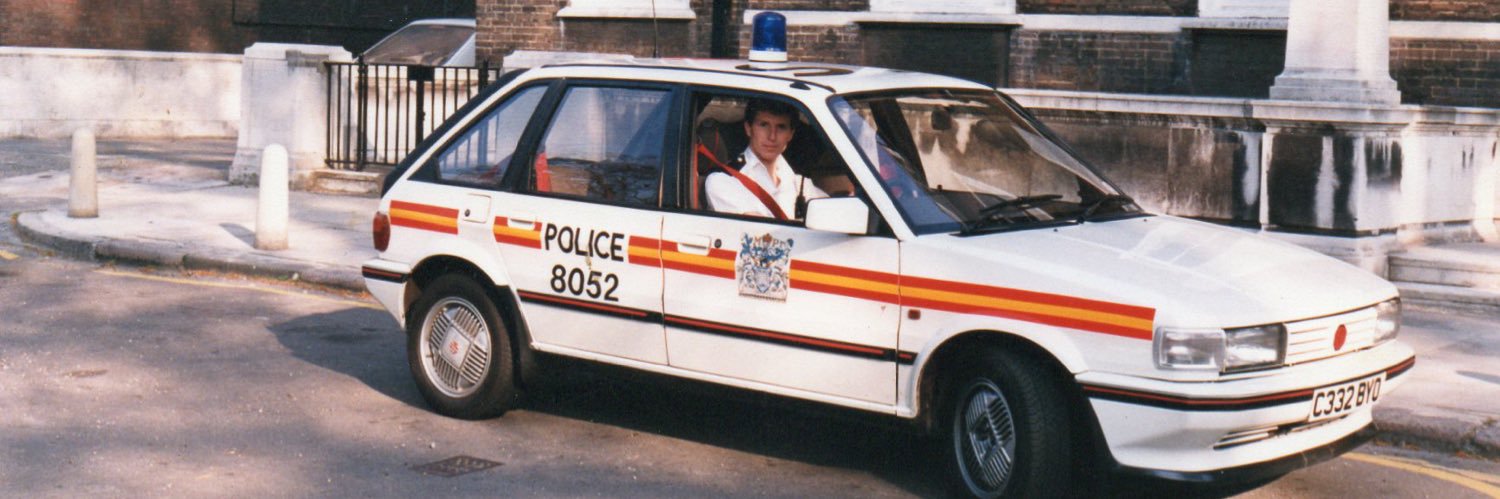
@UprightSpeedway Len Silver’s good friend Eddy Grimstead was the main Kawasaki dealer in East London. As well as Datsun car dealerships etc. clearly a pure coincidence…
Today's pathetic statements sum Southampton up - classless until the very end. They never did understand the seriousness of the matter.
✍️👇 | #Boro
https://t.co/NzK8YcuYE7
@NormanBrennan Jury members get less than the minimum wage for their trouble - £65 a day. So people on the minimum wage will be punished (and demotivated) in being there for any time, let alone 6 weeks or more. The nation then gets jurors who are public sector, retired, student and unemployed.
@TonyMunday1968@daisychristo I was a copper at Limehouse and Bow. My mate, from Leman Street, investigated a crime at her place on the Ocean Estate. It was a bit of a thing at the time.
VAR
I enthusiastically welcomed it. Was sold on the higher percentage of right decisions so we could all go home knowing football justice had been done and we could concentrate on which player was crap instead.
But I was wrong. Woefully and completely wrong.
Waiting 5 minutes for a decision to be made alone means the system isn't fit for purpose. Why? Because I sat with TV producers who said everything would be wrapped up in 10-30 seconds. It has literally taken the spontaneous joy from the most important part of the game. A goal.
Then, one thing completely blindsided me and many others.
Subjectivity.
I thought there would be science and a nailed on guarantee of a successfully and universally accepted decision. How wrong we were. Instead, arbitrary lines are drawn that simply can't with any certainty say whether a player is offside or not. So a human in a portacabin, 200 miles away only does what the referee can do, make a best guess.
Likewise handballs, dives, any penalty decision to be honest. A subjective decision decided out of stadium allowing an increasingly small and poor refereeing pool a get out of jail free card. Instead of them making a shit decision and owning it, they just pass it on 200 miles away so 3 men in a portacabin can make a shit decision instead. Lunacy.
For the love of the game, let's go back to investing in getting more referees, respecting them so that they join the trade and don't feel constantly abused. In short, treat them like rugby referees. Ultimate respect.
Then, fuck VAR off, it's ruined the game, made it petty and chaotic, and taken that one ingredient that you simply can't replace, instantaneous joy.
As a player and fan I accepted a referee making a bad decision in a game in the same way I accepted fucking up a shot or pass. We're all human.
Let's get back to that, humans doing their best, everyone walks away from the ground accepting that and less unrealistic pressure put on officials to be perfect when perfection doesn't exist in any walk of life.
VAR stinks. A system designed to help is a massive hindrance and it's about time pundits, fans, players, referees, clubs put pressure on authorities to get rid of it. We only need goal line tech, the rest can and should be refer refereed by humans making their best judgement. A best judgement that was over 98% right( audited fact pre VAR).
Enough is enough, fuck it off.
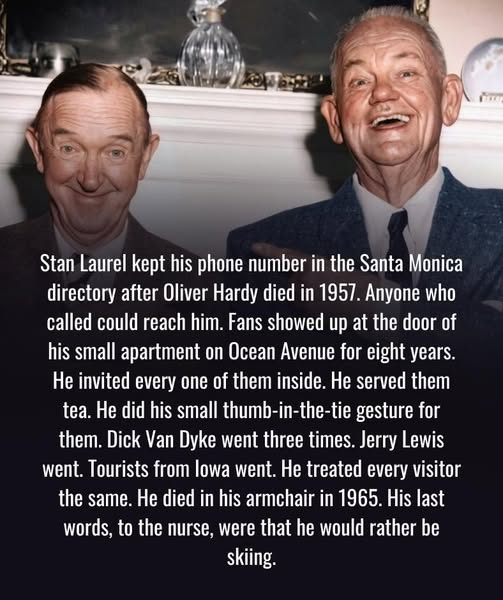
His phone number was in the book.
It was 1957. Oliver Hardy had died in August. Stan Laurel was sixty-seven years old. He was living in a small two-bedroom apartment at the Oceana on Ocean Avenue in Santa Monica. He had moved there after his last divorce because the rent was reasonable and it was within walking distance of the beach.
He had been Hardy's partner for thirty years. They had made over a hundred films together. They had been the most famous comedy duo in the world. They had not been wealthy — they had made most of their films for Hal Roach Studios on contracts that gave them almost nothing in residuals — and by the 1950s they had been living on personal appearance tours and what was left of their savings.
Hardy had a stroke in 1956. He had lost the ability to speak. Stan had visited him every week at his home in North Hollywood. He had sat by the bed and talked. Hardy could not answer. Stan had talked anyway.
Hardy died in August 1957. He weighed a hundred and forty pounds at the end. He had been three hundred at his peak.
Stan was too sick to attend the funeral.
He had been having his own health problems for years. A stroke of his own in 1955. Diabetes. He could no longer travel. The doctor had told him to stay in Santa Monica and rest.
He stayed.
He did not stop working. He could not. He had been writing comedy material for forty years, and he did not know how to do anything else, and the work was the thing that kept him from sitting in the apartment looking at the wall.
He wrote sketches for younger comedians. He answered fan mail. He kept his phone number listed in the Santa Monica directory under his own name. Anyone who wanted to call him could.
The fans started calling.
They started writing. They started showing up at the door. Word had gotten out, somehow, that the apartment number was easy to find. Tourists who had grown up watching the films would knock on the door of 849 Franklin Street, and Stan would open it.
He invited them in.
Every single one of them. For eight years.
He sat in his living room and talked to anyone who came. He served them tea. He showed them photographs from the films. He answered questions. He did his small thumb-in-the-tie gesture that he had done at the end of every film. He laughed at his own jokes and theirs.
He did not have an assistant. He did not have a secretary. He did not have security. He had his second wife, Ida, who made coffee and brought out cake. He did the rest himself.
He did this for hundreds of people.
Filmmakers who would later become famous — Dick Van Dyke, Jerry Lewis, Marcel Marceau, Peter Sellers, the writer Larry Harmon — came to the apartment because they had heard the door was open. So did tourists from Iowa. So did salesmen from Toronto. So did teenagers from Glendale who had ridden the bus across town. He gave them all the same hour.
Dick Van Dyke later said that Stan Laurel had taught him everything he had ever learned about comedy. He said he had gone to that apartment three times in five years. The first time, Stan had sat with him for four hours.
In 1961, Stan was given a special Academy Award for his contribution to comedy. He could not travel to the ceremony. Danny Kaye accepted on his behalf and read a short speech Stan had written. The speech ended with one line, which Stan had insisted on.
The line was: I wish my partner could share this with me. He was the funnier of the two of us.
Stan kept the Oscar on a bookshelf in the apartment. He showed it to fans when they asked. He let them hold it. He told them which year it was for. He never said it had been awarded to him alone. He always said it was for the two of them.
He died in February 1965. He was seventy-four. Heart attack. He had been resting in his armchair in the apartment. The nurse who was attending him in his last weeks had stepped into the kitchen. When she came back, he was gone.
His last words, spoken to the nurse minutes before, were about skiing. He had said he would rather be skiing. She had asked him if he liked to ski. He had said no, he had never skied in his life, but he would rather be doing that than what he was doing.
Then he laughed.
Then he died.
Dick Van Dyke gave the eulogy at the funeral. He said one line that became famous in comedy circles afterward. He said: a man like Stan Laurel doesn't really die. The thing he made is the thing that survives him.
The phone number in the Santa Monica directory was removed by Ida the week after the funeral. She kept the apartment for another two years. Fans still came to the door. She told them, kindly, that Stan was gone.
Some of them had not known.
She invited them in for tea anyway. She showed them the photographs. She told them stories. She did this for two years before she could bear to move out.
Some people, in the last act of their life, keep the door open to anyone who knocks, because they have nothing left to give but their time, and they discover, surprisingly, that their time is the only thing anyone had ever really wanted from them