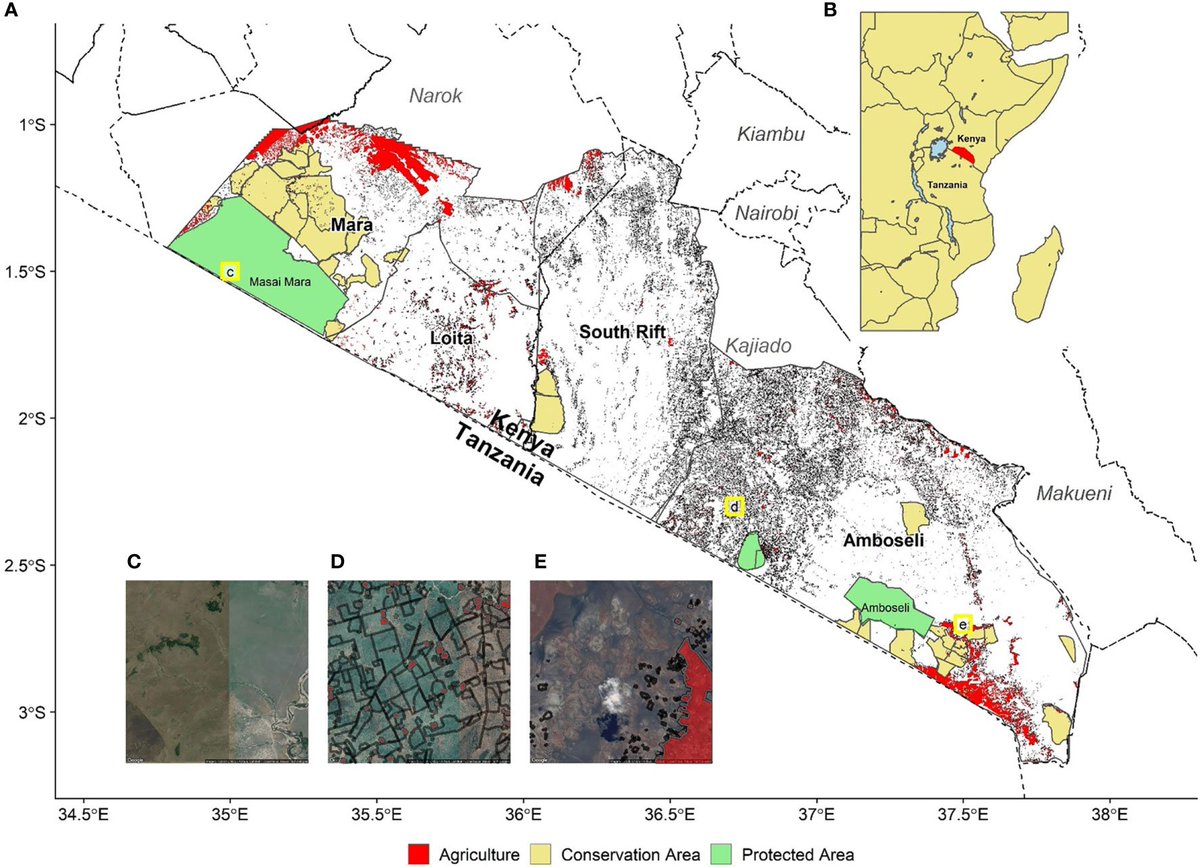
New data covering 30,000 km2 of southern Kenya's rangelands are now available: https://t.co/gfWEyGHMc2
Working with 17 organisations and 32 authors, we collated spatial data including 31,000 livestock enclosures, nearly 40,000 km of fencing, and 1,500 km2 of agriculture 🧵
🚨New paper alert!🚨 Excited to share our Practice Insight on the evolution of a community conservancy in the Maasai Mara https://t.co/iIK8PyLUuM
We explore how communities are balancing conservation with development, offering key insights for others facing similar trade-offs.
💡 All 6 ideas from our 2023 class endorsed!
These instruments have mobilized nearly $10 million and offer $795 million in investment opportunities.
@cardano@catalystfund @conservationcap @lendable@platcorpfdn@vox_capital@villgro
https://t.co/6hwJrijfBd
@WilliamJohnOwen@ranil@MattHancock@scottmann4NC Agreed, but only in areas with lower opportunity costs. If TH was a land-use option here, outcomes could be very similar. Ecotourism/TH at 10-30$/Acre/yr cannot compete when land values are 1000-10,000$/Acre. Livestock is not always a threat, but a vital ecological-economic part.
This is not enough - the rangelands of southern Kenya will not remain open and healthy for the vital wildlife and pastoral migrations (which have all but collapsed) unless more is done to twin locally-led institutions with far larger landscape-scale economic options and planning
New Article: Wildlife and pastoralists are rapidly running out of space in Kenya, with over 40,000 km of fencing proliferating on private land across the famous Amboseli, the South Rift, Loita and Mara ecosystems. 🧵https://t.co/qU4MQK4nfo
Most of this information is not new to conservation and rangeland NGOs. Projects are underway across the region to reverse or stabilize this trend with various tools from land-use planning, ecotourism, and carbon credits. https://t.co/imYrycn3I5
Going to the African Protected Areas Congress next week in Kigali? #apac2022 On Fri 22nd of July @petertyrrell_ke will be running a clinic (room MH1 12.00-14.00) to share some things we've been working on over the past year with lots of brilliant partners in East Africa.... /1
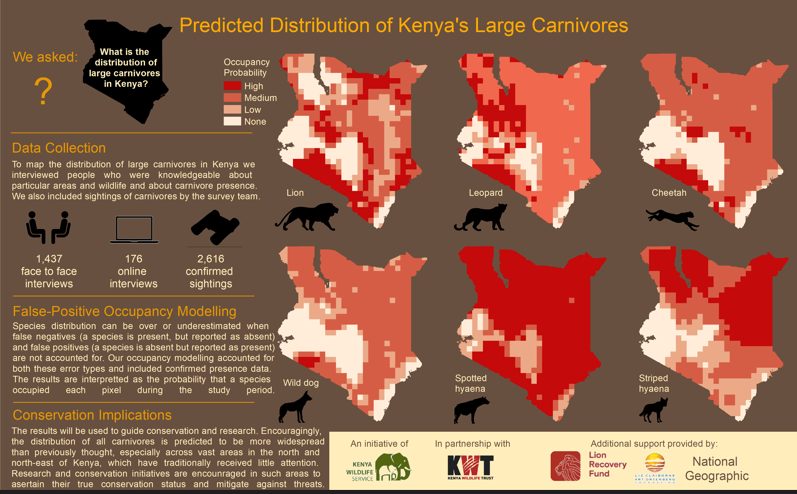
Using a novel data-driven approach we predict large carnivore distributions in Kenya, providing important insights into conservation and knowledge gaps + a workflow for creating species distribution maps
@kwskenya@WRTIKenya@KenyaWildTrust https://t.co/elkyf0aSaw
Yesterday marked my last day as an intern at Dascot Ltd and I must say it was quite an exhilerating learning experience. I got the chance to work with an amazing open team and got to extensively expand my #R/#ShinyApp skills. Special thanks to @petertyrrell_ke , @peadarbrehony
@mikemusgrave@jocelynesze @emiel_delange @anthfletch@hollieboothie@KhanyariMunib@jamesecology@brambuscher Regardless, my point was that the graphic above seems to be misleading perhaps because it is at another end of the ideological spectrum you mention. We need to be fair in our judgments of success and failures and embrace complexity and site-specific factors to create solutions
@mikemusgrave@jocelynesze @emiel_delange @anthfletch@hollieboothie@KhanyariMunib@jamesecology@brambuscher I think we need to think very carefully when we assume conservation success is measured purely by overall wildlife numbers (with variable baselines), rather than ecosystem function/health/biodiversity outcomes. Let alone the social and equity implications...