@StatiSense Do you mean "most people " or highest "proportion" of people?
Nigeria's 34% proportion should dwarf all the others if converted to a head count figures
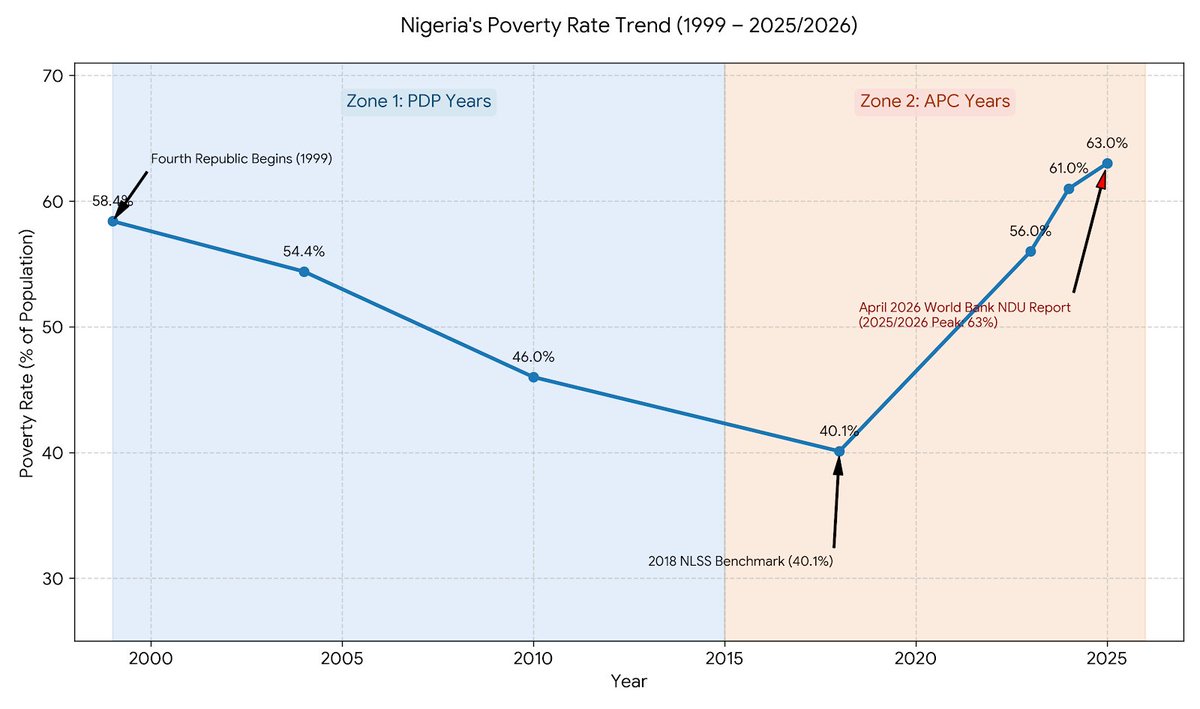
For context, Nigeria's population has doubled since return to democracy in 1999. In every one of the PDP's 16 years, Nigeria's poverty rate dropped. Since 2016, the APC's first full year in power, poverty rate has increase every year and is now higher than 1999's poverty rate
Before the collapse of Oyo and the Yoruba civil wars, Yoruba houses were much taller and the towns much better kept. I thought these walls at Koso were defensive due to their height but these are actually walls of houses. Likely between 8-11 ft
This tweet reminded me today of the late Prof Pius Adesanmi, of blessed memory, a mind Nigeria lost too early.
He often wrote about this in his Facebook posts & books.
He warned that Africa's obsession with "leapfrogging" from the pre-industrial to the Information Age is a delusion. You cannot skip the hard work of building basic infrastructure.
The Information Age is built on top of the Industrial Age. You are not just putting the cart before the horse; you are actively whipping the cart to move forward. 💀
He will say that a society cannot bypass the discipline, chemistry, & logistics needed to manufacture a simple pencil and expect to create iPads. Skipping industrialisation doesn't make us tech innovators—it just makes us tech consumers.
That "leapfrogging" was part of the general political scam in Africa. It allows leaders to skip the "boring," difficult parts of development (power grids, steel mills, railways) so they can chase the "cool" parts (apps, startups, smart cities) that look good on social media.
Trying to run a 4th Industrial Revolution on 17th-century infrastructure is a trap. Without a solid industrial foundation, the digital economy remains fragile, imported, & hollow. True progress requires patient capital and production.
@Tootalkz@yabaleftonline I wouldn't put other "adolescents" lives at risk
The point here is that the effect of this infrastructure sabotage is going to be felt mostly by other "adolescents", not the "parents"
No one should endanger road users and other citizens as a form of protest.
It's silly to say
Guys, this is not the type of stuff your your government should be telling you. Podcaster, life coach, maybe even your pastor, but not your government
Pls understand this first
In December 2003, 38-year-old Joyce Vincent died alone in her small flat above a busy shopping center in North London.
No one found her for more than two years.
When officials finally forced open the door, they found the television still on. On the sofa was a human skeleton, surrounded by wrapped Christmas presents.
No one had reported her missing. Part of her rent was paid automatically by a benefits agency, so money kept arriving.
Neighbors assumed the flat was empty. The building was noisy, so the sound of the television raised no alarm. When they noticed a smell, they blamed the garbage bins outside.
Her body was too badly decomposed to determine how she died, and the coroner recorded an open verdict. Police identified her by comparing her teeth with dental records and a photograph of her smiling while on holiday.
Joyce had not always been isolated. Friends remembered her as popular, funny, and ambitious.
But in her final years, she quit her job, drifted away from her friends, and spent time in a shelter for victims of domestic abuse. One by one, the people in her life lost track of her, each assuming she was fine.
No one knows exactly how she died or who the presents were for.
To understand the feat Tanzania has just pulled off, Uganda has a total installed electricity generation capacity of approximately 2098 MW. This is what it has built in it's entire existence. Tanzania has added in one swoop 2135 MW from a single dam built in 6 years
I understand the perspective of both parties, the young lady and TOE.
But if the lady addressed TOE by his first name because that was “company policy”, then TOE should not have publicly corrected her like that.
Whether she should have exercised discretion is a separate matter.
It may seem subtle, but these are some of the little things you observe and begin to question the corporate governance and culture of a company.
We shouldn't pick and choose culture based on who’s involved. If it’s first-name basis, it’s first-name basis. You may not like it, but 'you' approved the policy that HR drills into them during training. You should lead it.
"Company policy says 'A' but you should apply wisdom and say 'B.'"
This is a foolish statement.
Following the company policy is what a wise person would do.
Na the Tony wey be hypocrite naim spoil everything.
I am afraid, this does not fly, in my opinion.
If you deliberately establish a “first-name” culture, it should apply broadly, including to senior leadership, unless the policy explicitly carves out the board (by the way, imagine setting a culture and it is not starting from the top).
Yes, non-executive directors occupy a different governance position from employees and executive management, but their unique position within the company does not inherently exempt them from the first-name policy.
If a company says “we operate a first-name culture. Irrespective of seniority, employees address one another by their first names”, then having an unwritten exception “but obviously you don’t call a director or person xyz by their first name” undermines the philosophy behind the policy.
After all, the purpose of a first-name culture is usually to reduce unnecessary status signaling, make senior people more approachable and create a less hierarchical working environment.
If management wants the convention to be “first names for everybody below the board, formal titles for directors”, then say so.
It is highly problematic when the written or communicated policy says one thing while an invisible hierarchy says something else.
What is all these talk about “wisdom”, “culture”, etc.? If those things indeed were a big deal, why the performative stunt of “first-names policy”?
Or why is no one directing the “wisdom” yarn to TOE that the young lady is still very young, maybe inexperienced, and does not understand yet how things ideally work, and so you do not come off as conflicting what the laid-down principle is publicly?
If the irritation comes from “I am way older and way above you in status”, was that not considered before setting a policy? You all didn’t know that?
You import the form of an institution without accepting the behavioural implications that give the institution meaning. The company gets to present itself as having a flat, progressive culture without senior people actually surrendering any of the status markers associated with the old culture.
This is how we bastardise concepts and principles.
If the organisation is not comfortable with the consequences of that philosophy, there is much cleaner solution… “Simply don’t adopt the policy”.
Be hierarchical. Be formal. Require whatever title or whatever conventions you consider appropriate.
I wouldn’t call TOE by his first name too, but that’s me. But saying “we are on a first-name basis here” and then humiliating someone doing that is an inconsistency that is worse.
At the heart of it, this really speaks to a broader problem of weak institutional culture and “big-manism ” in the corporate world, where formal policies supposedly apply to everyone until they clash with status and hierarchy.
“Can you call Aliko or Femi Otedola by their first name?” Let them not implement first-name policy if it would be an issue or if the “cultural context” is that very strong (and that would be perfectly fine).
Institutions should be stronger than personalities. Let’s quit all that performative nonsense.