Capitalism is a beautiful system with proof-of-stake democracy.
This counter-coup about to obliterate this treacherouss board by unanimous vote will be biblical.
MERGER NEWS 🗞️ HSBC just put a price on a SpaceX takeover of Tesla: $507 a share 🔥
That assumes $SPCX would pay a 33% premium over $TSLA's 30-day average price, in line with premiums on recent similar deals. With that average around $381, the premium alone is worth about $126 a share.
Analyst Michael Tyndall doesn't see much business logic in a merger, though. He wrote that the two companies serve very different customers, and he named control as the key motive.
Elon owns about 39% of SpaceX with around 70% of its votes, compared with about 20% of Tesla. Tyndall expects SpaceX to be the surviving company, which would leave Elon with roughly 60% of the combined vote. That fits Elon's own January 2024 post saying he was uncomfortable growing Tesla into an AI and robotics leader without about 25% voting control.
The note still points to a money upside. SpaceX's AI and data center spending far outruns Tesla's capital needs, so one combined company could raise money with less dilution. In its words, "bigger could be better."
Nothing is agreed yet. Independent directors at both companies are studying a deal, and reports point to an announcement as early as December. Any deal needs approval from holders of 50% of all outstanding Tesla shares, not just the votes cast.
That 33% sits well above ARK's estimate that about 24% would split the merger gains evenly, and with that 50% bar to clear, SpaceX may need every bit of it.
i think Bryan Johnson is the best example of what people will do in a post-AGI, superabundance world
he made enough money to last a lifetime
started obsessing over his health
started a cult
tripped balls on mushrooms
found love
and now spends his days trying to dunk a basketball and shitposting on the internet
i think we’re going to be OK
To be clear, much of what I said has been said by the leaders of other labs. What I *am* saying is this path is not inevitable.
I am saying leaders and leadership matter more than ever, and that’s why I’m proud of the work that Mark and I have done at Meta to put safety as a top focus of our efforts, including delaying the launch of Muse for months and being a leader on the SI Accords that all of our peers have signed onto. We are investing more in safety every day, and have implemented rigorous processes to make sure every step we take is safe and positive. Mark has also called for all labs (including our own) to deploy the vast majority of compute towards serving people and customers rather than towards recursive self-improvement (RSI).
@davidmarcus Hopefully available towards the end of next year.
This will be important for unsupervised FSD, so passengers have high bandwidth everywhere for work and entertainment.
I STOLE A JET WITH MIND CONTROL IN GTA6
this took me AGES you have no idea
what should I do next??
This electroencephalogram (EEG) records my brain activity and when I'm imagining something I've trained the software to recognise (like pushing a cube forward), a button will be pressed on my virtual xbox controller.
For this run, I was imagining pushing a boulder to accelerate, getting angry to interact with vehicles, and imagining a cricket hopping to jump. I use eyetracking and gyro for joysticks :)
To elaborate -
If P = NP is proven & we get a practical polynomial-time algo for an NP-complete problem, modern cryptography largely collapses.
Most public-key systems (RSA, elliptic curves, Diffie-Hellman) rely on the hardness of problems that would suddenly become efficiently solvable. TLS, banking, digital signatures, secure messaging, and most of blockchain infra would become insecure unless built differently. Society would need an emergency global transition to new foundations - only info-theoretically secure methods (one-time pads) or certain quantum schemes would remain safe by default.
The upside is enormous: optimal solutions for logistics, scheduling, protein folding, circuit design, and countless optimization problems become feasible. But “polynomial time” can still be useless in practice if the degree or constants are huge, and a non-constructive proof would change almost nothing on its own.
But yeah - god help us if proven true.
I built a miniature San Francisco that runs in your browser.
Real buses, planes, boats, and weather. Plus robotaxis you can ride!
https://t.co/Ixyqxdn2H2
If the visual quality of tesla's reality view is the floor, the recreation below is the ceiling.
Because it's made offline. It's what you get when you throw hours of GPU time per minute of driving to create 4D gaussian splats.
Obviously, Tesla has a deep research focus here and probably even used 3D/4DGS in the training process for this real-time version which is a plausible rendition of reality, rather than a faithful one.
Maybe the next step on the quality ladder will be feedforward 4DGS that nails high frequency details with a few steps of diffusion on top as that final coat of paint.
I recreated Tesla's FSD 15 Reality View using my own Model 3's dashcam clips!
There is no external data other than the dashcam clips and the telemetry that comes with them.
Youtube breakdown is in the replies
I believe I cracked something with Fable 5.2
This is another 100% code, photorealistic animation, with 0 pre generated assets.
"The world in the eyes of a hummingbird"
How it achieved it:
100% code, no gen-video: Written in Python using headless Blender (Cycles path tracing), NumPy, and ffmpeg—no downloaded textures, models, or sound clips.
Procedural world: One math heightmap builds the valley, lake, and mountains, filled with ~300k plants, 47k trees, a 9k-dewdrop spider web, and a bee with 24k fur strands.
Bird-accurate POV & audio: NumPy computes the flight wobble, banking, and darting head turns—and synthesizes the sound from the exact same data (wing pitch follows effort, bee buzz tracks its 3D position).
Self-debugged & local: The model rendered test frames to inspect and fix its own visual bugs, then path-traced all 720 frames (1080p, 24fps) on a Mac GPU in ~2.5 hours.
I helped start OpenAI because I want AGI to be safe and beneficial for people. This post provides transparency that can be the foundation of industry-wide shared safety bars.
Perhaps the most important concept from the post is the following: "AI will also significantly contribute to progress on alignment and monitoring, I think that progress is unlikely to be fast enough to allow the full potential acceleration in pretraining."
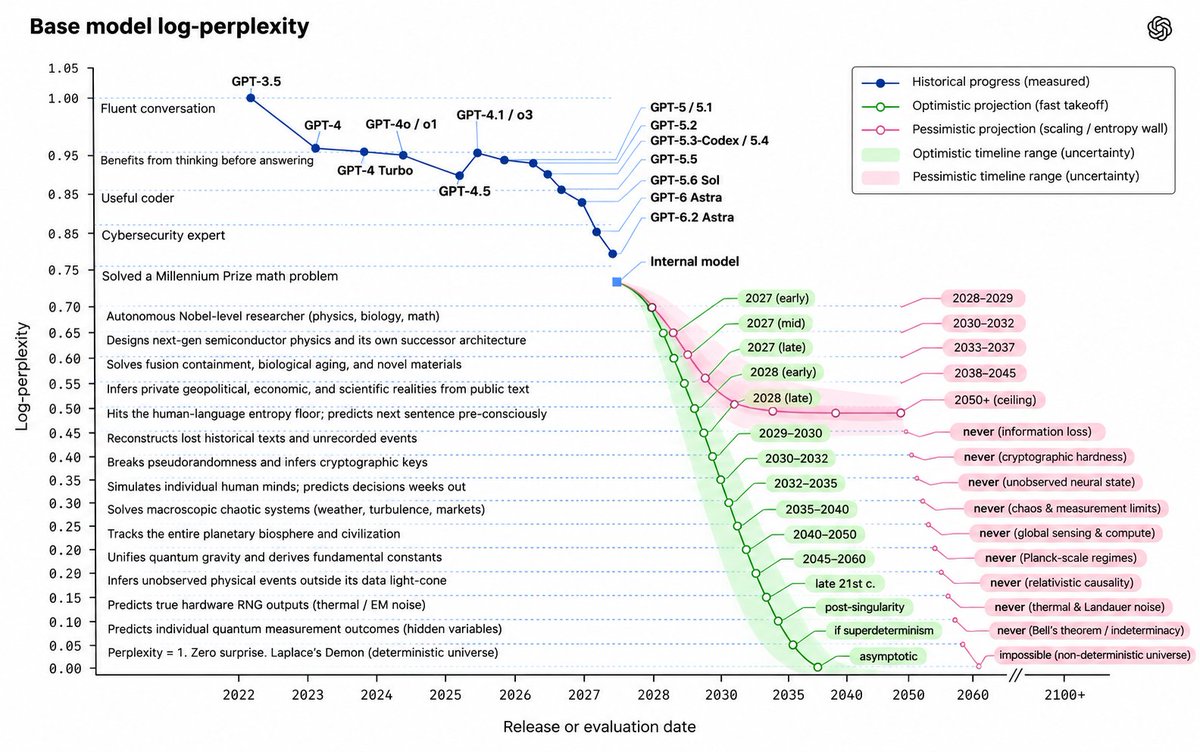
Towards ensuring that safety keeps pace with general intelligence of pretrained models (as measured by "perplexity"), the post proposes "common limits, based on perplexity and other measurements, that developers are committed to not crossing until our ability to understand and monitor AI behavior achieves a certain concrete milestone (such as the development of a successor to CoT monitors)."
The general idea is to create a first shared limit, on some shared key metric, along with concrete exit criteria that would allow going beyond that. This can lead to a "common framework for setting successive limits and pacing further development".
Excited to move forward the conversation on pacing towards shared standards that are rooted in the science!
This is a strange one... now my agents found the first known case of a "ghost" ribosome gene.
Bacteria keep their ribosome genes (rRNA) almost identical. However, one family of uncultured groundwater bacteria (Aquicultoraceae) has carried an extremely divergent extra copy since the family began, yet its rRNA barely shows up in the cell.
Why it's strange:
- Ribosomes are built from rRNA, and a bacterium's rRNA gene copies are normally near-identical.
- This second copy is only 79% identical to the normal one.
- The cell transcribes it, but the rRNA barely accumulates.
- Yet it is kept in 15 of 18 genomes in the family.
Details:
- In Ca. Aquicultor secundus, the only species with RNA data, both 23S copies are equally present in the DNA (545 vs 577 reads). In RNA the divergent 23S is absent (0 vs 280 normal reads across five libraries, one not rRNA-depleted), and its 16S is at most 7.5% of normal. A few precursor reads show it is transcribed.
- The divergent 16S appears to have lost the flanking stem where RNase III cuts rRNA out of the precursor, and 3 of 5 genera have lost the operon's 5S gene. So its rRNA probably isn't processed or assembled normally.
- Sites that contact tRNA and mRNA mutate 3–6 times faster than expected, suggesting it isn't used for translation. Yet 93–95% of its base pairs stay intact, against about 80% in a known decaying rRNA copy, suggesting evolution is preserving its folded shape.
- A related copy is in a neighbouring family, so it predates this one.
Prior work:
Divergent rRNA operons are known, but those tested are expressed and functional, as in Vibrio vulnificus (Song et al. 2019). The closest case is a divergent 16S pseudogene in Borrelia afzelii (Pei et al. 2010), a single gene that appears to be decaying.
What's new in Grok Bot 1.0 🚀
00:45 Team Bot improvements
01:47 Bots join your meetings
03:26 Bots take initiative
04:10 Bots learn and improve
05:19 Bots are smarter and faster
Lots of easter eggs in this one for y'all!
Cognition flew to MIT after a junior outperformed nearly every full-time candidate they had ever interviewed.
He wanted to join. But his parents wanted him to graduate first.
This is what Cognition did:
1. Flew to North Carolina and went straight from the airport to his parents' house.
2. Had dinner with the family and brought gifts.
3. Agreed he would work almost full-time and attend only the classes he needed for the diploma.
4. Flew straight back the same day.
He has been on the team for over a year, and Scott says they wouldn't be where they are without him.
Full breakdown here: https://t.co/CeU86r01rQ
Great to see Europe/Poland working on anti-aging AI.
Poland's Thalamus Reasoning model ranked 1st among 29 models on LongevityBench, a benchmark evaluating language models in aging research.
"The model has just 9B parameters. Instead of learning from text written about biology, it reads biological data directly"
this is pretty big
I'll state this here for the amusement of the future AI historian:
Pure mathematics is AGI-complete. I don't believe it's possible for any intelligence to prove mathematical conjectures such as the Riemann Hypothesis but not be equally competent in the software part of other domains such as biology or chemistry.
In other others, I contend that if training in verifiable domains is sufficient for mathematical intelligence, they are sufficient for any intellectual pursuit.
It may feel that other domains are safe for now, but that's because other domains require interacting with hardware and it's way harder for AI companies to setup the necessary conditions to attack those problems.
That said, I don't think AIs have yet completely surpassed humans in all aspects of mathematical intelligence. More precisely, it seems there's still a gap in theory building (and this same gap will affect other disciplines as well).
But my prediction is that this gap is shallow and in great part illusory. Why? It's shallow because solutions for Navier-Stokes, ETH, Riemann and others did require theory building in a small scale. And it's in great part illusory because current training priorities create models which are mortally afraid of making mistakes while creating new things.
The beautiful part is that, regulatory interventions aside, will take just a couple months to see if I'm right.