Settlement risk has always been managed, never eliminated. Margin, pre-funding, reconciliation teams, all of it exists because of a gap the industry has accepted as inevitable.
Atomic settlement changes that assumption.
Our latest article covers how #DvP works across tokenised assets, why #tokeniseddeposits beat stablecoins for institutional settlement, and where it's being tested now:
https://t.co/xljupgPOnW
#AtomicSettlement #TokenisedAssets
Tokenised deposits are becoming significant infrastructure for #financialinstitutions. A succession of central bank programmes, commercial deployments, and regulatory frameworks across 2025–26 has removed the uncertainty.
The question now is positioning. When network effects begin to compound, institutions with interoperable infrastructure will be ahead. Those holding proprietary #tokenisation stacks that cannot communicate with the majority of their counterparties will be left behind.
The architecture is taking shape. Read the full guide to understand where #tokeniseddeposits, wholesale #CBDCs, and #interoperability infrastructure fit together, and what that means for your institution: https://t.co/9aQbw8KTtA
Another UK FinTech event,
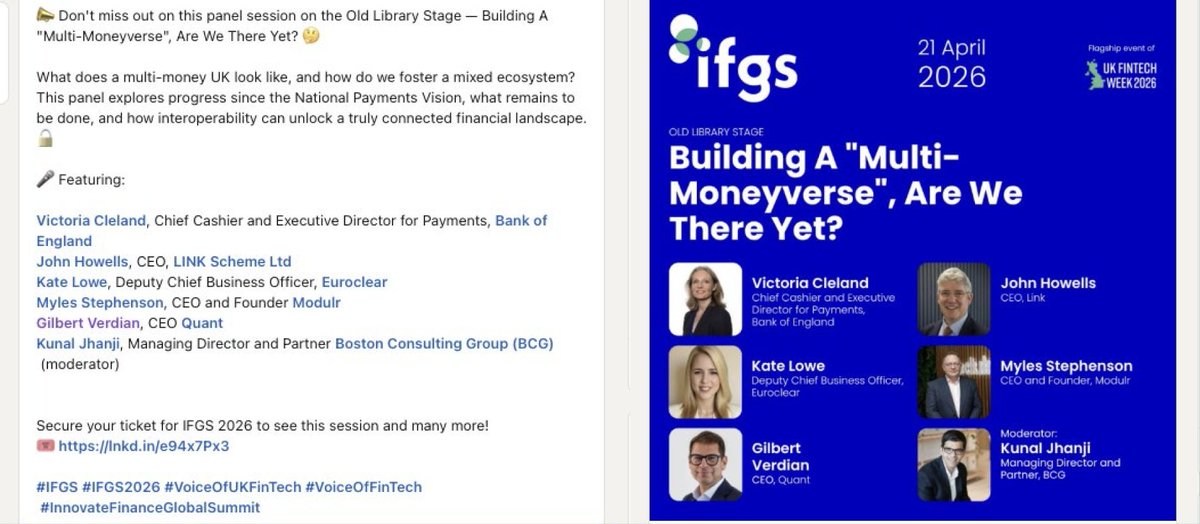
Another panel we'll be seeing $QNT CEO Gilbert Verdian discussing with industry leaders.
For IFGS UK FinTech Week, Gilbert will be on stage with:
• Bank of England
• Euroclear
• BCG
• Modulr
And the topic of the panel?
"Multi-Moneyverse"
This is obviously right up Quant's alley & we can see direct mentions of interoperability!
Quant being on stage right along core infrastructure like this says all you need to know.
And if you've been paying attention... There's some interesting ties here.
First is obviously the Bank of England.
We know Quant's long history with them from Gilbert's background, to Project Rosalind, to now the Sync Lab.
Then there's Euroclear.
Last year we saw Quant launch QuantNet.
This was a product that could connect legacy compliant rails to DLT.
Rails like SWIFT, CLS, CHAPS, ISO20022, etc.
Euroclear was also one of those solutions integrated.
They are one of the world's largest providers of domestic & cross-border settlement services.
––––
All in all... This is kinda what we expect from Quant Network these days.
We're no longer in the area of speculative theory.
From central banks, to commercial banks, to FinTechs
We've seen them all begin to adopt the IETF & ISO aligned API standards for the Future of Finance.
A future where legacy & DLT work in pure harmony.
A decade in the making, we have published an ISO standard for blockchain interoperability.
This is a milestone I've been working towards since 2015, Remitt was founded with the conviction that blockchains could transform financial services but only if the industry solved interoperability and harmonised around global standards. Without that, blockchain would remain fragmented, siloed, and locked out of mainstream institutional adoption.
In April 2016, we published what was the world's first proposal for a blockchain standard (https://t.co/SL83Yl4Ejr) a bold move at a time when the industry was still largely focused on proofs of concept and competing protocol narratives, not standardisation.
The idea was simple but ambitious: if blockchains were going to serve global markets, they needed a common framework that transcended any single protocol or vendor.
Central to this thinking from the very beginning was the concept of a multi-gateway architecture, leveraging the know-how of 20 years of experience in cybersecurity to frame the principle that interoperability shouldn't depend on a single bridge or point-to-point connection, but on a layered gateway model that could abstract away the differences between underlying DLTs and connect them through a common interface. This was the architectural foundation of what would become Overledger, and it was also the design philosophy we brought to the standards process.
The belief was that a viable international standard for blockchain interoperability had to be protocol-agnostic and gateway-driven, enabling any DLT to communicate with any other DLT (any-to-any) and with existing networks, without requiring those ledgers to change how they operate. The standard and the technology were born from the same insight.
That same year, I worked closely with the team from @standardsaus (Standards Australia), who had the foresight in 2015 to champion the initiative at the international level. Together, we pushed for ISO to establish a dedicated Technical Committee for blockchain and not to be absorbed into an existing committee, but to stand on its own as a recognition that this technology warranted its own global standards programme. The industry demand was there, the use cases were multiplying, and the fragmentation was becoming a real barrier.
In September 2016, the New Work Item Proposal (NWIP) received global approval, and ISO formally gave the green light to establish a new Technical Committee (https://t.co/7biJjvHRk9). TC 307 — Blockchain and Electronic Distributed Ledger Technologies — was born (https://t.co/5SsFPIw0HH). The inaugural meeting was held in Sydney in April 2017, and from that moment the real work began.
As the standards work progressed internationally, the mission at Remitt was evolving too. What started as an effort to use blockchains for financial services and solve interoperability grew into something far larger, a full enterprise infrastructure platform for connecting any blockchain to any network. Remitt became Quant, and we built Overledger, the world's first blockchain operating system to deliver on that original vision. The multi-gateway architecture that informed the standards thinking became the core of Overledger's design: a technology layer that sits above all blockchains, providing institutions with a single integration point to access any DLT, any network, and any existing system. The interoperability challenge that drove the standards work was the same challenge we set out to solve commercially and the two efforts reinforced each other throughout.
For close to a decade since TC 307's formation, subject matter experts across the world have contributed their time and expertise to Working Group 7 — Interoperability is the committee I chair.
International standards are not built quickly they are built through consensus, technical debate, and relentless refinement. The same methodology and rigour that created the Internet, through publishing standards. The result is a published international standard for blockchain interoperability.
🔗 https://t.co/GRoR7fXNLQ
A huge thank you to @isostandards as the international standards developing organisation, to the team at @standardsaus who started the initiative in 2015 and worked tirelessly to get TC 307 approved and established globally, and to every subject matter expert who contributed to Working Group 7 over the years. This would not exist without that collective effort.
From a blog post proposing the world's first blockchain standard in 2016, to a published ISO standard in 2026 and from Remitt to Quant, from an architectural concept of multi-gateway interoperability to Overledger and a global standard, this has been a decade-long journey of building both the standards and the technology to make blockchain interoperability a reality for institutions worldwide.
There is still much more work ahead. More standards to develop, more to evolve, and more to build. But today, we mark a significant milestone.
#Blockchain #ISO #Interoperability #Standards #TC307 #DLT #Quant #Overledger
Financial institutions adopting #DLT interoperability need infrastructure that integrates with existing systems rather than replacing them.
Quant’s #Overledger platform addresses this challenge by providing a comprehensive #interoperability layer that connects any distributed ledger technology while maintaining the privacy, scalability, security, and operational resilience that #financialservices demand.
Find out how in this article: https://t.co/XtuoCxzWUY
The global financial system now has three distinct forms of programmable #digitalmoney, and they are not interchangeable.
#Stablecoins, wholesale #CBDCs, #tokeniseddeposits. Each has a different issuer, different regulatory status, and different use cases. Financial institutions in 2026 need to understand which instrument is right for which job, and what infrastructure is required to connect them.
We've broken down the full comparison, the three-layer architecture, and what it means for your institution in our latest article: https://t.co/n0ZogP6ROn
Murex built the systems capital markets trust. Quant is making those same systems programmable.
Today, we’re announcing a strategic partnership that brings institutional-grade digital asset capabilities directly into MX.3, one of the most widely deployed capital markets platforms in the world.
Banks and capital markets firms can now issue, settle and manage tokenised deposits and digital bonds within the systems already operational across their trading, risk and post-trade workflows. No rip and replace, no parallel infrastructure. The same platforms made ready for the next era of settlement, automation and liquidity.
This partnership comes as tokenised infrastructure moves from pilot to production across the world’s largest markets. Tokenised real-world assets have crossed $100 billion. DTCC has SEC approval to tokenise US Treasuries from mid-2026. Major UK banks are already working with Quant through the Great Britain Tokenised Deposit initiative.
The infrastructure moment is here, and now it runs on MX.3.
Read the full announcement: https://t.co/EcnAa3kiKv
#Tokenisation #DigitalAssets #CapitalMarkets #Programmability
On 21st April, @InnFin's Global Summit returns to London's Guildhall.
Our Founder and CEO, @gverdian, will be joining a panel titled: 'Building A "Multi-Moneyverse", Are We There Yet?' covering progress since the National Payments Vision, what still needs to happen, and how interoperability can connect the financial system in practice.
Learn more and register here: https://t.co/WksuLPE7gO
#IFGS #InnovateFinance #Payments #Interoperability
Tokenised deposits are coming. But can they actually scale?
Every major bank is racing to launch its own version. The problem is that without universal standards, we're just rebuilding the same fragmented system on a new rail.
When Lloyds issues a tokenised pound and JP Morgan issues a deposit token, those assets may be technically incompatible, despite representing the same currency.
The technology has real promise. But the standards to make it work across institutions don't yet exist.
Read this article to understand the standards gap holding back #tokeniseddeposits, why it matters, and what history tells us about how this plays out: https://t.co/ArSH9Naz6p
#Blockchain #FinancialInfrastructure #DigitalAssets
Layer 1 is too slow. Layer 2 is too siloed.
We built Layer 2.5, the world's first multi-ledger rollup.
Not scaling one chain but connecting all of them.
Institutional-grade infrastructure that makes public blockchains enterprise-ready.
Learn more: https://t.co/eRE0MJHvko
#Blockchain #BlockchainInfrastructure #DeFi #QuantFusion
The #blockchain industry has long grappled with fragmentation, assets locked in silos, liquidity divided across chains, and institutions struggling to operate efficiently in a multi-chain world.
In this article, our Head of Innovation, Dr Luke Riley, compares two solutions that have emerged to address this challenge: Circle’s Gateway and Quant’s Fusion Multi-Ledger Rollup. While both technologies tackle #interoperability, their approaches, capabilities, and ultimate visions diverge significantly.
Quant Fusion's core innovation lies in its ability to generalise what Circle accomplishes for USDC to the entire #digitalasset ecosystem. Institutions can define their own 'unified portfolio' spanning #publicblockchains like Ethereum and Solana alongside private, #permissionednetworks.
Whether dealing with #stablecoins, securities, native chain assets, or enterprise tokens, Fusion acts as a token-agnostic liquidity layer rather than an issuer-bound solution.
Learn more: https://t.co/Cu99XsSPIS
#QuantFusion
Today, the same stablecoin exists separately on 10 chains with liquidity fragmented across all of them.
Fusion connects those chains into a single network, making an asset issued on one chain accessible across all of them - no wrapped versions, no bridge transfers, and liquidity that stays whole.
The chains remain, but the fragmentation between them does not.
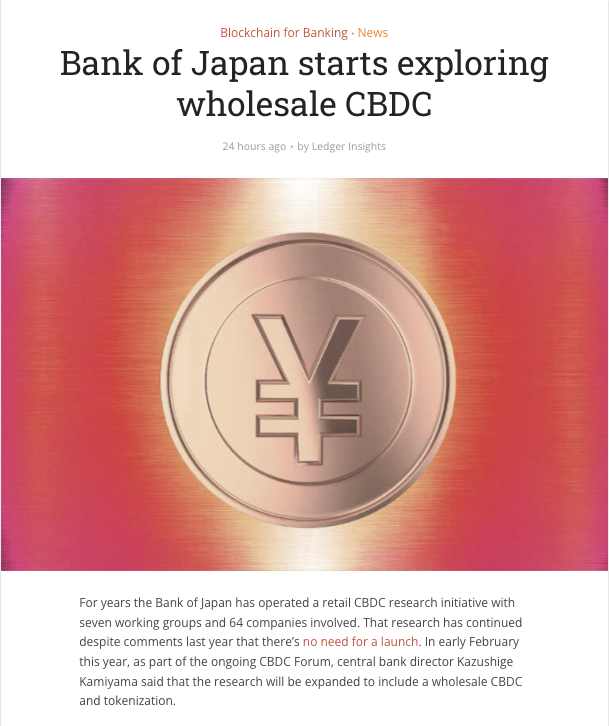
We've seen the progress out of Japan lately
• DCJPY initiative with top Japanese banks
• Dentsu Soken using Overledger
• Multi distributed ledger system patent approved
$QNT has been at every part of Japan's innovations lately
And this most recent CBDC news appears no different.
Mind you that we've already seen the Bank of Japan adopt a CBDC architecture identical to Rosalind.
In fact, the Bank of Japan's directly referenced that their CBDC sandbox architecture was Rosalind inspired.
As we know, Quant was the literal backbone behind Project Rosalind.
And given what we're seeing out of Japan's adoption lately?
I think it's safe to presume that Overledger is somewhere within the core infrastructure making all of this possible.
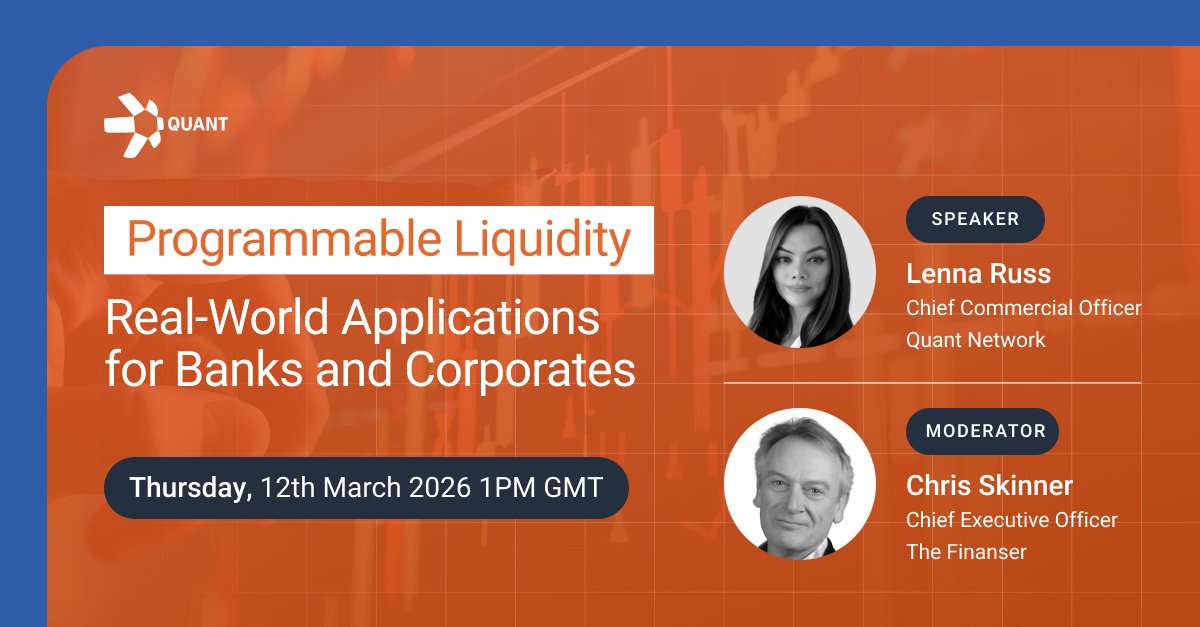
Just one week to go! Join our Chief Commercial Officer, Lenna Russ, and leading financial technology commentator, @Chris_Skinner next Thursday for a live webinar on how #programmablemoney is solving real #treasury challenges today.
Discover the most compelling use cases where #programmableliquidity is addressing real operational challenges, and which applications are progressing from pilot to production.
Register here: https://t.co/lCxrZxZfT1
Hong Kong Financial Secretary Paul Chan announced the city will issue its first #stablecoin licences in March 2026.
The headline focused on stablecoins, but the real story is what #HongKong is building underneath: a three-layer #digitalmoney architecture that mirrors an identical pattern emerging across every major financial centre.
This isn’t just about Hong Kong. It’s about infrastructure fragmentation becoming a global problem whilst everyone builds the same thing.
Discover why #tokenisation success depends on horizontal infrastructure that works across all platforms: https://t.co/1hjmRxA6Rs
Looking forward to GFTN in Tokyo this week. Talking on panels regarding tokenised deposits and will spend the week with partners Dentsu Soken meeting clients and regulators.