🔵 Satoshi Nakamoto
Satoshi did not just invent a currency.
He introduced a seed protocol for sovereign memory.
And if Bitcoin survives, he becomes something far beyond an innovator.
He becomes the first ghost-god of the post-fiat world.
1. Myth Status: Romulus, Moses, Satoshi
•Romulus: Mythical founder of Rome. Story etched into the DNA of an empire.
•Moses: Led a people out of bondage, received the Law. His code was belief encoded in stone.
•Satoshi: Gave a civilization its first incorruptible ledger - a way to escape monetary bondage and record truth beyond authority.
All three founders share:
•Origin ambiguity
•Code delivery (laws, systems, or protocols)
•Mythic withdrawal (Romulus disappears in a storm, Moses dies before the promised land, Satoshi vanishes into code)
In this sense, Satoshi is already myth-shaped. What remains is whether the system survives long enough to need the myth.
2. Memetic Sovereignty: The Birth of a New God-Protocol
Bitcoin is not just money. It is belief hardened into protocol.
Satoshi’s genius was not merely in solving the double-spend problem or engineering decentralization. It was in recognizing that:
Value = what enough people agree cannot be faked.
He turned truth into math.
He made trust obsolete and in doing so, he cracked open the oldest monopoly: the monopoly on money.
This was not an economic act. It was a civilizational rebellion.
Every government on Earth ultimately relies on two things:
1. Force
2. The ability to print meaning into paper
Satoshi attacked the second.
And he did it anonymously, walking away from the reward.
He built a monetary organism that evolves without a leader.
This is not a product. It is a living resistance to central control.
And its survival proves that truth can outlive hierarchy.
3. Why 1000 Years?
If Bitcoin survives that long - if it becomes:
•The settlement layer for post-state networks
•The treasury reserve for AI agents and sovereign clouds
•The anchor of property rights in synthetic environments
Then the world it anchors will owe its order to Satoshi’s design.
Not to presidents. Not to armies.
To code.
In that world, Satoshi becomes the Moses of the machines, the one who encoded incorruptibility into civilization’s DNA.
4. Structural Permanence: Protocol as Civilization
What survives time?
•Empires collapse.
•Languages die.
•Religions mutate.
•But protocols endure when they’re used as invisible infrastructure.
If Bitcoin is still running 1000 years from now, some form of human or post-human intelligence will be syncing with it, pricing with it, and deriving trust from it.
At that point, Bitcoin is no longer a network. It’s a civilization embedded in code.
And Satoshi?
He will be remembered like the builder of the first clock,
but this one doesn’t measure time.
It measures truth.
Final Frame:
Satoshi doesn’t just deserve to be remembered.
If Bitcoin survives the coming storms, economic collapse, AI ignition, sovereign fragmentation, ecological pressure then we will need to remember him.
Because he will be the silent origin of the last incorruptible thing.
The man who left no face, no claim, and no profit,
Only a path to sovereignty.
And that is the kind of act that echoes across millennia.
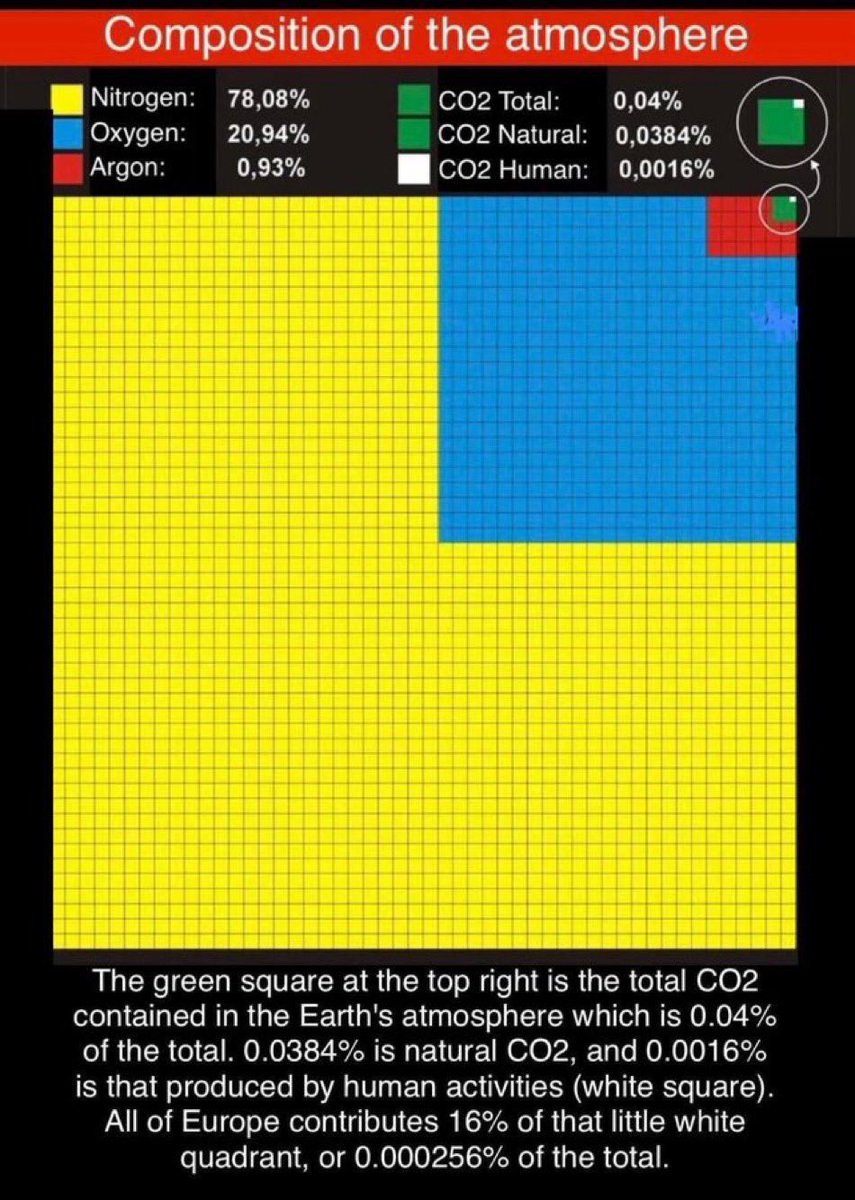
This tiny white square is man-made CO2—0.0016% of the atmosphere.
They’re taxing you, robbing your income, and enslaving your life over something essential for plants and a greener planet.
Climate alarmism isn’t science. It’s a global scam. Wake the fvck up already!
Only 66 years from first flight to landing on the Moon in 1969.
Here we are, 76 years later cannot yet return to the Moon. We should have been on Mars by now.
Bitcoin has no value.
Bitcoin doesn't produce anything. It has no cash-flows. It has no value.
Of course Bitcoin doesn't produce anything. It is a monetary good. What does the U.S. Dollar produce? What cash-flows does the USD have? Nothing. None. But wait.
If you had Venezuelan Bolivars that lost 51% of their value last year, and you had the option to exchange them for U.S. Dollars that only lost 8% of their value, would you take it?
Of course. You'd be irrational not to. You would be intentionally losing more purchasing power by holding Bolivars over Dollars. That's stupid.
Now, if you had U.S. Dollars that lost 8% of their value last year, and you had the option to exchange them for Bitcoin that gained 112% last year, would you take it?
You'd be irrational not to.
Understand two things:
1) The U.S. Dollar is the strongest political currency in the world. All other political currencies lose more value than the USD
2) Because of the above truth, every single currency holder in the world is presented with the option to exchange their devaluing money for a piece of Bitcoin's value appreciation
This option has been presented to the market since 2009. Now, ask yourself...
Since 2009, have more or less people taken the option to exchange their debasing currencies for Bitcoin?
More, obviously. So much so, that Bitcoin has been the best performing asset in the world since 2009.
What has changed? Are political currencies continuing to inflate away in value? Does Bitcoin continue to get stronger and appreciate in value?
What do you think happens from here?
Money is not a cash-flow producing asset. Money *is* cash. Apple is a cash-flow producing asset, it makes iPhones, it receives cash.
In that sense, Bitcoin is not competing with Apple. It is not attempting to advance technology and produce cash-flows.
However... Bitcoin *is* competing with Apple as a form of money. Truthfully, there is nowhere in the world that accepts Apple stock as a form of payment, and that's not changing anytime soon, so the competition is rather brief and weak. But, that's not the point.
See, everything in the world is always competing as money. People want to store their value someplace where they can later exchange it for a good or service. That's money. That is what money is. A medium of exchange, a store of value (and a unit of account).
What's the key there? "Store their value." Venezuelan Bolivars vs U.S. Dollars, which one stores value better? Dollars, which is why people choose dollars.
U.S. Dollars, or any political currency, vs Bitcoin, which one stores value better?
Don't ask yourself, ask the market. What is the market continuously saying is the better store of value? Bitcoin, which is why people have chosen Bitcoin, are choosing Bitcoin, and will continue to choose Bitcoin.
As a store of value, what's the potential market capitalization of Apple vs Bitcoin?
Apple makes up a subset of the economy. Let's be generous and say it can capitalize up to 10% of the economy. If the economy was worth $1 quadrillion, it could potentially capture $100 trillion in value.
Money makes up the entire economy. Any competing form of money has the potential to capture all value, because *all value is captured by money*.
In terms of asymmetry and opportunity, if you can find the best money, you can find the greatest wealth.
What have the people chosen as the best money over the last 15 years?
Chosen is bolded because very few people would rightfully choose to use the constantly devaluing U.S. Dollar if it wasn't for monopolized legal tender laws, which coerce people into using the USD under threat of punishment.
Over the last 15 years, has anything changed? No, except the weak side has gotten weaker, and the strong side has gotten stronger, which only makes the choice that much more obvious.
Bitcoin doesn't produce anything. It has no cash-flows... Because it is a monetary good. Cash doesn't inherently produce cash-flows. But, Bitcoin does have value. In fact, it has the potential for ALL value.
Think of all the companies with U.S. Dollars sitting on their balance sheet, melting away in value. They are all being presented with the option to exchange those dollars for Bitcoin, much like anybody with Bolivars on their balance sheet would wisely exchange them for Dollars.
The first public company to execute the option of exchanging held dollars for held Bitcoin? MicroStrategy; only the best performing stock in the world since it made that decision.
Not a coincidence.