Studying the Social, Scientific, and Political Factors of Per- and Polyfluoroalkyl Substances to share with impacted communities and other stakeholders
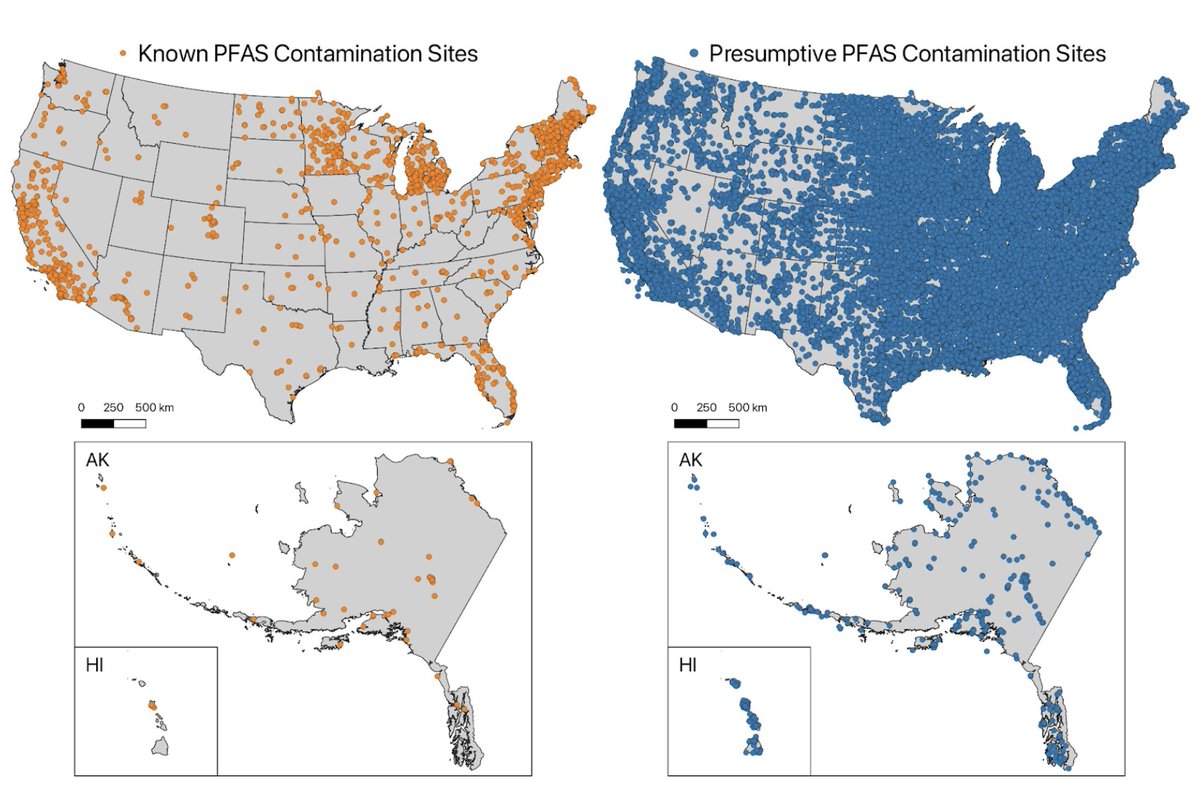
PFAS Project Lab Data Tools Expanded and Analyzed to Identify Over 2,200 Known and 79,800 Presumptive PFAS Contamination Sites. Check out the update here: https://t.co/PpzzByJCVW
On May 18, 2026, @EPA publicly acknowledged: "The science on the two most studied PFAS has never been clearer. They are linked to serious health effects, they persist in the environment, they build up in the human body. And addressing that is not optional. It is essential to making America healthy again. ... The science on these two chemicals is some of the strongest of any drinking water contaminant we regulate."
#PFAS #PFOS #PFOA #foreverchemicals @Taftlaw@YaleSPH@Lesscancer #ExposureBook @DarkWatersMovie
https://t.co/q3JBJIWhy3
Other potential culprits are more than 16,000 chemicals that can leach out of plastics. At least a third are toxic to humans or animals, including hormone-mimicking bisphenols, phthalates, flame retardants and PFAS, commonly known as forever chemicals. https://t.co/2BZmCw44sb
USA: "The grim reality is that 23-35 million pounds of pesticide ingredients used annually in the United States are PFAS. California has registered 53 PFAS pesticides. And about 2.5 million pounds of those poisons are applied annually to California cropland."
Peaches, pears and PFAS: California lawmakers may limit 'forever' pesticides in foods https://t.co/zzI2Jbtvde
Breaking News: Australia is suing 3M for $1.4 billion, alleging the U.S. company hid information about the effects of “forever chemicals” at military bases. https://t.co/1exrT5Zntf
As Maine expands access to PFAS blood testing, more residents are trying to better understand what exposure to so-called “forever chemicals” could mean for their health. https://t.co/EPxcOXFrPJ
The Trump administration is moving to roll back limits on some PFAS, the toxic “forever chemicals” found in the drinking water of millions of Americans. https://t.co/0mPOhzxBhH
The Trump administration is moving to roll back limits on some PFAS, the toxic “forever chemicals” found in the drinking water of millions of Americans.
The Biden-era rule set the first national drinking-water limits for several PFAS compounds. But industry groups argued the standards were legally flawed and too costly to meet.
@WmBrangham has more.
The Trump administration is moving to roll back limits on some PFAS, the toxic "forever chemicals" found in the drinking water for millions of Americans.
The Biden-era rule set the first national drinking water limits for several PFAS compounds, but industry groups argued the standards were legally flawed and too costly to meet. EPA Administrator Lee Zeldin says the chemicals still need to be addressed, but that the previous administration overreached.
William Brangham (@WmBrangham) joins Geoff Bennett (@GeoffRBennett) with more.
Key Biden-era regulations designed to protect the nation’s drinking water from the most dangerous cancer-causing per-and polyfluoroalkyl substances, or PFAS, have been removed by the Trump administration. https://t.co/yCfj23xnfH
Breaking news: The EPA proposed repealing limits on four types of “forever chemicals” in drinking water.
The proposal would end the Biden-era restrictions on four PFAS compounds and give utilities more time to comply with limits on two others. https://t.co/5GMu4BxYOx
The Minnesota Pollution Control Agency (MPCA) says new testing near 3M's Cottage Grove site found PFAS levels far above the state limits, in an area already under a fish consumption advisory. https://t.co/xBU0YzX5bu
Sewage sludge, containing PFAS, is being spread on farmlands across America as fertilizer, and it's now appearing in the plants that farmers harvest and the meat and milk of the livestock they raise.
https://t.co/WZtnbCKV48
The EPA withdrew a Biden-era proposed rule to clarify that significantly harmful materials could be managed under one of the major hazardous waste control laws. https://t.co/3gOqW39KpJ
The recent U.S. FDA characterization of baby formula as “safe” is entirely misleading.
In the FDA dataset, about two-thirds of the infant formulas tested had detectable PFAS. The highest levels were found in soy-based formula samples, especially powder soy-based formulas.
These detections were mainly driven by PFBA, with some soy powder samples containing around 30-34 ppt.
@bennettpeer@Nathan_Donley
https://t.co/m03teSSwWZ
State officials learned nearly two decades ago that toxic chemicals known as PFAS were spreading from textile mills into the waters of northwest Georgia. Years later, no one is taking responsibility as the toll on human health emerges. https://t.co/UyhSur9Nyp