This was the livetweeting account for @pfanderson. Have been locked out & am unable to access help from @TwitterSupport Librarian, LongCOVID March 2020
1) There's a new critical review of patient-reported outcome measures in ME/CFS and Long Covid.
The paper argues that trials often fail to include important symptom domains such as post-exertional malaise, dysautonomia and mast cell activation symptoms.
If you are a parent in the US and have not gotten your kids their COVlD and flu booster shots yet, now is the time.
The past two years, the rollout of available COVlD boosters has gone slowly and with confusion, so I will answer a few common questions.
1. Are my kids eligible?
▪️Children 6 months and older are eligible.
▪️A prescription from a physician generally is not needed.
▪️You generally do not need to attest to your child having a high risk medical condition. That is not required by the CDC.
▪️Note that the implementation of this general guidance may vary by state and pharmacy. Most pharmacies have now worked through the rollout confusion.
2. What options are available?
▪️Moderna (Spikevax): Ages 6 months and up
▪️Pfizer (Comirnaty): Ages 5 years and up
▪️Moderna (mNexspike): Ages 12 years and up
▪️Novavax (Nuvaxovid): Ages 12 years and up
Pfizer and Moderna are mRNA-based, whereas Novavax is a protein subunit (non-mRNA) option. The biggest advantage to Novavax is that current evidence indicates fewer common short-term reactions (e.g., fatigue, headache, injection-site discomfort); the evidence is primarily from adults though. There is no robust comparative effectiveness evidence to date suggesting one option works better than the others; over time, such evidence may emerge, but findings have been mixed thus far, at times even within individual studies.
3. Does COVlD still matter?
▪️Yes, it matters for children. In addition to the importance of reducing acute infections, anyone can develop chronic health problems after any SARS-CoV-2 infection, commonly called Long COVID or post-acute sequelae. Updated boosters can reduce infection risk, urgent care use, and emergency care use, especially in the initial months after boosting. Protection wanes, and the level and durability of protection against infection vary. Especially during waves, additional protection from infection is useful. The studies are mixed as to whether the boosters reduce the chances of Long COVlD among people who get infected, with some suggesting a benefit, and others suggesting no discernible benefit among those infected. The benefit remains even if purely on the side of reducing infection chances.
▪️Yes, it matters for families, schools, and communities. Each infection prevented can stop a forward chain of transmission that can lead others in the family, school, and community to get COVlD. That is helpful for family economics so people are not missing work and beneficial for overall public health. Americans have experienced a steady rise in disability since pandemic onset that continues in 2026. Moreover, people continue to die of COVlD, at lower rates than the first two years since pandemic onset, but often these deaths have shifted to the post-acute phase, months or years after infection. These deaths often show up as heart attacks, excess deaths among people already battling a significant health condition (e.g., cancer, organ damage), and various other causes.
4. Will the COVlD boosters prevent all infections?
▪️No. When scientists use the word "prevent," they often mean "reduce the overall risk of." For example, seatbelts prevent car accident fatalities. This is a poor word choice in public health communication because many assume "prevent" means "stop all risk of." The boosters are not a panacea. They are a good tool and one of the easier tools for reducing risk.
▪️The most effective way to reduce risk of COVlD is to use layered prevention. That includes boosters, wearing well-fitting high-quality masks (for children, a Flo Mask or vetted, well-fitting KN95/KF94 like those sold by Wellbefore and others), using air purifiers, testing, and staying home when sick. These interventions are costly to families, which is why they warrant public funding.
5. Would you get your kids boosted?
▪️Yes. For the reasons noted above, it is the easiest option for reducing risk.
6. Where can my kids get boosted?
▪️Retail chains like Walgreens that have actual in-house pharmacies offer boosters, typically to children 3 years and older. If scheduling through their website, one can often schedule multiple kids for the same appointment time. Local policies and practices may vary.
▪️If seeking out Novavax, Costco is a good option, including for non-members. The major retail chains sometimes carry it. If you talk to a pharmacist, you may need to refer to it as Nuvaxovid.
▪️Children who are covered by Medicaid, uninsured, underinsured, American Indian, or Alaska Native may be eligible to get boosted through the Vaccines for Children Program.
7. What else should I know?
▪️If you and your children do not regularly mask, a pharmacy appointment is a wise place to do so. Often, the booster waiting area is the same place where people are picking up medications for acute illness. Nobody wants to get sick while getting a booster.
▪️Since children under 2 cannot mask, ask a pediatrician to offer the booster outdoors or at the first appointment of the day while those who can mask do so.
8. Do you have any financial conflicts of interest?
▪️No. I do not receive any revenue from any COVlD-related product or business. Scientists must report this to universities annually. I do not accept pharma funding ether. The CMS Open Payments Data directory remains useful for tracking pharma-related funding.
Links in next. Please provide any follow-up questions and feedback on anything that has worked well or gone poorly.
Our family got Nuvaxovid last month. This week: Sanofi’s Flublok… an egg-free recombinant flu shot.
Trials have found stronger antibody responses than standard egg-based vaccines.
Ask pharmacies about your options.
When the Oxford children's dictionary discarded dozens of nature-words—"dandelion," "fern," "starling"—as irrelevant to children's imagination and replaced them with words like "broadband" and "cut-and-paste," this inspired act of resistance was born: https://t.co/Is4zFAQqc6
This paper answers why can’t you remember being a baby?
For over a century, science said you can't remember being a baby because your infant brain was just too "immature" to record anything. researchers assumed your hard drive was basically turned off for the first two years of life.
But this wild paper from Yale completely rewrites how we understand human memory..
Researchers literally put awake babies (between 4 and 25 months old) into an fMRI scanner to watch their brains process new visual experiences in real-time.
and what they found is mindblowing..
the infant hippocampus isn't turned off at all. it is actively firing, capturing, and encoding episodic memories. they proved that babies with higher hippocampal activity during a new experience formed a highly stable memory trace.
the babies are recording the data. the memory of your first birthday, your first steps, the exact layout of the room you slept in.. it was all successfully saved to your brain.
so why can't you remember it?
the paper concludes that infantile amnesia isn't an "encoding" problem.. it is a "retrieval" problem.
your brain recorded everything perfectly. but as you grew, your brain underwent massive developmental shifts, like explosive neurogenesis (the rapid birth of new neurons), which completely restructured your neural networks. the pathways to access those early files got buried or locked away.
you didn't fail to make the memories.. you just lost the encryption key to open them.
somewhere deep in your hippocampus, the exact first-person memory of being a 1-year-old might still be sitting there. you just can't access the file anymore..
the human brain is terrifyingly beautiful.
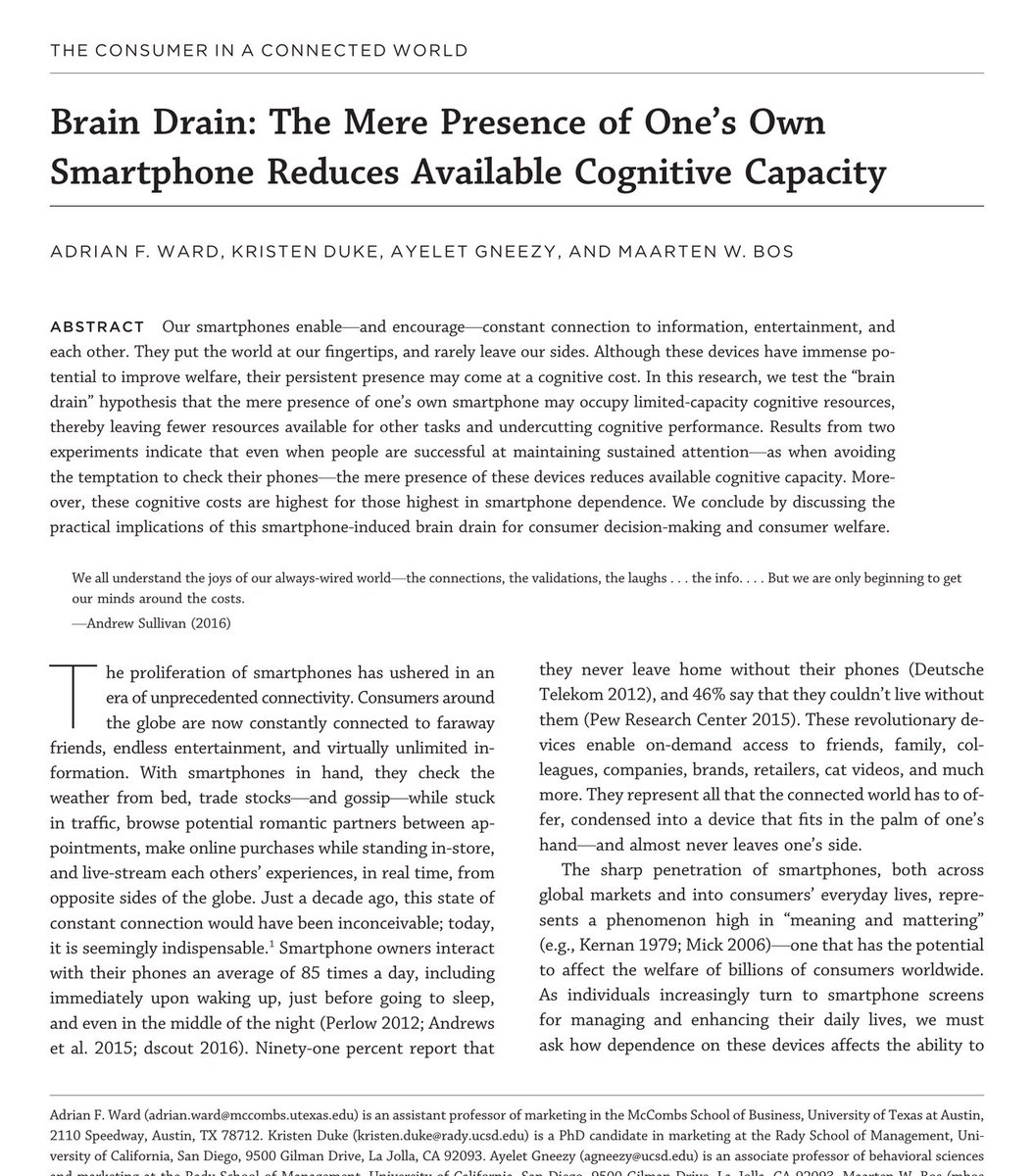
This paper answers why you can't think straight even when you're not touching your phone.
Researchers from UT Austin and UC San Diego published a paper that explains every unfinished task, every reread paragraph, and every afternoon that vanished.
It's called "Brain Drain."
they took 520 people and gave them tests of memory and problem solving.
the only difference was where their phone was.
on the desk, face down. in their pocket or bag. or in another room.
every phone was on silent. no buzzing. no notifications.
And the results are wild.
the people whose phones were in another room did significantly better than the people whose phones sat face down on the desk.
the closer the phone, the worse they scored.
then they ran it again and made half of them turn their phones completely off.
it didn't matter.
off and face down on the desk still drained the brain.
the paper revealed a brutal paradox:
most people said they weren't thinking about their phone at all.
75.9% said its location didn't affect their performance "at all."
they were wrong.
your brain spends energy just to not pick it up. a quiet, constant effort to ignore the most interesting object in the room.
that effort comes from the same tank you use to think.
and the more dependent people were on their phones, the bigger the hit.
you are not distracted because you're weak.
you are distracted because the most powerful attention machine ever built is sitting three inches from your hand.
the fix is almost insultingly simple.
put it in another room.
Lights out: the island that goes dark to save young seabirds:
After 3 months in the nest, young Cory’s shearwaters attempt to fly to the ocean guided by the stars. Corvo Island, Azores, turns off its public lighting for a few key days to help fledglings
https://t.co/zEUUSeYNhH
Every time the science has been settled, somebody paid for the settlement, and the bill has a name on it.
1747: James Lind cures scurvy with lemons. The Navy keeps it settled as a disease of damp air for forty-eight years and loses more sailors to it than to the French.
1799: Bleeding is settled. George Washington is drained of nearly half his blood for a sore throat and is dead by evening.
1847: Childbed fever is settled as bad air. Ignaz Semmelweis washes his hands and the deaths on his ward fall from one mother in ten to one in a hundred. He is sacked, committed, and beaten to death in an asylum.
1915: Pellagra is settled as an infection. Joseph Goldberger proves it is the corn diet of the poor by injecting himself with sufferers' blood. The South keeps the corn, and 100,000 Americans die of it.
1941: The lobotomy is settled, and about to win a Nobel. Rosemary Kennedy, twenty-three, is left unable to walk or speak, one of 40,000 Americans put under the pick.
1956: The pregnancy X-ray is settled as harmless. Alice Stewart shows one scan doubles a child's chance of cancer. She loses her funding and the scans run for another quarter century.
1961: Thalidomide is settled as safe for morning sickness. Ten thousand babies.
1971: DES is settled as a pregnancy protector. The daughters of the women who took it develop a cancer nobody has seen before.
1972: Sugar is settled as harmless. John Yudkin writes that it is not, and the fat men and the sugar men end his career between them.
1984: Fat is settled as the killer, and a generation of mothers swaps the butter for a tub of oil.
2004: Vioxx is settled as a safe painkiller. Up to 140,000 heart attacks before it is pulled.
The science was settled every single time. The only thing it ever settled was who took the blame afterwards.
just my two cents - but i think TYPE and DOSE and RELEASE time are really big players here (especially when you consider underlying autoantibodies). there is a selective vs. non-selective divide (such as between propranolol and metoprolol), then there is IR vs ER (immediate vs. extended) release, and then a very wide dosage range being tried. add to this that those on BBs are also on multiple meds (exposed to polypharmacy). it took me a few years to dial in the right BB and dose (for me its metoprolol, twice a day 75mg each time).
Has anyone else had trouble canceling SuperGrok? I’ve sent repeated cancellation requests to support, yet was charged in September and again today. I’m requesting a refund. If you managed to get yours canceled, what worked? @xai
@wynfran I'd love to see a serious examination of whether this seventy-six-year-old arrangement still serves the people it was created to protect. If the farmer's wool is worth less than the cost of shearing it, something fundamental has failed.
Walker: "I nearly bought a wool jumper in town. £140. Nice work if you can get it."
Farmer: "I got about £2 for the fleece."
Walker: "£2?"
Farmer: "Per sheep, per year. Clipped it off her in two minutes, rolled it, bagged it, drove it to the depot. The cheque for the whole flock didn't cover the diesel."
Walker: "Then who's getting the £140?"
Farmer: "Not me, not the shearer. He costs me more per sheep than the wool fetches. I pay to have it taken off."
Walker: "So you lose money shearing."
Farmer: "Every year. And I can't not shear, or she cooks in July and the flies eat her alive. The wool's a welfare job that used to be an income."
Walker: "Sell it yourself, then. Cut out the middleman."
Farmer: "Not allowed. By law it goes through the board. Has done since 1950. I can keep a fleece for the wife to knit with, and that's about the extent of my freedom."
Walker: "So where does it go?"
Farmer: "Washed in Bradford, if we're lucky. Shipped to China, spun, knitted, shipped back, and sold to you with a label about heritage. By the time it's in the window there are eleven people between us and I'm the only one who met the sheep."
Walker: "That's mad."
Farmer: "My grandfather paid the rent on the wool cheque. I pay a man to take it away. Same sheep, same hill, same jumper in the window. Only the price of the farmer went down."
Walker: "What would fix it?"
Farmer: "You buying the jumper. And asking them where the other £138 went."