Gathering statistics from Quint models (using a Quint fork to add support for `q::tap`, similar to clojure's tap> that allow us to send info to any interested listener), similar to what was done in TLA+ at https://t.co/Esqz9kROgz \o
@bugarela Yes, indeed, these recordings were made during the executions. Good for learning something about your specs across the runs, not necessarily something like q::tap is needed (although it eases experimentation by the community), it could be some built-in flag that gathers stats o/
I'm happy to announce that @quint_lang is becoming its own company with me as its CEO.
I have an incredible team joining me in this new journey as we spin out of @informalinc into Quint Co. Quint remains open source at its core, and I'm confident that the ecosystem we are building around it has the value needed to empower our amazing team to expand and maintain tools we'll all be using more and more.
AI code generation has created the opportunity for Quint not only to become sustainable, but to scale at the level we always dreamt of. I've been working hard to decrease cost and increase value of formal specifications for about 8 years, and AI agents have impacted both these factors so incredibly much that I'm now reading about formal methods from new people on social media everyday. And as with every opportunity given to me and Quint this far: I will absolutely take it.
Over the past years, Quint became not just a surface syntax for TLA+, but a tool for trust and understanding. Through Quint, I got insights about complex systems in a way I have never experienced before. AI is creating a big trust and understanding gap that I know Quint can fill, not by providing some checkmark, but by being the executable specification language that brings confidence holistically: from the design phase all the way through testing and production.
So, CEO, I know. I've internally transitioned into this role a month ago, and I couldn't have predicted how natural it feels. I'm so used to thinking about what is best for Quint and have always taken decisions very seriously, even at times when I was a one-person team. In some ways, it feels like I'm just doing the same things but with a whole lot more help. My vision has been clearer than ever, and I'm getting to exercise it many times a day, every day, across business, marketing, management and technical decisions.
By my side, I have people that complement my passion with respectable experience:
- @zarinjo, CTO, who provokes way more than I can, opening paths that I never regret pursuing.
- @josef_widder, Chief Scientist, the only person that was able to make me love Quint more than I already did, more than once.
- @ArianneFlemming, COO, which is one of those rare people that can understand banks, lawyers, technical people, and everything else as far as I'm concerned. She explains everything to us and barely needs any explanation herself.
- An extremely talented and fun technical team of real and amazing people.
I'm filled with gratitude, but we are far from done, of course. I'm confident and working hard. I'm taking this seriously while also enjoying my dream come true.
I thank everyone of you who did anything for Quint in these past four years, and I promise my dedication and passion to everything that awaits us in the future.
@bugarela@quint_lang@informalinc Eita!!!! 🤯 Best of luck for you, Gab!!! Hope quint advances more and more as I’ve just started to introduce it in my workplace (mostly clj, so built a small clj quint connector to find and repro bugs), we will need it ahahahaa o/
Keep the good work \o/
As someone who has audited dozens of safety-critical systems, built static analysis tools, and used most formal verification and security tools, here are some red flags that should be a caution in taking these claims at face value:
1. There are no comparison benchmarks with 1/
New blog post: "A sufficiently detailed spec is code"
I wrote this because I was tired of people claiming that the future of agentic coding is thoughtful specification work. As I show in the post, the reality devolves into slop pseudocode
https://t.co/V86V7cjWpS
Late-breaking news: one more, international keynote speaker at BugBash! By special request, @bugarela of @informalinc will be coming to talk about executable specs.
Excited? We are too - get your tickets below!
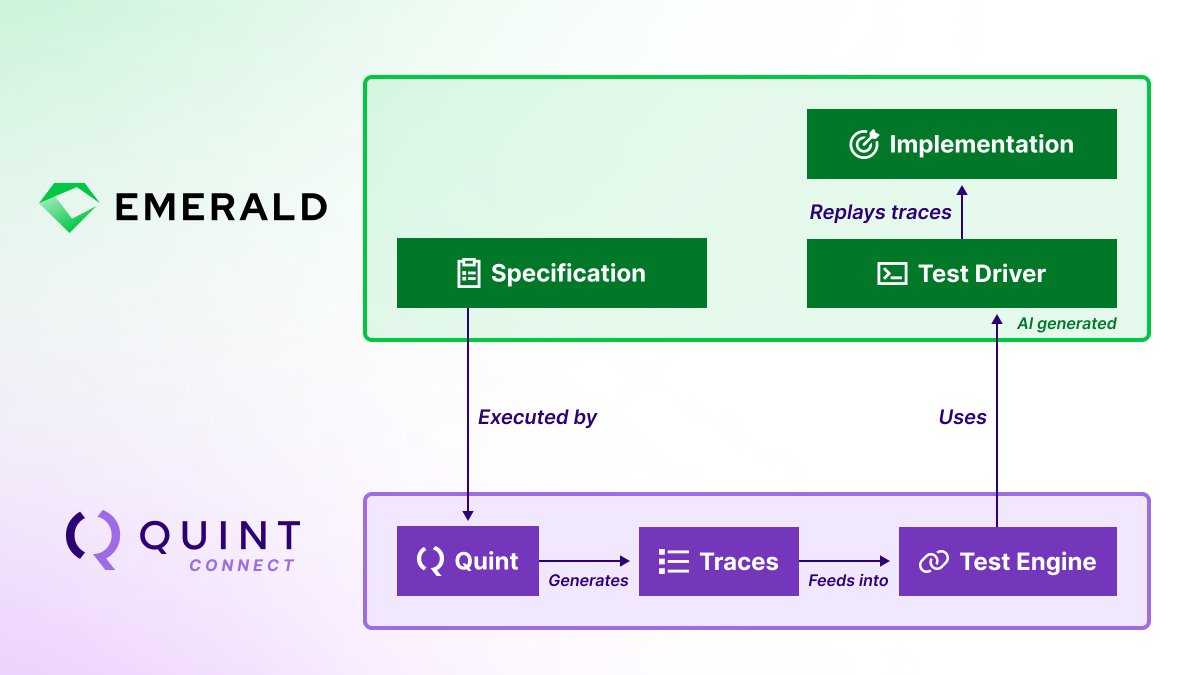
Do you know you can use Quint specifications to test your actual application? This is Model-Based Testing.
If you have a Rust project, you can take a shortcut: Quint Connect is a library that sets it all up for you, and agents can take care of the rest.
Emerald is using it 👇
@quint_lang Awesome!! Another way would be also to add some q::tap fn so you can send it elsewhere. Similar to tap> in clj, then we can viz, for example, the data (not only string) as in https://t.co/5bkEi0aMzU
Quint v0.31.0 is out, and it's a big one!
🦀 Rust backend is feature complete and now the default
✅ TLC is now available as an alternative backend for quint verify
🪄 IDE (LSP) improvements for a smoother experience
Quint now has its own X account!
We'll be posting tips and tricks, use cases, release updates, and more.
Join us in writing better >executable< specs in the LLM era.
I think this is broadly correct.
But I'd focus on specification instead - getting good at thinking about and formally writing down the safety, liveness, and performance properties of the system.
Verification follows from specification.
Yesterday, the Bazel team was dealing with an expired SSL certificate that broke builds for external users.
I wrote a quick post on why I think SSL certificates are so dangerous: https://t.co/fgSIuPOcB0