My simple framework for peak performance from my time with the Toronto Raptors:
Environment shapes everything. 3 key pillars:
- Autonomy (let athletes own their path)
- Mastery (focus on growth, not just outcomes)
- Connection (build genuine team bonds)
The foundation? Wellbeing basics:
• Sleep (crucial for learning + recovery)
• Movement
• Play (keep it fun!)
• Nutrition
• Resilience
• Social support
What separates elite performers?
Self-regulation: Plan → Monitor → Adjust
The mindset shift that matters most:
Stress isn't your enemy - it's your body preparing for something important. Navy SEALs who saw stress as enhancing performed better AND lifted their teams up.
Recovery isn't weakness - it's investing in future performance.
The science is clear: you can't perform if you're not well.
Environment + wellbeing + mindset = sustainable excellence.
Elite performance is 90% mental.
After studying 100+ professional and olympic athletes, I found they all face the same barriers: self-doubt, anxiety, and more.
The difference between champions and everyone else isn't talent - it's their ability to master their mind.
The one phrase I hear in #sport everywhere I go is "It's different here. That's the way we do it here. Those other ways wouldn't work here".
Sure - there are unique elements in every town, every region, every country and in every sport. But the big picture issues are globally consistent.
The reasons kids play sport in Australia - are the same reasons they play sport in Africa - in Asia - in the UK - in Ireland - in the USA....it's fun, they enjoy it, they're learning, they're improving and their friends do it.
And the reasons they stop playing sport are also the same...it stopped being fun, their friends left to do other things, they stopped improving, they stopped enjoying it.
Always find it amazing that where I go - within Australia or around the world that people all believe their problems are unique and no one can possibly understand what challenges they face when in reality my friends - it truly is the same all over the world: make it fun, focus on learning, foster positive relationships, make it safe - create the environment where they fall in love with their sport.
I’ve spent the last 5+ years researching athlete development.
After reading 100+ research papers and books,
These are the most important lessons I’ve found:
It's becoming more and more common having to deal with the over the top parent or coach willing to push they're kids into doing inappropriate levels of work and intensity for their own gain. "Oh, look at me and my kid: didn't you know lifting weights is good for kids..."mini adult" training and early intensification is the new early specialization. Mostly because they've never actually taken a young athlete through all the age appropriate stages. Instead, they just jump ahead to make it look like their program is special. Look at my kids doing college level stuff. Then we never hear about the end result.
I'll die on the age appropriate training hill because I've seen the end result...
#LTAD
Michael Jordan said, “Some people want it to happen, some wish it would happen, and others make it happen.”
Success doesn't happen overnight.
• It means drive.
• It means hard work.
• It means resilience.
Top performers know that peak performance is not about the destination, it's about the journey.
They know the focus is on sustainable excellence and long-term mastery, rather than just a fleeting moment of success.
It means continuous learning, adapting, and growing.
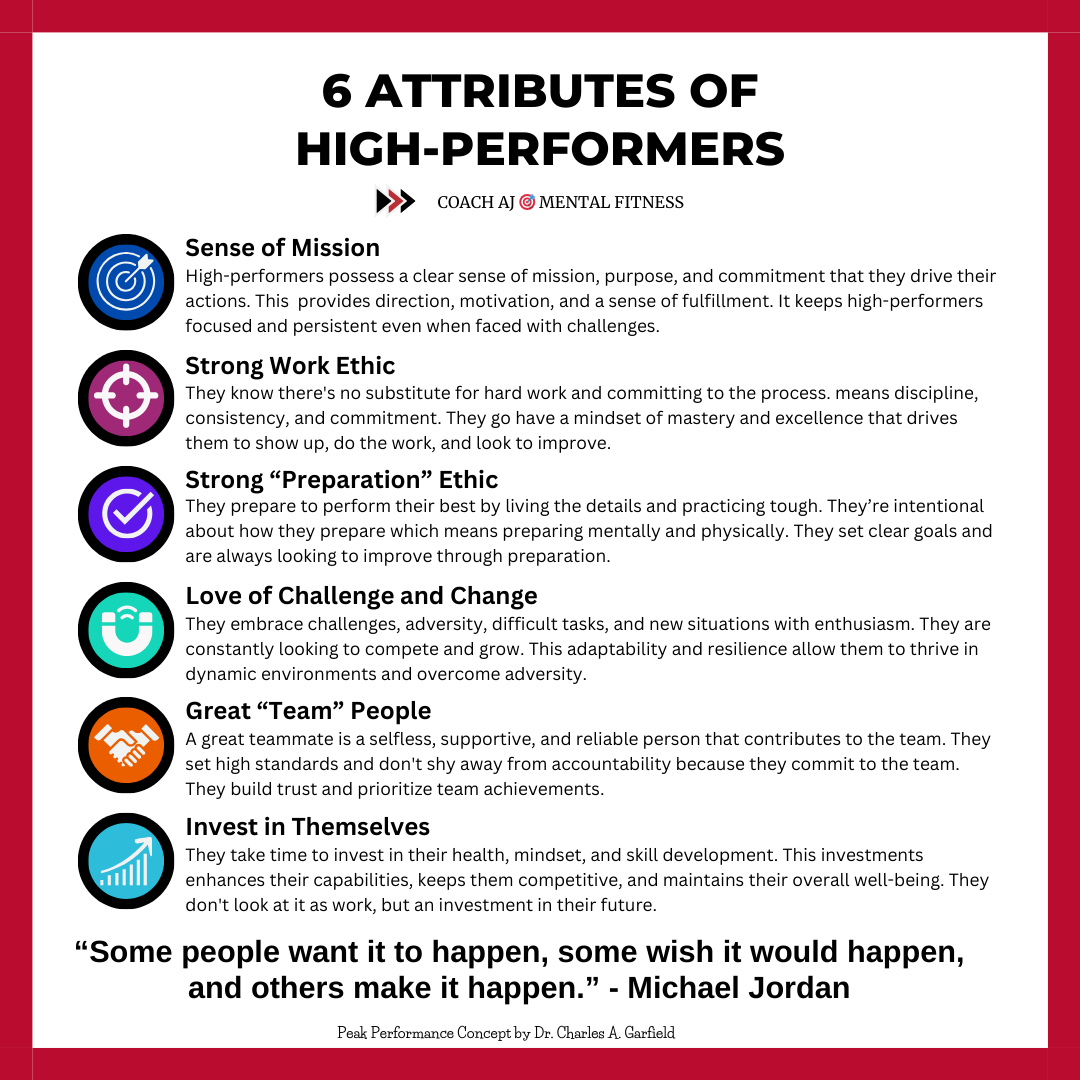
The 6 Attributes of High-Performers:
1. Sense of Mission - High-performers possess a clear sense of mission, purpose, and commitment that they drive their actions. This provides direction, motivation, and a sense of fulfillment. It keeps high-performers focused and persistent even when faced with challenges.
2. Strong Work Ethic - They know there's no substitute for hard work and committing to the process. It means discipline, consistency, and commitment. They go above and beyond, and they are always look to improve.
3. Strong "Preparation" Ethic - They prepare to perform their best by living the details and practicing tough. They’re intentional about how they prepare which means preparing mentally and physically. They set clear goals and are always looking to improve through preparation.
4. Love of Challenge and Change - They embrace challenges, adversity, difficult tasks, and new situations with enthusiasm. They are constantly looking to compete and grow. This adaptability and resilience allow them to thrive in dynamic environments and overcome adversity.
5. Great "Team" People - A great teammate is a selfless, supportive, and reliable person that contributes to the team. They set high standards and don't shy away from accountability because they commit to the team. They build trust and prioritize team achievements.
6. Invest in Themselves - They take time to invest in their health, mindset, and skill development. This investments enhances their capabilities, keeps them competitive, and maintains their overall well-being. They don't look at it as work, but an investment in their future.
Some of the best sprint coaches in the world are slow white guys.
Teaching & doing are 2 different skills
You can do both. But it takes time and effort to learn how to coach & teach
Far too many people think if they have a bit of success in a domain they can teach others well
Too many youth sports practices are just "repping it out."
This doesn't teach kids how to perform at game time.
Rote practice is inadequate because it doesn't match the demands of competition.
We just need to let the kids play more.
It's the closest think to the real game.
We talk way too much about coaching "styles".
There's just you. You're either yourself or trying to be something you're not.
The healthier you are, the better leader you are, and the greater impact you'll have.
Be better for your athletes.
Some of the best coaches in history never played their sport or were horrible at it.
Experience in the thing can help but much more important is a willingness to learn, understand, and care.
Coaching/Teaching and doing are two different skills.
Everyone talks about getting 1% better every day.
Few people actually explain how to do it.
Here's the real science of self-improvement and how you can use it to reach your full potential:
What separates adult world-class athletes from successful juniors?
Researchers did a meta-analysis on 6000+ athletes from 15 countries.
Here’s what they found:
@kestrelpsych@AlexAuerbachPhD@adamlaw217@SportPsychDunc It doesn’t hurt his team chemistry b/c it is just one part of his whole system. The chemistry built between he and his players and between players is of paramount importance to the whole structure. Read The Man Watching and you’ll find your answers.
We are at peak health and fitness Guru.
They are everywhere. Slinging supplements and protocols to fix every problem.
And much of it is BS...but it's easy to fall for it and hard to sort signal from noise.
Here are 7 ways to detect Guru BS: