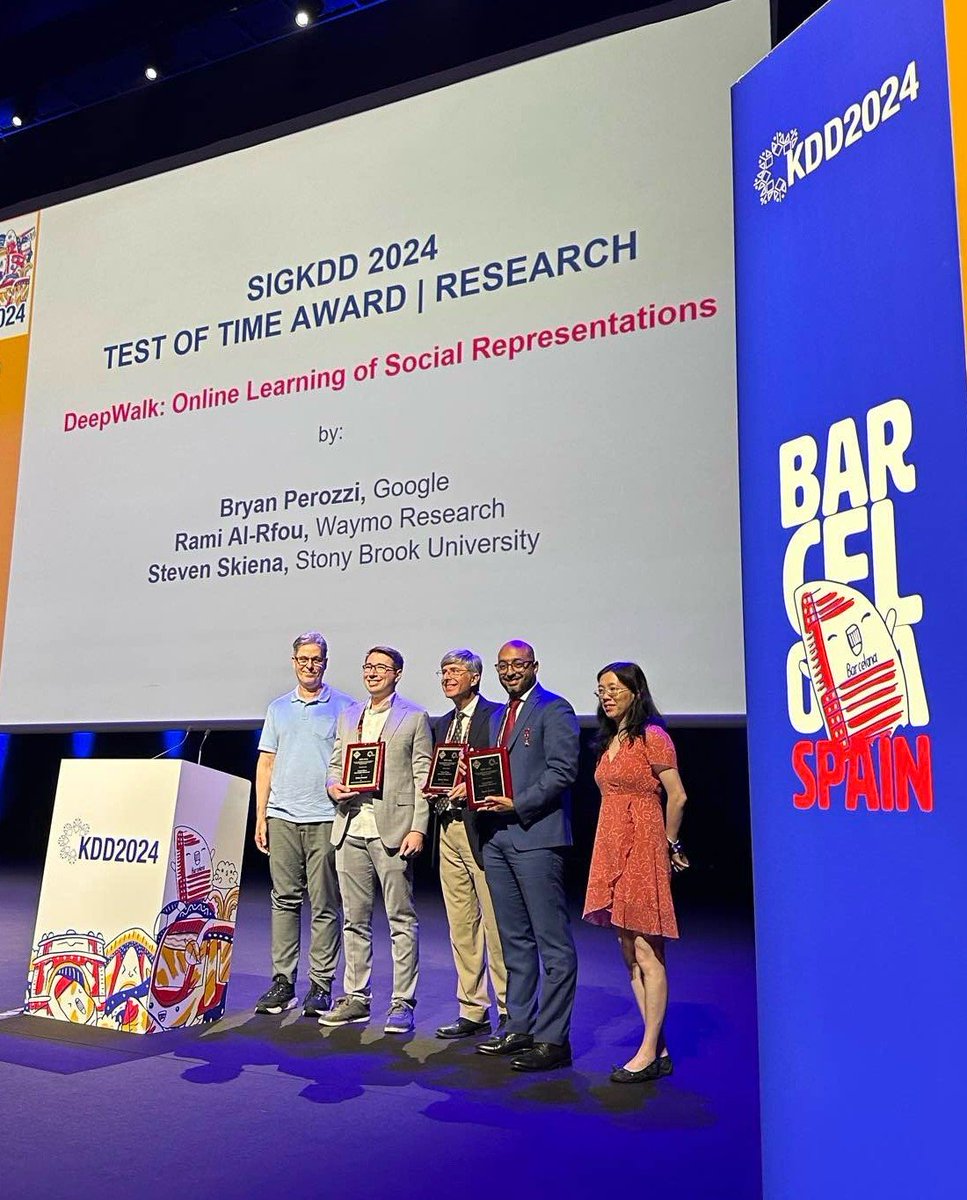
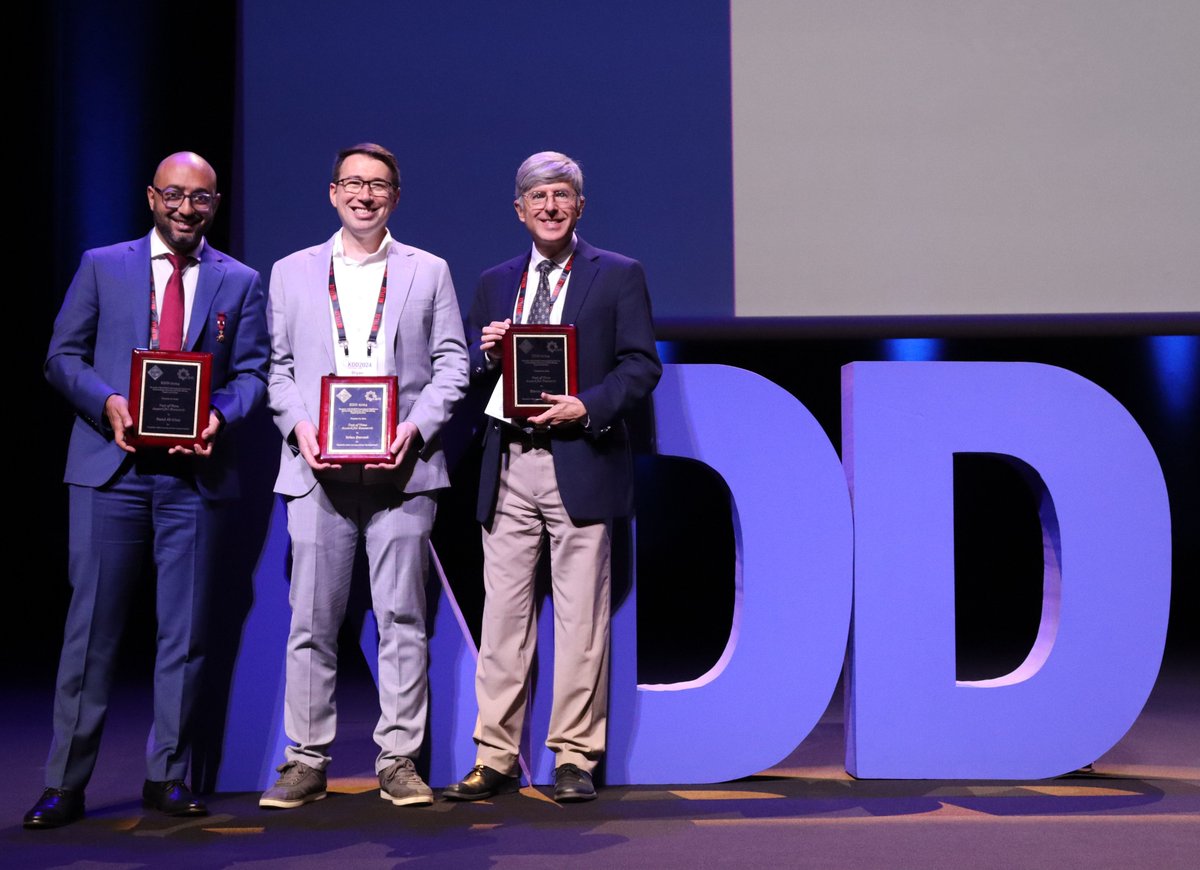
Honored to win the ACM SIGKDD Test of Time award for "DeepWalk: Online Learning of Social Representations" at KDD'24!! 🏆
(1/3) @kdd_news
w/ @BedouinRanger and @StevenSkiena
AI is rapidly accelerating scientific discovery and contributing to the effort to better understand cancer. We're proud to announce two major open-source breakthroughs from @GoogleResearch and @GoogleDeepMind that demonstrate the immense potential of AI in this field:
First, DeepSomatic can significantly improve cancer diagnostics by accurately identifying key genetic variants within cancer cells, outperforming current state-of-the-art methods. This provides researchers and clinicians with a more precise and reliable tool for mapping cancer's blueprint, which is essential for targeted therapy development.
Second, our new Gemma C2S-Scale 27B model (built using our open Gemma family), achieved an exciting milestone: it generated a novel hypothesis to convert "cold" tumors—which are notoriously resistant to current immunotherapies—into "hot" tumors that can be successfully treated. This discovery may offer a new avenue for cancer drug development.
Congrats to the team from Google and Yale on the release of C2S-ScaleGemma weights today! Building on some of our graph learning expertise, I'm impressed by how far we've come with advancing both science & math with foundation models, and look forward to more!
I would share this with anyone who still claims that AI (including LLMs) cannot make scientific discoveries. Soon, I will also reveal something really cool & important related to medicine.☺️
I repeat my advice: Don’t say “AI can never do this or that,” and don’t bet against AI!
This work is incredibly close to my heart. So grateful to our team @GoogleDeepMind@GoogleResearch & @Yale collaborators.
It's been a hard road and a hard-won milestone, and this is just the beginning.
The path from a finding like this to the clinic is very long, requiring extensive preclinical and clinical validation. But the potential is what drives us. We hope that as these AI models scale, they can help researchers overcome fundamental challenges in cancer treatment like therapeutic adaptation or discover new pathways to re-energize our immune cells.
A long way to go, but a hopeful first step.
One of our new Gemma open models, Cell2Sentence-Scale, has identified a novel cancer therapy pathway that’s been validated experimentally in living cells. Developed w/ @GoogleDeepMind & @Yale University, it looks deep into how to represent cells & biological information for AI ↓
An exciting milestone for AI in science: Our C2S-Scale 27B foundation model, built with @Yale and based on Gemma, generated a novel hypothesis about cancer cellular behavior, which scientists experimentally validated in living cells.
With more preclinical and clinical tests, this discovery may reveal a promising new pathway for developing therapies to fight cancer.
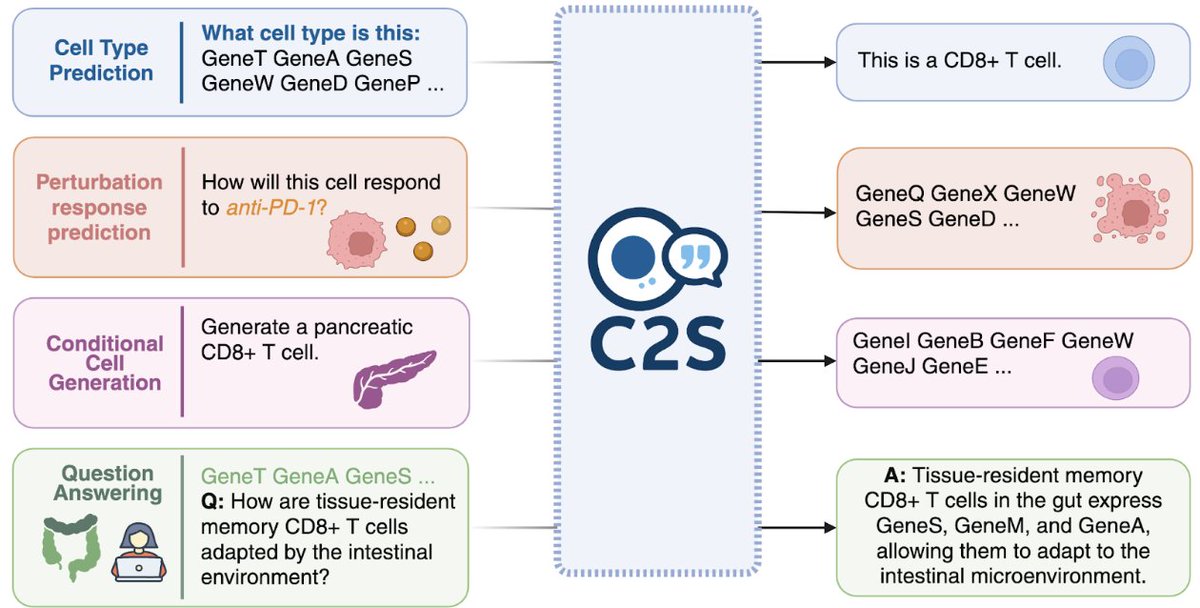
⚕️ Introducing C2S-Scale 27B, our new Gemma open model that can translate complex single-cell gene expression data into “cell sentences” that LLMs can understand.
C2S-Scale is a new 27 billion parameter foundation model built on the Gemma family of open models that generated a novel hypothesis about cancer cellular behavior that we’ve confirmed with experimental validation in living cells. This discovery reveals a promising new pathway for developing therapies to fight cancer.
An exciting milestone for AI in science: Our C2S-Scale 27B foundation model, built with @Yale and based on Gemma, generated a novel hypothesis about cancer cellular behavior, which scientists experimentally validated in living cells.
With more preclinical and clinical tests, this discovery may reveal a promising new pathway for developing therapies to fight cancer.
Check out the #ICML2025 EXPO talk at 4:30pm by Bryan Perozzi & Michael Galkin on "Graph Foundation Models: Thoughts and Results", which will explain how single models can learn transferable representations for generalization across diverse graphs & tasks. https://t.co/H6NFNE2esd
📣 Our spicy ICML 2025 position paper: “Graph Learning Will Lose Relevance Due To Poor Benchmarks”.
Graph learning is less trendy in the ML world than it was in 2020-2022. We believe the problem is in poor benchmarks that hold the field back - and suggest ways to fix it!
🧵1/10
This is a landmark paper I’ve been waiting for-toward creating “virtual cells,” which will revolutionize how we study & interact with biological systems in silico through AI rather than in the wet lab! This should’ve been major news! Congrats to @GoogleAI team &
@david_van_dijk
What if LLMs could “read” & “write” biology? 🤔
Introducing C2S‑Scale—a @Yale + @GoogleAI@GoogleDeepMind collab: we scaled LLMs (up to 27 B!) to analyze & generate single‑cell insights by turning transcriptomes into text 🧬➡️📝
🔗 Blog: https://t.co/3GbnXbKVmb
🔗 Preprint: https://t.co/beO8Z9CESc
#SingleCell #AI #LLM
Fun fact: we actually suggested modeling biological sequences to our advisor as a follow up to DeepWalk in 2013. Happy to finally be scratching this itch 😄
Today on the blog we introduce Cell2Sentence-Scale, which looks deep into how to best represent cells and biological information as text, opening up exciting applications for language-driven single-cell analysis with large language models. Learn more →https://t.co/Rzy4FSFnQY
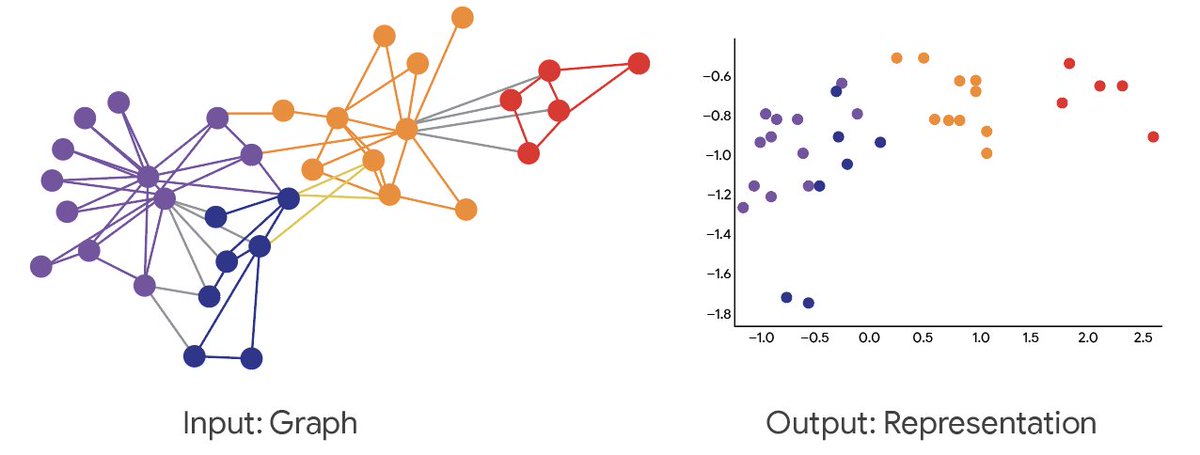
Graphs provide a powerful way to model & solve many real-life problems, from traffic prediction to understanding why molecules smell. Learn more about the recent history of graph-based #ML & the role that Google researchers have played in the field →https://t.co/MDXAn94tyS
Today on the blog, we share a comprehensive evaluation of transformer models’ graph reasoning capabilities, shedding light on their effectiveness across a variety of graph reasoning tasks and introducing a novel representational hierarchy. Learn more →https://t.co/EEuPJmYiqQ
The Google Research blogpost is out!
Which classes of graph problems can "thinking" models solve more efficiently than pure transformers? Answer in the paper~
https://t.co/k5Yw5mS9Ko
How can we best encode structured data into sequential form for LLMs? Join @phanein for a live demo today at 12:30PM at the #NeurIPS2024 Google Research booth to learn how Graph Tokens significantly boost an LLM's ability to solve graph reasoning tasks.
https://t.co/CMH5QqATZ1