Few perfume tips, to have a great fragrance collection.
Start with three:
• A fresh scent for everyday wear.
• A refined scent for work and meetings.
• A rich,distinctive scent for special occasions.
What three perfumes would make up your collection? #GreysEssence
Gold is crashing and oil is surging days to Ghana’s 2027 budget reading. This is going to be one of the bigger tests yet for this administration. Favourable external conditions have been a factor (in addition to fiscal consolidation & real sector reforms) to Ghana’s recovery.
Harry Kane going from football’s most famous trophyless player to a Ballon d’Or winner might be the greatest example of why changing employers can improve your life.
Let me add to this.
I studied Psychology at university and have since gone on to do almost everything except Psychology.
I’ve founded multiple tech companies, served as Country Manager for a company, led communications and programmes across different organisations, started several initiatives and raised over $500K across my projects.
Looking back, here’s what I would tell any undergraduate in Ghana who wants to build an interesting and successful career.
1. On taking your grades seriously.
I didn’t particularly optimise for grades in university. At the time, I didn’t think they mattered much for the kind of future I imagined for myself.
In retrospect, I think that was a mistake. Good grades open doors, especially for scholarships, postgraduate opportunities and certain early-career programmes.
You may never need them, but you don’t want to discover that you do when it’s too late.
2. Join clubs that teach you skills your degree probably won’t. If I could recommend just one, it would be a debate society. Learn to construct arguments, defend positions, think on your feet and speak confidently in front of people.
I cannot overstate how important public speaking and argumentation are in the real world. I’ve seen incredibly intelligent people struggle to advance because they cannot communicate their ideas. I’ve also seen fairly average people go very far because they can command a room.
Learn to speak. It’s non-negotiable.
3. Develop entrepreneurial thinking, regardless of whether you ever intend to start a business.
And I don’t mean the hustle culture of trying to sell everything or make money from anything.
I mean learning to identify problems, mobilise people, manage limited resources, test ideas and create something people find valuable.
These are skills that will serve you in almost any career.
4. Join organisations like Enactus, AIESEC, Junior Achievement or similar student-led initiatives. The real value of these organisations is the exposure.
You get to work with people who think differently, solve problems outside the classroom, manage projects and sometimes interact with organisations you would otherwise have no access to.
These experiences fundamentally change how you think about what’s possible.
5. Build things.
Start a club. Organise a campus event. Volunteer to help run a conference. Lead a student initiative. Work on a community project. You don’t need permission to start doing interesting things, and that process you’ll learn to write proposals, convince people, raise resources, negotiate, deal with difficult personalities and actually execute ideas.
These are things no lecture can adequately teach you.
6. On networking.
Most students approach networking the wrong way. They attend an event, identify the most important person in the room and spend the entire time trying to get their attention. Terrible strategy. Go to events with genuine curiosity. Introduce yourself to people, ask what they’re working on, listen and thoughtful questions.
Great conversations are archetypes for many meaningful relationships.
7. Have a LinkedIn account.
I know people think LinkedIn is tacky but if you’re a young person trying to build a career, I think it’s non-negotiable. Document your journey. Events you helped organize, interesting problems you’re exploring, anything.
Over time, people begin to associate you with certain interests and capabilities.
You’re building a public record of your growth.
if you’re an undergrad optimizing for employability, i think your best bet in ghana is to
a) get the best grades possible (a non-negotiable)
b) keep tabs on industry trends
c) find a mentor who actually wants to see you succeed
d) network consciously
Most hilarious thing about Prem fans is begging Arsenal to win the league instead of just asking their team to step up. And then also saying Arsenal is the worst team to win.
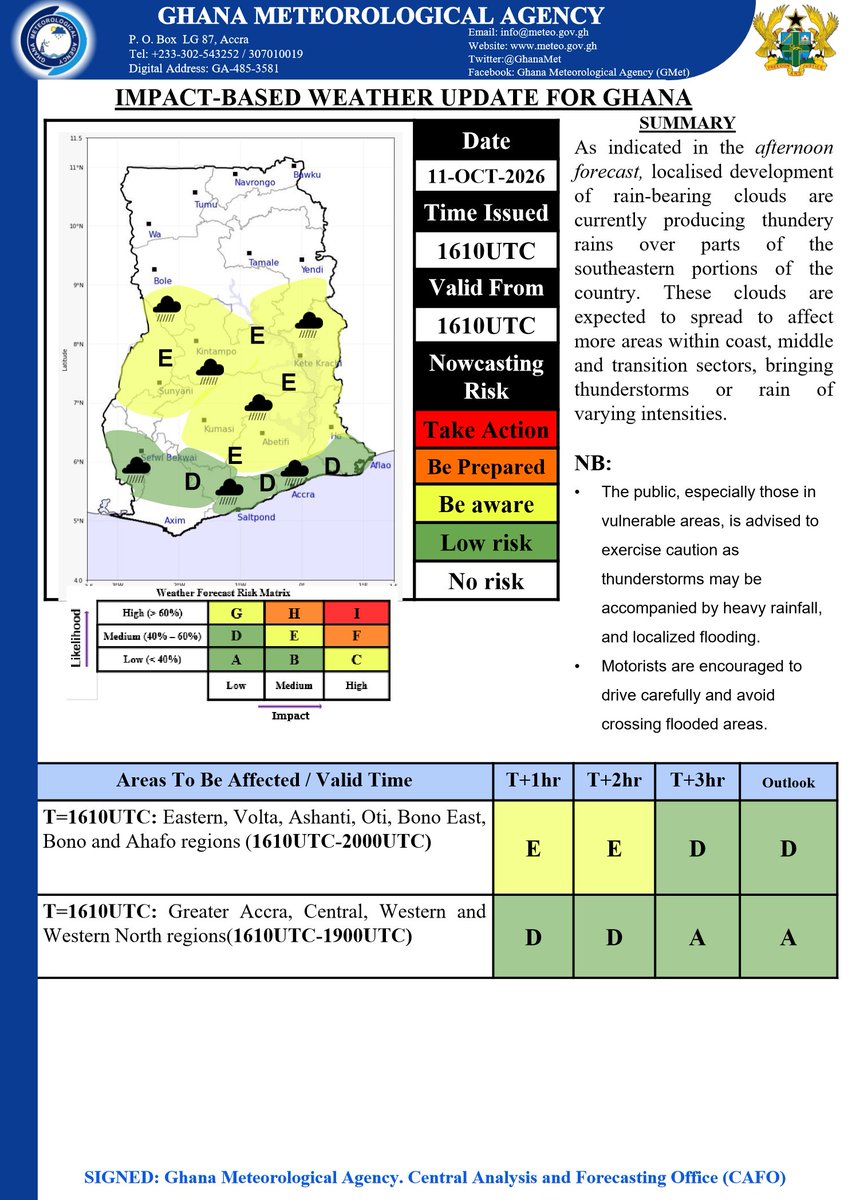
⚠️WEATHER UPDATE 11/10/2026
🌧️ Rain-bearing clouds are spreading across parts of southern Ghana, bringing thunderstorms and rain of varying intensities to more areas within the coastal, middle and transition sectors.
#GMet#WeatherUpdate#GhanaWeather
You get to select from 14 different cars. The lowest starting at GHS 145,000 & highest going as much as GHS 450,000.
Payment plans start as low as GHS 2,407 cedis and as high as GHS 7,470 a month.
Spread across for 7 years. 👍🏾
Electric and Petrol cars available
Text me ASAP limited numbers only
So let’s come back to the employer who has already paid September salary using the old monthly table.
There may be an adjustment to make. Absolutely.
But what exactly has happened that the tax framework cannot deal with?
The fact that September salary has already been paid doesn’t prevent us from determining the employee’s correct tax liability for the year. It doesn’t turn the PAYE already withheld into a final tax. And it doesn’t mean a withholding computation made earlier cannot be adjusted. Regulation 4 itself contemplates an estimate being reconsidered during the year.
I suspect we have become so used to the monthly PAYE tables that we sometimes think about PAYE almost entirely in monthly terms. But the underlying tax liability isn’t monthly. It is annual, and the PAYE deducted along the way is generally tax paid on account of that liability.
Could GRA have communicated this earlier? Of course. That’s a fair criticism.
But that is a different question from whether employers who have already processed September salaries now face some major tax problem.
When section 1, sections 119 and 120, paragraph 9 of the First Schedule and regulations 3, 4 and 9 of L.I. 2244 are read together, I don’t think they do.
There may be an adjustment to make. But the law already gives us the framework for dealing with it.
L.I. 2244 makes the annual nature of this even clearer.
Regulation 3 talks about withholding during the year to meet the employee’s employment tax liability for that year. Regulation 4 then works with an estimate of the employee’s employment tax liability for the year, taking into account what has already been withheld.
And regulation 4(3) actually allows the employer to reconsider an earlier estimate and make a new one where the earlier estimate is no longer accurate.
Then there is paragraph 9 of the First Schedule itself. For me, this is probably the most important provision in the whole discussion.
It is headed “Change of rate”.
The law expressly anticipated that tax rates could change during a year of assessment. Where that happens, you do a tentative computation using the old rates and another using the new rates. Both are based on the person’s chargeable income for the entire year. You then apportion according to the number of months each rate was in force.
So the law already contemplated one set of rates applying for part of the year and another set applying for the rest of the same year.
Regulation 9 of L.I. 2244 takes us back to the same annual concept. The employee’s employment tax liability is calculated for a year of assessment by applying the appropriate First Schedule rates to the employment income for the year, subject of course to the relevant deductions.
I’ve seen quite a number of comments on this today. GRA has only now communicated that the new graduated rates take effect from 1 September, by which time some employers have already processed and even paid September salaries.
Fair concern.
But let me play devil’s advocate for a moment because I think there is another way to look at this.
My starting point is quite simple. The First Schedule to Act 896 does not contain a separate monthly graduated tax schedule. Paragraph 1 gives us annual rates. Section 1 itself imposes income tax for each year of assessment.
So ultimately, we are dealing with an annual tax liability.
Of course we have monthly PAYE tables and we use them every month. But those make the monthly withholding obligation workable. They shouldn’t be confused with the underlying graduated rates in the Act.
There is another point I think is very important in this discussion. PAYE withheld from the employee is generally not a final tax. It is tax paid on account of the employee’s tax liability for the year.
Sections 119 and 120 of Act 896 are useful here. Section 119 tells us what constitutes a final withholding payment. Section 120 then provides that where a withholding payment is not final, the taxpayer is treated as having paid the amount withheld and gets a tax credit for it for that year of assessment.
So the PAYE deducted from an employee in September is not some final September tax which closes the door once the salary has been paid. It is a withholding towards the employee’s tax liability for the year.