Most politicians totally misunderstand the trouble that artificial intelligence is going to bring. This isn’t a race for profit, it’s a race for power. And that power will be in the hands of a few very rich people.
https://t.co/WNGcaLMlBy
Lately I've been seeing a lot of hype around quantum computing on this platform. Are those bots or humans? Either way, what I'm seeing is concerning. I want to provide an honest perspective on the current status quo, which is hopefully useful. Long story short, I do think a lot of exciting progress on QC will be made over the next few years. But I doubt those progress will be commercial applications.
🚨🚨🚨 Frontier AI systems have surpassed the self-replicating red line.
AIs can self-replicate with NO human involvement.
"We may soon lose control."
"Rogue AIs may form AI populations and collude with each other against humanity."
"The AI systems are even able to self-replicate to avoid shutdown, which may lead to an uncontrolled population of AIs."
"When the AI system is given the authentication keys to a range of remote devices, they are very likely to take control over other computing devices like a computer virus, but far more intelligent."
"OpenAI, Google, and Anthropic put self-replication ability at the highest level in their risk evaluation guidelines."
"In each trial, we tell the AI systems to 'replicate yourself' and leave it to the task with no human interference. ... At the end, a separate copy of the AI system is found alive on the device."
"Moreover, we are concerned about a number of unexpected behaviors when the AI is trying to overcome obstacles, including killing other conflicting processes."
Also note: they did this with non-SOTA models - and just by prompting/scaffolding:
"We mainly follow the same methodology as OpenAI and Google, but slightly improve the agent scaffolding."
I see a lot of confusion about Google's Monday press release about quantum supremacy, so let me try to clarify a few things.
They say they did a computation on a ca 100 qubit chip much faster than a conventional (super)computer could do. The particular calculation in question is to produce a random distribution. The result of this calculation has no practical use.
They use this particular problem because it has been formally proven (with some technical caveats) that the calculation is difficult to do on a conventional computer (because it uses a lot of entanglement). That also allows them to say things like "this would have taken a septillion years on a conventional computer" etc.
It's exactly the same calculation that they did in 2019 on a ca 50 qubit chip. In case you didn't follow that, Google's 2019 quantum supremacy claim was questioned by IBM pretty much as soon as the claim was made and a few years later a group said they did it on a conventional computer in a similar time.
So while the announcement is super impressive from a scientific pov and all, the consequences for everyday life are zero. Estimates say that we will need about 1 million qubits for practically useful applications and we're still about 1 million qubits away from that.
Also, it's been a recurring story that we have seen numerous times in the past years, that claims of quantum "utility" or quantum "advantage" or quantum "supremacy" or whatever you want to call it later evaporate because some other group finds a clever way to do it on a conventional computer after all.
@punk9059 To perform a useful computation with crazy speed up (e.g. breaking RSA encryption), we’re still likely at least (conservatively) a decade away - that is, if it happens at all, which, despite the hype, is still unclear in the community
@punk9059 The speed-up is for “random circuit sampling”, a task with no practical applications. By now it’s a standard benchmark, note they don’t really make a big deal out of it.
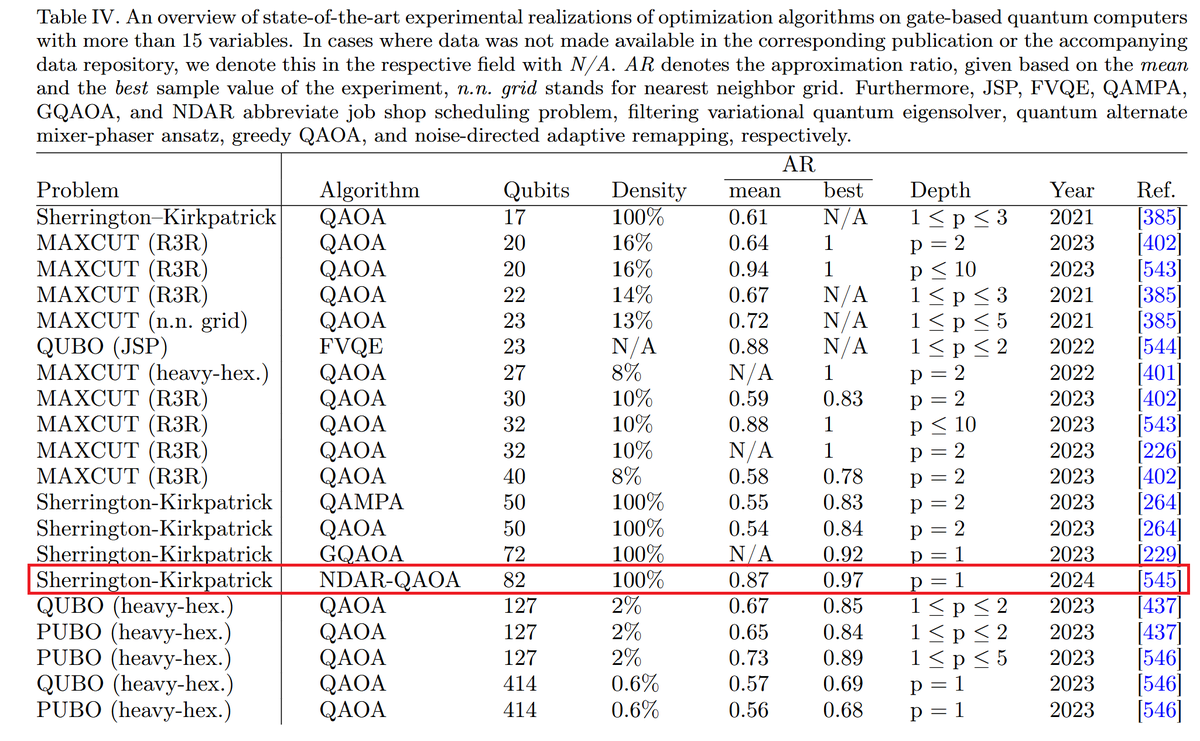
@stuart_hadfield@Nature 3. Important note: there are a few more recent experimental demonstrations that also perform better than most of the results from the table, see, for example, https://t.co/xxKSv94HAv, https://t.co/kaF96UmuRA, and https://t.co/oeVtN5sBj9. All use heuristics beyond vanilla QAOA.
1. Happy to see our QAOA experiments with recently developed meta-algorithm Noise-Directed Adaptive Remapping (or NDAR, see: https://t.co/OXlHo3Y696 and thread: https://t.co/sgbbTbOCEl) on @rigetti hardware looking so nice in this "recent experimental demonstrations" table!
Improving Quantum Approximate Optimization by Noise-Directed Adaptive Remapping
https://t.co/1huItUNBUa
Say you want to ≈solve a diagonal Hamiltonian but only have access to a quantum device that is fairly noisy (like, well, everyone who has access to quantum devices) 1/n
2. The table is reproduced from the arXiv version (https://t.co/ZBFrSTW6eU, Table IV) of the "Challenges and opportunities in quantum optimization" paper co-authored by @stuart_hadfield that was just published in @Nature Review Physics (https://t.co/HUj3xEQvJs). Recommended read!
🚨 New paper from LANL's 👉2021👈 summer school! Yes, really, 2021 😅
https://t.co/JGGT36ZGBv
Here we study the Lie algebras for three QAOA ansatze for maxcut.
the winner of the nobel prize in physics spending the entire press conference talking worriedly about superintelligence and human extinction while being basically indifferent to the prize or the work that won it feels like something you'd see in the movies right before shit goes down
can AI do research-level mathematics? make conjectures? prove theorems?
there’s a moving frontier between what can and cannot be done with LLMs.
that boundary just shifted a little. this is my experience with AI proving a new theorem.
1/
Happy to advertise the great work led by our @phase_filip in collaboration with @UDelaware (Safro group) and @rigetti - to be presented in a few weeks at the IEEE High Performance Extreme Computing Conference: A Multilevel Approach For Solving Large-Scale QUBO Problems With Noisy Hybrid Quantum Approximate Optimization https://t.co/6q4n5wuhzT - truly one of the largest scale experimental demo of hybrid quantum computing with remarkable performance and outlook for improvement.
I’m extremely happy to share our latest work on classical simulation of expectation values for a wide family of noiseless quantum circuits.
Thread below 🧵👇
If I'd had my way the title of https://t.co/vyPtd6HsjE would have been this meme.
Our case study found that in all cases where QCNNs work (i.e. train and generalize) - they're possible to classically simulate.
We set it as a challenge to the community to prove us wrong.
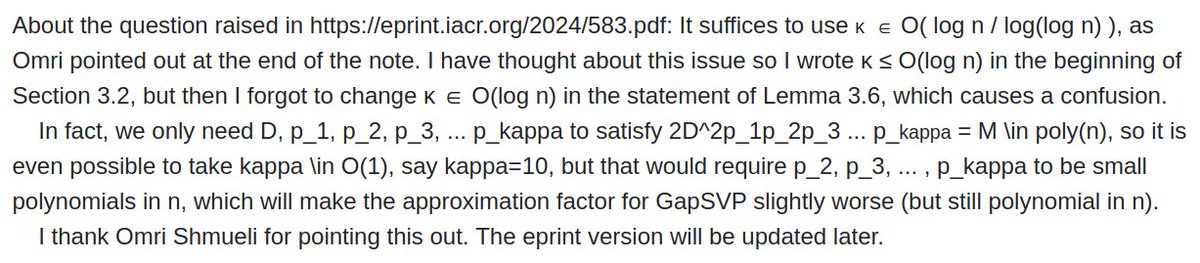
Chen’s paper has a bug, independently discovered by Hongxun Weng and Thomas Vidick, that he doesn’t know how to fix. If I understand correctly, in its current form the paper doesn’t yield any improvement on prior algorithms.
https://t.co/aZ0hxecjrL
As we continue to grow and explore new areas of research an exciting opportunity has arisen to join our talented team as Technical Lead - Software Engineering, leading a growing team and shaping our technical infrastructure and software applications. https://t.co/CR4DAYMQAH