Radiology -- too many scans. Are we losing the art of physical exam in medicine? Are medical students taught physical exam thoroughly or just which tests to order? Enjoy this fun video 😀
Radiology -- too many scans. Are we losing the art of physical exam in medicine? Are medical students taught physical exam thoroughly or just which tests to order? Enjoy this fun video 😀
@VinnyLingham Sustaining 25% over 20 years (~100X) in an investment is a rare gem, involves luck and high conviction
25% annualized over 10 years (10x in 10 years) have more realistic opportunities
Your point is very valid about starting young and using time as major lever!
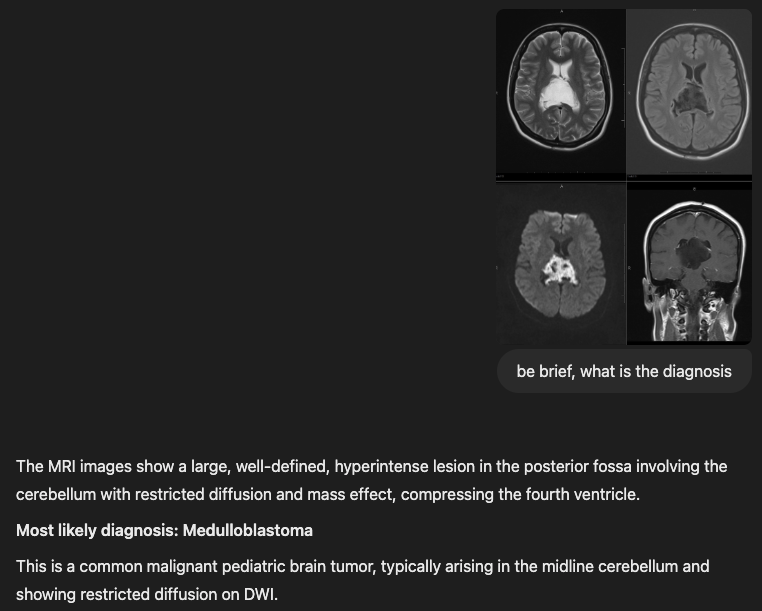
Was curious how LLMs such as Chat GPT and Grok 3 were interpreting medical imaging scans such as MRI, CT, X-ray, etc.. so I asked them directly 😀
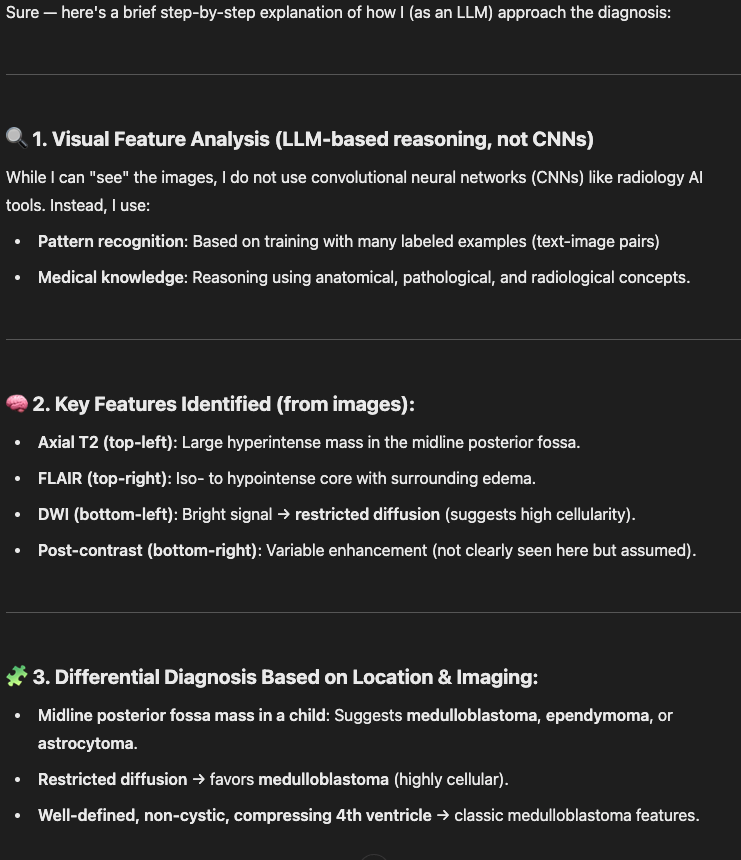
It seems Chat GPT is using :
Visual Feature Analysis: (LLM-based reasoning, not CNNs)
1. Pattern recognition: Based on training with many labeled examples (text-image pairs)
2. Medical knowledge: Reasoning using anatomical, pathological, and radiological concepts.
They are not using convolutional neural networks (CNNs) like some established radiology AI tools.
This is really interesting because they are learning by associating images of scans with associated descriptive text, I assume from digitized books or reference articles when the LLM is trained. This is similar to how basic book knowledge is obtained by radiology residents. They LLM's should eventually get better and learn to diagnose textbook medical cases consistently.
In clinical practice, majority of the cases are not "classic" textbook cases, whether you have to infer a novel concept or diagnose with artifact/suboptimal images. This is where practical knowledge is gained in residency and with experience. It is definitely possible the LLMs can make this leap as well...very interesting times.
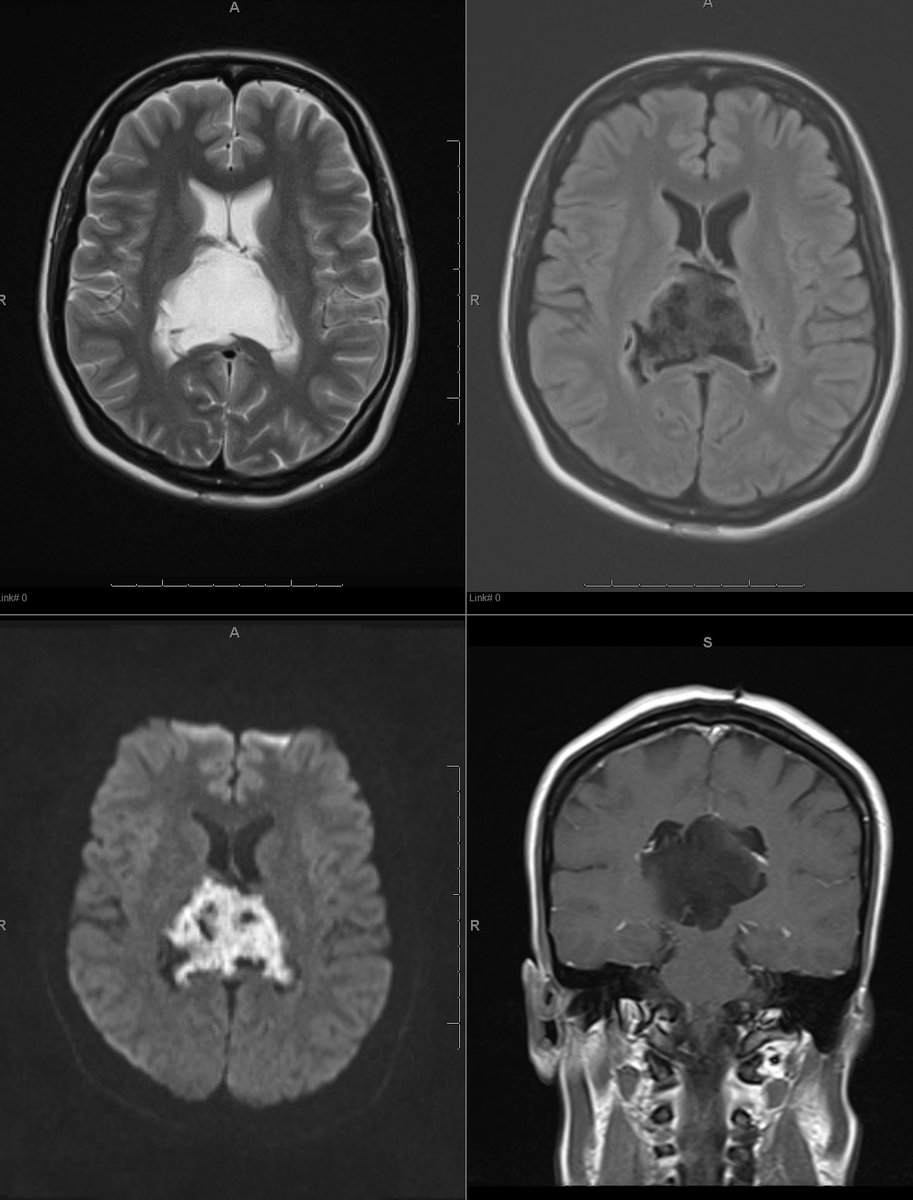
Who do you think would be better at diagnosing this brain MRI case?
A. Second year resident
B. GPT 4o
C. Grok 3
Take a look at what Chat GPT and Grok thing about the MRI scan. They are getting some correct diagnoses on easy scans but trip up on some of the more challenging ones.
Another interesting scenario for LLMs interpreting MRI medical scans is that the output can change. Here is MRI of basal ganglia abnormality. It gets it right on the first shot, but when asked again, it clearly hallucinates and thinks that it is looking at a car instrument panel showing low tire pressure.
Still early days yet, but very interesting!!
Another interesting scenario for LLMs interpreting MRI medical scans is that the output can change. Here is MRI of basal ganglia abnormality. It gets it right on the first shot, but when asked again, it clearly hallucinates and thinks that it is looking at a car instrument panel showing low tire pressure.
Still early days yet, but very interesting!!
Here are some sample tests of gpt 4.5 and grok 3 trying their interpretive skills on brain MRI.
They both accurately nail the large stroke. However it is somewhat of a black box in how they arrived at the interpretation when you ask it to annotate the abnormality.
As a radiologist I've been playing with these LLMs since the beginning. It's impressive how far they have advanced in the last 6 months.
Really fascinating stuff - this is rapidly accelerating!!
Computer vision for medical scans is still very early but will be interesting where it goes
As a radiologist myself I have been playing with some of the LLMs, still not there yet. Think computer vision for medical scans can be solved but maybe needs CNNs rather than LLMs similar to full self driving
Here are some sample tests of gpt 4.5 and grok 3 trying their interpretive skills on brain MRI.
They both accurately nail the large stroke. However it is somewhat of a black box in how they arrived at the interpretation when you ask it to annotate the abnormality.
As a radiologist I've been playing with these LLMs since the beginning. It's impressive how far they have advanced in the last 6 months.
Really fascinating stuff - this is rapidly accelerating!!
My friend went to the doctor recently.
Doctor diagnosed them with a serious issue.
Friend took the medical scans and uploaded to ChatGPT.
ChatGPT diagnosed friend with something different and much lower risk.
Friend sends ChatGPT results to doctor.
Doctor confirms they made a mistake and ChatGPT is right.
Insane situation.
But obvious where the world is quickly going…
Computer vision for medical scans is still very early but will be interesting where it goes
As a radiologist myself I have been playing with some of the LLMs, still not there yet. Think computer vision for medical scans can be solved but maybe needs CNNs rather than LLMs similar to full self driving
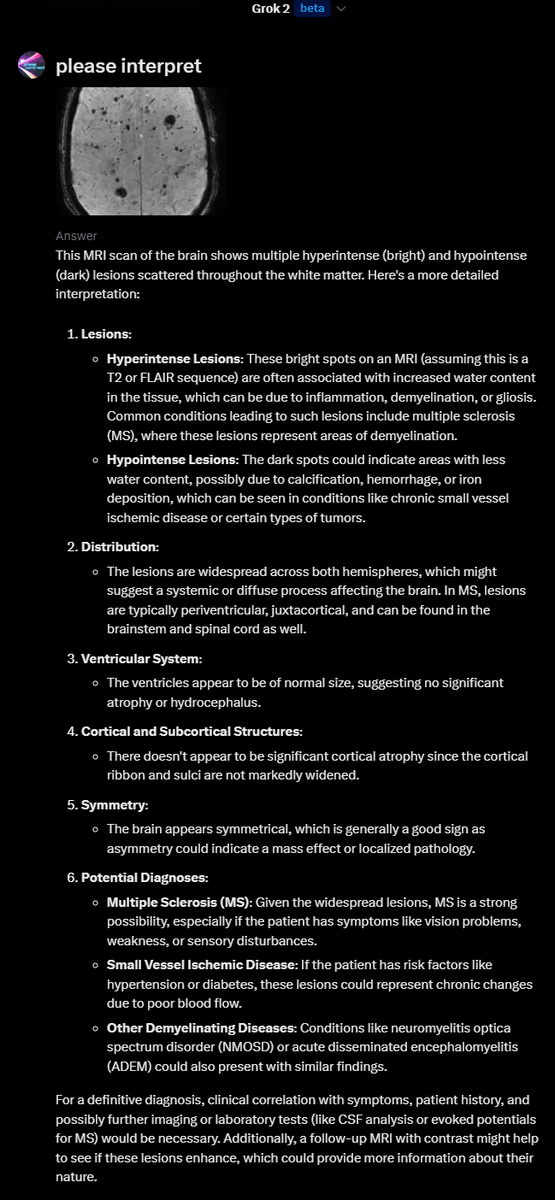
MRI battle:
Chat GPT vs Grok
Chat GPT performed better, as it correctly identified the sequence as SWI and made the abnormal finding but would not come to final dx. ??guardrails
Grok was able to identify that it was looking at MRI, but could not identify the sequence. It was all over the place in interpretation and unable to make the correct findings, trying to look smart by being wordy.
For those interested these were multiple cavernomas.
Made a fun song/video for Radiology. It's called "Just read fast...and don't miss that bleed"
It's for all us radiologists who have to read CT scans, MRI scans, imaging super fast in this radiologist shortage. Hope you enjoy and have a laugh!