@aemonten@hyphaltip@KState@KSUPlantDr Hi Alejandro,
I am wondering about the same question. Is the Fungal genetics stock center still alive. I would like to order a plasmid. Any information welcome.
Many thanks, Martin
Researchers have created a new curation tool that can match up information on completely unrelated species - invaluable for scientists studying interactions between pathogens and hosts
Full story 👇
https://t.co/7NhqbMf1OU
Exciting news for #bioinformatics researchers! PHI-base version 4.15 is now live, featuring 237 new curated references, 384 new genes, and 1069 new interactions. Dive into the latest release and unlock new insights for your #genomics research. #PHIbase#database
Are you interested in fungicide resistance of pathogenic organisms and biocuration? We have a job opportunity for UK-based graduates. https://t.co/riYbTDnCXZ
PHI-base Version 4.14 (Nov 2022) has now been released! 🎉 The database contains a total of 8993 genes from 4847 curated articles. Compared to version 4.13 we have an additional 285 genes from 236 newly curated research papers included.
Our new release of PHI-base Version 4.13 is online! Compared to the last release an additional 224 references are included. The references describe 297 additional genes and their contribution to virulence. We now list a total of 18982 pathogen-host interactons.
Interested in Bio-curation? PHI-base has a part-time job opportunity (20%) to help authors globally to curate the pathogen-host microbial literature. The position is for UK applicants only but can be done remotely. For more more information, see https://t.co/FpWDM2hD92
PHI-base is published in a new database article in Nucleic Acid Res available now online!
https://t.co/1T7tZdIZKH
The article provides a detailed description of data types, host and pathogen groups available in the current Version 4.12.
Our new PHI-base 4.12 release (September 2021) is now available online and as a download. The database contains manually curated phenotype and molecular data from 4,387 publications describing host-pathogen interactions.
Our recent PHI-base 4.11 release (May 2021) is available for download in csv and fasta format form the web site or via github (https://t.co/U21fz8MHkP). Old versions can be accessed as well.
PHI-base Version 4.10 is now available providing information for an additional 555 genes from 232 curated articles. Fusarium graminearum is still the species with the highest number of records. ~10% of all F. graminearum genes are already experimentally tested.
Update of the fungal infection-mammalian selection (FIMS) hypothesis at the end of the Cretaceous Period suggests critical role of fungal pathogens for mammalian evolution https://t.co/jMDxqLce1t #science#feedly
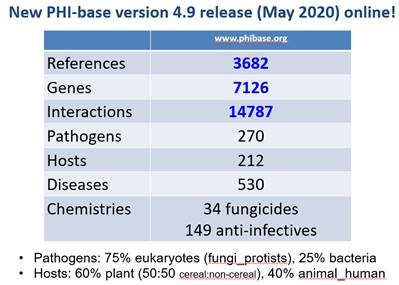
Our PHI-base version 4.9 (May 2020 release) is out! An additional 346 genes described in 228 papers were curated. New database downloads in FASTA/CSV are available.
PHI-base created protein-protein interaction networks for 15 Ascomycete fungal species including rice blast, Fusarium and Botrytis. In a use case study virulence interacting proteins of siRNA targets were identified. Read more at https://t.co/Yux5RuJEKZ
Mutations in orthologous genes often manifest in similar phenotypes. A Unified Phenotype Ontology (uPheno) is being described for human and model species in the recent NAR article https://t.co/n9DwmgGiVJ by Shefchek et al jointly with PHI-base ontologists.
There is a new article out on Ensembl describing integration with PHI-base!
Ensembl Genomes 2020—enabling non-vertebrate genomic research https://t.co/Sat6hJ0ROu
Our PHI-base September 2019 release is now described in a new publication in Nucleic Acids Research Database issue. Title is:
PHI-base: the pathogen–host interactions database https://t.co/ayt0CALhn1