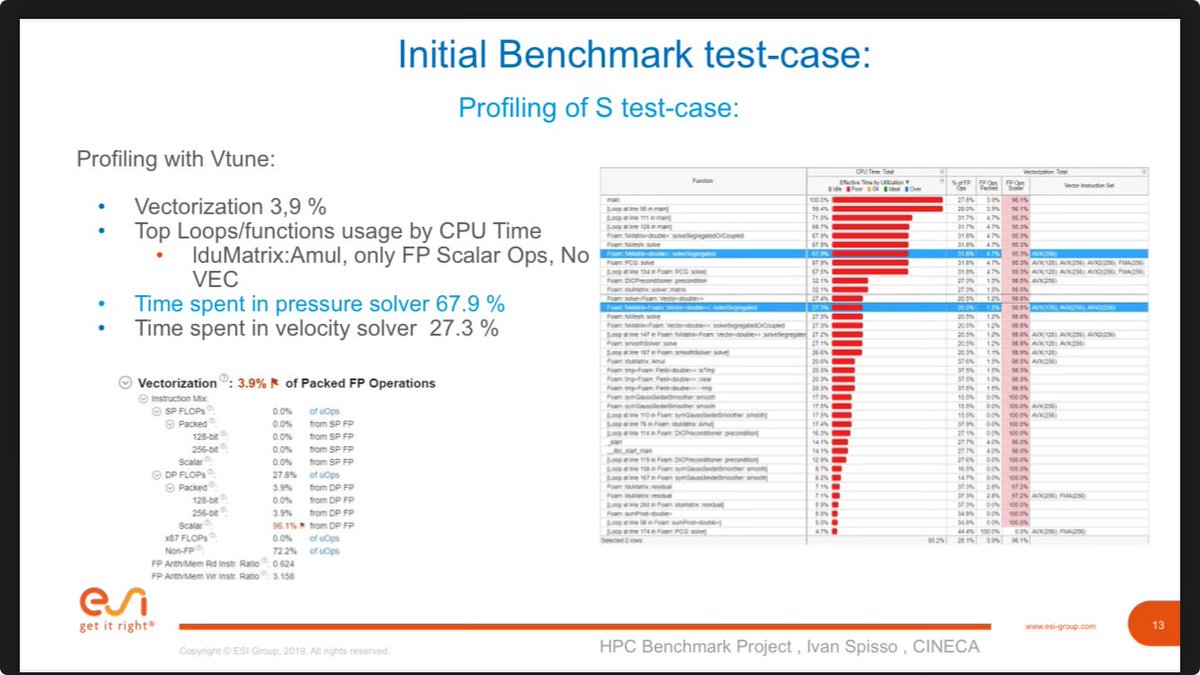
@HiroNishikawa Here are profile results of a 3D version of the cavity case using an OpenFOAM incompressible solver from a HPC benchmark project: pressure equation takes 67.9% of the time. Details at https://t.co/qzX9AJX56w
@HiroNishikawa I beleive that in many complex geometry RANS cases like this, the outer residuals do not converge per se, but stagnate (with noise), and the user checks the quantities of interest for statistical convergence in some sense, e.g., https://t.co/NwdJ1hNt9U is a tool for this
@HiroNishikawa As a concrete example, in the "motorbike" standard test case in OpenFOAM, which uses SIMPLE (+ kOmegaSST turbulence model), they perform 500 outer iterations (no outer convergence check), with relative tolerances of 0.1 for U/k/omega and 0.01 for p.
e.g., https://t.co/qR7VHEbINp
🎉 Registration is now OPEN for the 31st Annual BinI Conference 2026!
💡Early bird rates until Nov 21, 2025: PhD/Postdoc: €150 PI: €220 (Standard rates: €200 / €270)
🔗 Register via RAMI: https://t.co/CRd8vxNuvS
#BinI2026
@HiroNishikawa I wonder if there is a definition for “very high order” or “very very high order” in the same way high order is >2.
>4 seems like very so maybe over 8 is very very 😜
@HiroNishikawa MATLAB is nice but it will become slow for 2D and 3D (like other non compiled languages) unless you adopt or avoid certain code features eg nested for loops are not good for speed in script languages
Don't miss out on the OpenFoam Workshop submission deadline: 30th of April! This is your chance to showcase your latest results, learn from industry experts, and connect with fellow colleagues. Make sure to submit on time to be part of this event, in beautiful Vienna, Austria