@wwwjim Meaningful work is lacking I absolutely agree though. AI is not inspiring people, it’s disillusioning them due to fundamental misunderstanding of where it’s best used right now
@wwwjim I haven’t seen disappointment with increased headcount as often as high intent to increase productivity while keeping / cutting labor in most big companies
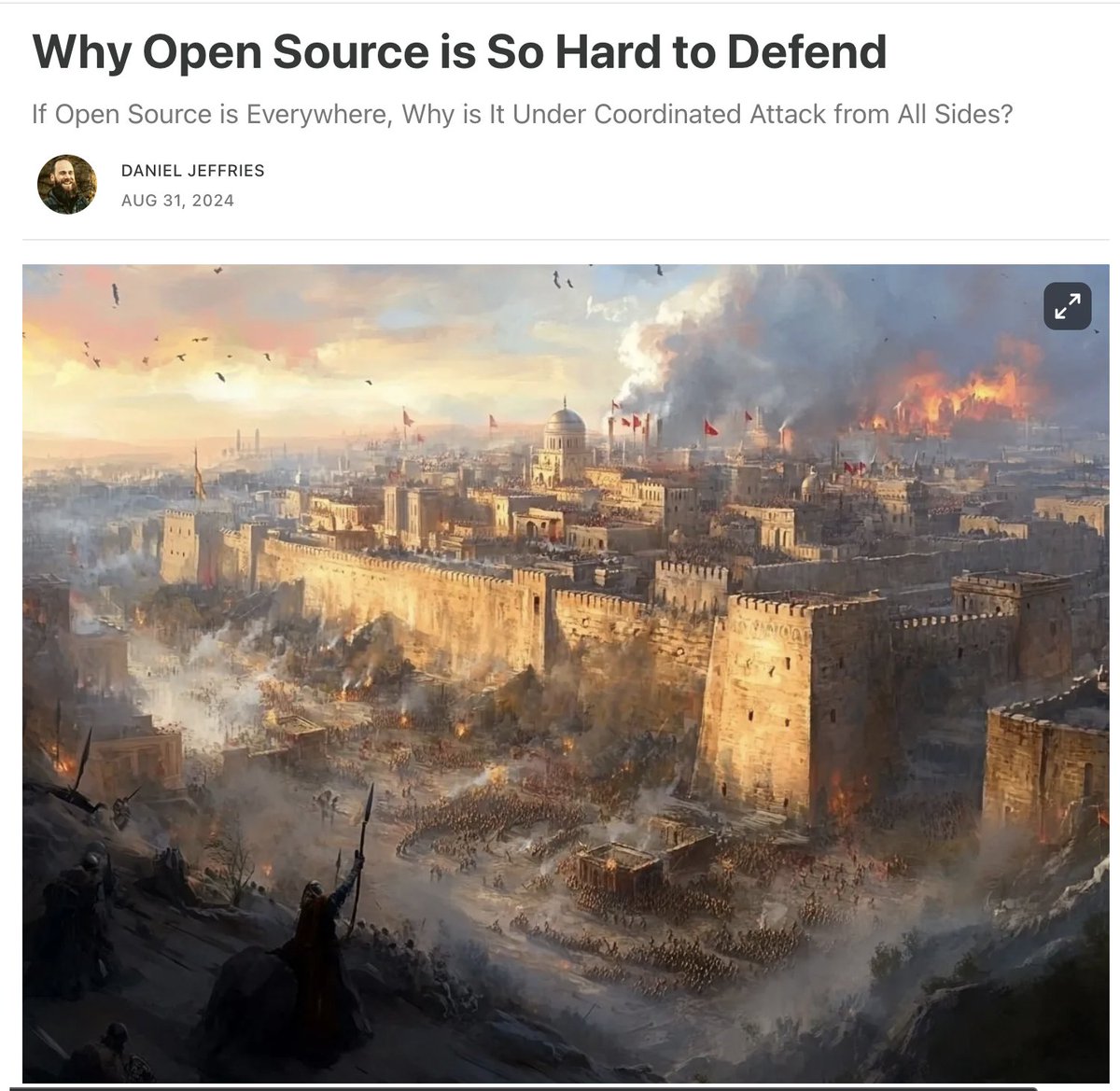
How is that that one of the most powerful ideas in the entire history of technology is now under coordinated attack?
If I told you that one little software concept powers the website you're reading this on, the router in your house that connects you to the internet, the phone in your pocket and your TV streaming service, what would you think?
What if I said that the NASDAQ and New York stock exchanges where your retirement portfolio trades is powered by the same ideas? Or that those same concepts power 100% of the top 500 supercomputers on the planet doing everything from hunting for cures for cancer, to making rockets safer, to mapping the human brain?
Not only that, it also powers all the major clouds, from Amazon Web Services, to Google Cloud and Alibaba and more.
You'd probably think that was a good thing, right? Not just good, but absolutely critical to the functioning of modern life at every level. And you're be right.
That critical infrastructure is "open source" and it powers the world.
It's everywhere, an invisible bedrock beneath our entire digital ecosystem, underpinning all the applications we take for granted every day.
It seems impossible that something that important would be under attack.
But that's exactly what's happening right now. Or rather, it's happening again. It's not the first time.
In the early days of open source, a powerful group of proprietary software makers went to war against open source, looking to kill it off.
SCO Unix, a proprietary Unix goliath, tried to sue Linux into oblivion under the guise of copyright violations.
Microsoft's former CEO, Steve Ballmer, called open source cancer and communism and launched a massive anti-Linux marketing barrage. They failed and now open source is the most successful software in history, the foundation of 90% of the planet's software, found in 95% of all enterprises on the planet.
Even Microsoft now runs on open source with the majority of the Azure cloud powered by Linux and other open software like Kubernetes and thousands upon thousands of packages like Docker, Prometheus, machine learning frameworks like Pytorch, ONNX and Deepspeed, managed databases like Postgres and MySQL and more.
Imagine if they'd been successful in their early attacks on open source? They would have smashed their own future revenue through short-sightedness and total lack of vision.
And yet open source critics are like an ant infestation in your house. No matter how successful open source gets or how essential it is to critical infrastructure they just keep coming back over and over and over.
Today's critics of open source AI try to cite security concerns and tell us only a small group of companies can protect us from our enemies so we've got to close everything down again and lock it all up behind closed doors.
But if open source is such a security risk, why does "the US Army [have] the single largest installed base for RedHat Linux" and why do many systems in the US Navy nuclear submarine fleet run on Linux, "including [many of] their sonar systems"? Why is it allowed to power our stock markets and clouds and our seven top supercomputers that run our most top secret workloads?
But they aren't stopping with criticism there. They're pushing to strangle open source AI in its crib, with California bills like SB 1047 set to choke out American AI research and development while tangling up open weights AI in suffocating red tape, despite a massive groundswell of opposition from centrist and left Democrats, Republicans, hundreds of members of academia and more, the bill passed and now goes to the governor. Eight members of Congress called on the governor to veto the bill. Speaker Pelosi took the unprecedented step of openly opposing a bill in a state Assembly that is primarily Democrat.
And yet still the bill presses forward.
Why?
Do too many people just not understand what open source means to the modern world?
Do they just not see how critical it is to everything from our power grid to our national security systems and to our economies?
And the answer is simple:
They don't.
That's because open source is invisible.
It runs in the background. It quietly does its job without anyone realizing that it's there. It just works. It's often not the interface to software, it's the engine of software, so it's under the hood but not often the hood itself. It runs our severs and routers and websites and machine learning systems. It's hidden just beneath the surface.
The average person has no idea what powers their Instagram and Facebook and TikTok and Wikipedia and their email servers and their WhatsApp and Signal. They don't know it's making their phone work or that the trades of their retirement portfolio depend on it.
And that's a problem.
Because if people don't even know it exists, how can we defend it?
1/
@ahkmeddd @prodarhan@hawaalidrammeh@notlilj So real, there are several student startup ideas I’ve seen brushed off by seattle VCs more than once. Not good ideas tbh, but when you go down to the bay and you see kids doing the same exact products with regular investor meetings and milestones it’s quite an eye opener :/
@mitchellh@wwwjim@beh_zod@internetxstudio You’re a serious inspiration to everyone looking to build companies out of UW—we’d be super honored to hang with you in the office!
@HarryStebbings This is my main concern with the application layer too. It seems really hard to build differentiated, venture scale products that can’t be built BETTER (due to data + distribution advantages) by incumbents. A lot
of the value in this space is probably in the long tail.
i got a seat open next to me.
looking for an engineer down to hack with us for a few weeks in sf.
flight covered.
airbnb covered.
goal: help us build a new ai product from scratch. mobile + web.
can even start this thursday, if you're down.
dms open.
Let's go! MetaVoice 1B 🔉
> 1.2B parameter model.
> Trained on 100K hours of data.
> Supports zero-shot voice cloning.
> Short & long-form synthesis.
> Emotional speech.
> Best part: Apache 2.0 licensed. 🔥
Powered by a simple yet robust architecture:
> Encodec (Multi-Band Diffusion) and GPT + Encoder Transformer LM.
> DeepFilterNet to clear up MBD artefacts.
Synthesised: "Have you heard about this new TTS model called MetaVoice."
We’re so lucky to have so many smart people doing this in UW’s backyard. Open source LLMs and AI development are vital for this tech to be something truly disruptive.
Even Llama has licensing requirements that kick in after 700 million users.
OLMo is here! And it’s 100% open.
It’s a state-of-the-art LLM and we are releasing it with all pre-training data and code. Let’s get to work on understanding the science behind LLMs. Learn more about the framework and how to access it here:
https://t.co/utvPpWwJIp