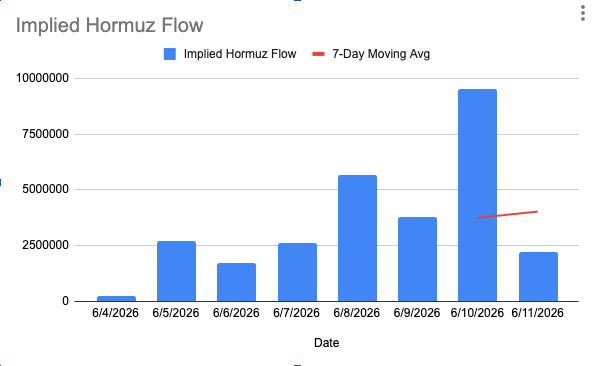
Going forward I will be tracking total flows out of the Gulf of Oman and subtracting the ~2.5 mpbd Fujiarah + Oman exports to get an estimate of Hormuz flows. Why? Because most Hormuz flows are dark now, but eventually turn AIS back on or transfer to legit ships that turn AIS on
@glbeaty Up til now I've just been assuming they're full based on MarineTraffic saying they're laden. I just spot checked a few and based on draught they're all full or close to full.
Drop back down to more normal levels today, implied hormuz flow of 2.2 million barrels yesterday, but that's enough to pull the 7 day average from 3.7 mbpd (3 mbpd quoted yesterday was due to a math error) to 4mbpd
For the past 7 days, average flows out of the gulf were 5.5 mbpd, which translates to 3 mbpd through the strait after netting out Fujairah + Oman. Notably, this average is pulled up massively by a large spike in flows over the last 3 days which saw ~6mbpd through the strait
@Rory_Johnston Of course the significance of this rests on whether this spike over the last few days is durable or just some kind of one off, but it's worth keeping an eye on
@briangobosox@sidprabhu Yeah let's see if the 6mbpd is a one off or an ongoing thing. One would think the recent escalations might lead to a clampdown, but who knows how good IRGC is at preventing bribes to low level commanders lol
@briangobosox@sidprabhu FYI I started my own thread to track dark transits and the estimate I get from this methodology pretty closely matches your 2.5 to 3 mbpd guesstimate https://t.co/d4HFVXAD38
For the past 7 days, average flows out of the gulf were 5.5 mbpd, which translates to 3 mbpd through the strait after netting out Fujairah + Oman. Notably, this average is pulled up massively by a large spike in flows over the last 3 days which saw ~6mbpd through the strait
@briangobosox@sidprabhu Not clear how much volume it is, this guy estimates 1.5 to 2 mbpd based on satellite imagery. It's basically shadow tankers who can't move Iranian oil anymore repurposing themselves to get non-sanctioned oil through the Iranian corridor https://t.co/73uwHhsjzA
@Adibougre It's pretty easy to do manually with Marine Traffic playback because it's color coded so you can ignore most of the traffic which isn't tankers. It's really only a handful of tankers a day that exit.
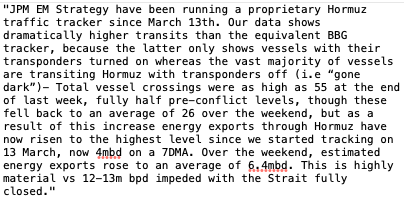
This methodology will lag gold standard satellite/SAR tracking by a day or two due to transit time to get out of the gulf + time needed for ship-to-ship transfers. But over the past week it has pretty closely tracked JPM's satellite/SAR Hormuz tracker https://t.co/D06Cywy8Me
@phileeppos@tleilax___@r_walk7 Someone shared the quote from one of the trading groups that I'm in, I don't have access to the full note. This is what I have
For the past 7 days, average flows out of the gulf were 5.5 mbpd, which translates to 3 mbpd through the strait after netting out Fujairah + Oman. Notably, this average is pulled up massively by a large spike in flows over the last 3 days which saw ~6mbpd through the strait
Going forward I will be tracking total flows out of the Gulf of Oman and subtracting the ~2.5 mpbd Fujiarah + Oman exports to get an estimate of Hormuz flows. Why? Because most Hormuz flows are dark now, but eventually turn AIS back on or transfer to legit ships that turn AIS on
@Adibougre It's actually not hard. I did the last 7 days this morning and it pretty closely tracked JPM's satellite/SAR tracking of Hormuz flows. https://t.co/d4HFVXAD38
For the past 7 days, average flows out of the gulf were 5.5 mbpd, which translates to 3 mbpd through the strait after netting out Fujairah + Oman. Notably, this average is pulled up massively by a large spike in flows over the last 3 days which saw ~6mbpd through the strait
@phileeppos@tleilax___@r_walk7 Someone shared the quote from one of the trading groups that I'm in, I don't have access to the full note. This is what I have
@obvs___@tleilax___@r_walk7 That is wild if true. Did you see someone else sharing this or are you a JPM client? Any chance you can share the report or your source?