In our latest policy update, we look at the ramifications for future R&D spending following the abolition of DSIT, and Jonathan Reynolds’s return to an expanded brief alongside Kanishka Narayan’s promotion to the Cabinet table.
https://t.co/G6ST7ETmpN
1/ Jamie Rumbelow and Henry Dashwood raised venture capital to fix Britain's planning system with software. The company was called Tract. It no longer exists, but their postmortem is among the best a British startup has ever produced. We interviewed them about why Britain can't build. Their story:
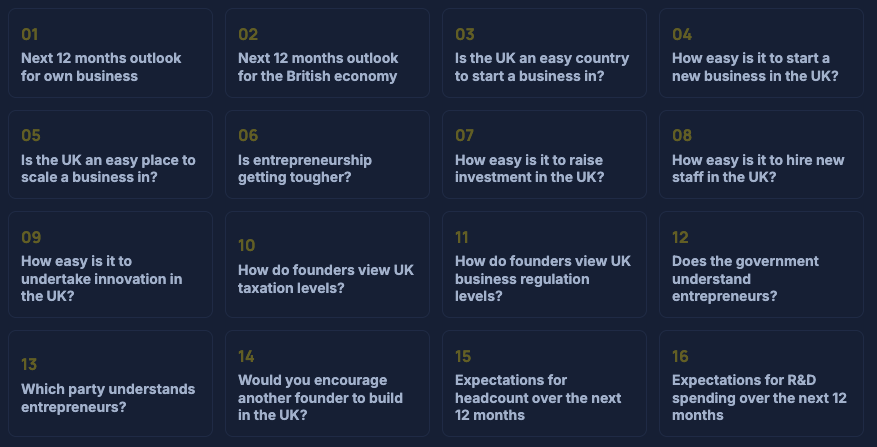
🚨 Hot off the press: the fourth wave of our Entrepreneurs Survey is out.
We asked founders across Britain how they feel about the economy, their plans for the year ahead, and which party they trust to understand them. The results:
📊 Government & Politics
– 79% say the government doesn't understand the needs of entrepreneurs
– Asked which Westminster party they trust most, the top answer was "none of the above" (32%) — ahead of the Conservatives (30%), Lib Dems (8.5%), Reform UK (7%) and Labour (6.6%)
– If a General Election were held tomorrow: Conservatives 22%, Labour 13%, Reform UK 11%, Lib Dems 10%, Greens 6%
📉 Business Conditions
– 82% have a negative view of the level of taxation
– 68% have a negative view of the level of regulation
– 74% say it's currently hard to raise investment
– 55% say it's hard to hire staff
– 54% say it's hard to innovate
– 72% say life as an entrepreneur has got harder since they started
– 65% say Britain is an easy place to start a business — but just 14% say it's an easy place to scale one
💭 Sentiment
– 63% are optimistic about the year ahead for their business, but only 18% are optimistic about the economy
– 54% would still encourage someone else to start a business
Read the full findings 👉 https://t.co/p9xuXruzML
It's been interesting and puzzling to witness the problems with accuracy in UK economic statistics over the past few years. (See the links in the next tweet for more.) It seems that the Office for National Statistics, ONS, now struggles to effectively measure basic figures such as employment, trade, and inflation. This resulted in a quite scathing government report published last summer, where Robert Devereux, a former permanent secretary, concluded that "most of the well-publicised problems with core economic statistics are the consequence of ONS’s own performance."
There's a lot of discussion about the travails facing the UK these days (including this big piece in The Atlantic a few weeks ago[1]), and the problems with the ONS feel like an unsettling microcosm of diffuse decline in broader institutional competence.
Anyhow: at Stripe, we became curious about the UK's published entrepreneurship data. While we observe a boom in many parts of the world, official figures don't show a similar increase in the UK. In the latest Stripe Economics post, we dug into the data, and, as far as we can tell, the official figures are probably misleading. The good and the bad news (mostly good, I think!) is that the UK is almost certainly witnessing an unmeasured boom in entrepreneurship: https://t.co/R7oTZNmxc6
UK-specific issues aside, I suspect that this measurement question is illustrative of forthcoming econometric challenges. Keeping the world's macro indicators up-to-date in response to the faster-than-usual changes wrought by AI will be both increasingly difficult and increasingly important in the coming years.
[1] https://t.co/OAnwRmpyON
Andy Burnham will soon walk into Number 10 carrying an aspiration (if not a plan) for the biggest rebalancing of power in Britain’s modern history. On the diagnosis, almost everyone now agrees. Britain is one of the most centralised economies in the developed world. But buying into the cure will be harder.
The basic case for devolution is that local people understand local conditions, so decisions taken nearer the ground will be better. There is something in this. Friedrich Hayek built much of his life’s work on the insight that the knowledge a society runs on is never held centrally but exists only as the particular circumstances of time and place, dispersed among the people actually on the spot. Whitehall cannot know what a mayor in Wolverhampton knows.
But knowing more is not the same as being made to act on it.
What makes the private sector work is not that entrepreneurs are wiser than mandarins. It is that competition, profit and loss, and the possibility of failure force a kind of discovery that no amount of cleverness can deliver. Give places the freedom to try different things, to keep the upside when they succeed and bear the cost when they fail, with voters and mobile investment standing in for the market. As @MrRBourne argues in The Times this week, the postcode lottery is “a feature, not a bug”. A devolution that can’t tolerate a postcode lottery isn’t really devolution at all.
@MannVirdee, our Head of Science and Tech, set this out in our APPG for Entrepreneurship’s latest newsletter:
“There are really two kinds of devolution on offer. One hands money in the hope that local knowledge makes for better decisions. The other lets places keep the proceeds of growth — and bear the consequences of failure. Only the second changes incentives, and it is the harder sell. Letting places keep the proceeds of growth also means letting them diverge, and fears of a postcode lottery are the likeliest barrier.”
Charles Tiebout argued in 1956 that where people can move between jurisdictions, choosing the mix of taxes and services that suits them, local governments face something close to a market. Gabriella Montinola, Yingyi Qian and Barry Weingast went further, describing a system in which competition between regions for people and capital disciplines governments into behaving, and which they credit with a good deal of China’s growth.
Blöchliger’s work for the OECD finds decentralisation — and genuine tax autonomy rather than mere spending freedom — positively associated with GDP per capita, on the order of a few percentage points for a doubling of the local share. It is, however, a small and contested literature, so to some extent we’re relying on first principles here.
Of course, failure has its limits. When a firm fails, its customers walk away at no cost; when a region fails, most of the people living in it cannot simply leave, and would not want to. Exit is sticky. The evidence from Scotland’s divergent income-tax rates is that migration responses have been small.
But just because it’s not a pure market doesn’t mean it’s not better than the status quo. We are already bearing the brunt of failure. The levelling-up years were wasteful and dispiriting. Councils spent around £30,000 a bid to compete for grants from central government, with roughly three-quarters of them rejected, in what the Public Accounts Committee heard described as a “begging bowl culture”.
Local experimentation will uncover more of what works, voters and investors will back success, and over time good governance will be copied. There is no discovery without the divergence. If Number 10 North is to mean anything, it means letting Wolverhampton and Wakefield make different choices and reach different ends.
https://t.co/DBljdMPqbQ
I’ve unveiled a secret project today. One that we’ve been working on for the past year.
Something that can add a billion pounds a year to the economy of the north while making the environment better.
And we think we can deliver it at no cost to government.
Ambitious, right?
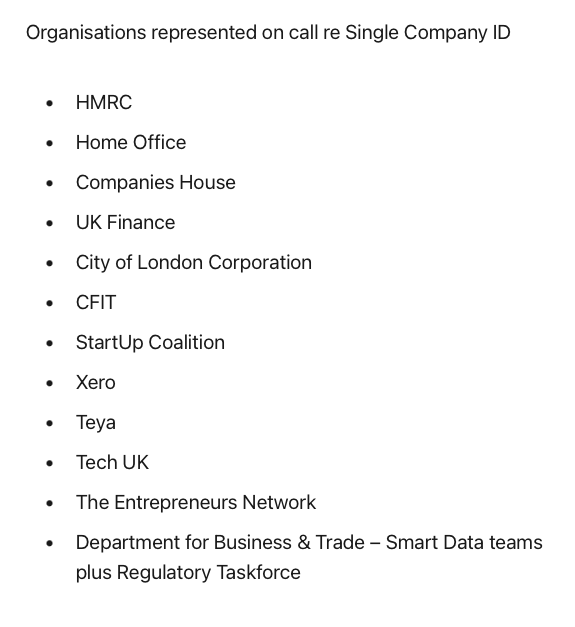
PS @emmaljones, the govt's Small Business Commissioner, flags that there are efforts underway to develop an improved/wider-scale form of business ID that would fix some of this. Link here https://t.co/pG5lunZJYP
Have written today on a fascinating - and v v important - economic puzzle. Either:
1) AI is driving a boom in entrepreneurship everywhere but Britain
or
2) AI is driving a boom in British entrepreneurship, but our economic data is too broken to notice.
Which is it?
Gary Stevenson clearly cares deeply about inequality, and passionately wants a wealth tax. But he is uninterested in the detail of either the problem or his solution.
He exaggerates his expertise, and his research is sloppy.
Given the size of his audience, that's a shame.
As many founders reading this will know all too well, most public contracts award around a tenth of the marks not for the thing being bought but for the supplier’s commitments alongside it — including training, jobs outside London, and Net Zero.
All are worthwhile goals, but as @jo3hill of the think tank @restate_thinks argues, bolting them onto procurement as a toll for working with government is a poor way to pursue them.
It is, first, largely performative: suppliers promise, and nobody checks — policing it would cost more than government already manages to spend monitoring whether contracts are delivered at all. It also hits entrepreneurs hardest. While it might be trivial for the big “primes”, it’s a real burden for startups.
Nor is it free. Whatever suppliers do that they otherwise wouldn’t is folded into the price of the bid, so the taxpayer ends up funding a thousand sub-scale Net Zero initiatives and pretending it costs nothing because the bill is scattered across thousands of tenders. It is, in Hill’s phrase, “the worst kind of Everythingism.” As Hill has written previously:
“Everythingism is the belief that every proposal, project or policy is a means for promoting every national objective, all at the same time. Because of Everythingism, we never do any one thing well, we do everything badly. Housing policy becomes the main route for fixing the nitrogen imbalances in local rivers, and creating more social housing the main way of subsidising the welfare state. Trains must look after bats. Climate policy is to support the services sector.”
At heart, government — and society more broadly — has a deficient definition of social value. Everything government buys should be bought in the public’s service; delivering a contract well, at a fair price, is a social good of the first order. Priority number one, two, three, ad infinitum for public procurement should be to make it easier for good companies — especially new, innovative ones — to bid and win contracts, and easier for government to leave bad contracts behind.
https://t.co/7l4x02nbyb
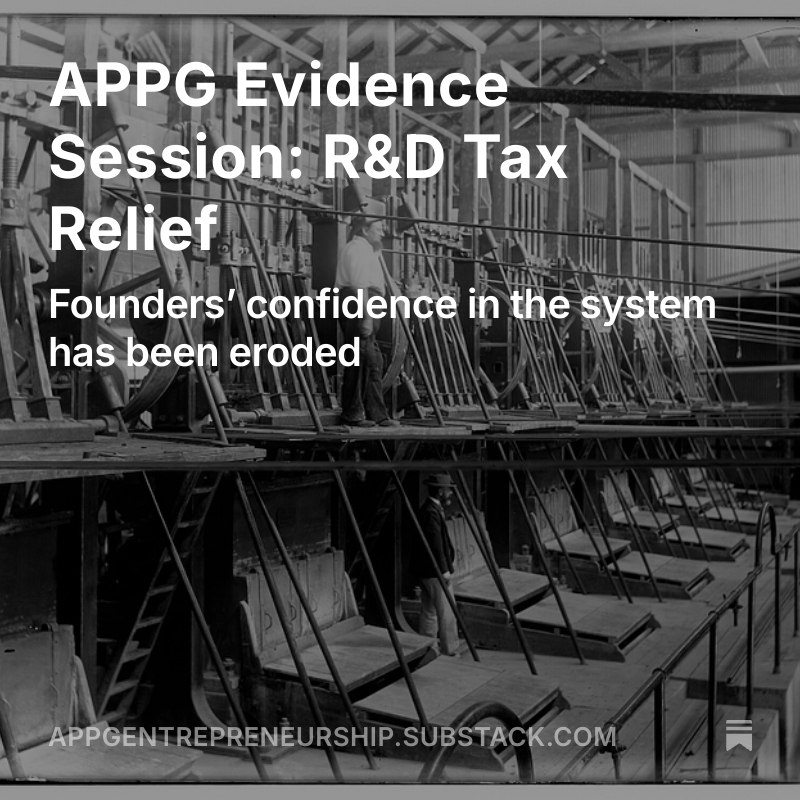
At our recent APPG Evidence Session, founders reflected that constant churn to the R&D tax relief regime is chilling legitimate claims. Participants described how some have simply given up on the scheme.
Full write-up: https://t.co/EGNQYOmmDN
A few weeks ago, tax supremo Dan Neidle begged a small favour on here: “Please please don’t gossip about exit taxes. I know for a fact the exit tax rumours last summer caused some entrepreneurs to leave the UK.”
He’s right. Last time round, I lost count of the number of entrepreneurs who told me they knew people who had left, and we got a fair number of responses to event invitations from people telling us they had left the country, while not mincing their words as to why.
He’s also right that if the next Government really is planning an exit tax, it is in HMRC’s interest — and that of taxpayers more broadly — that people don’t find out first, causing a mass exodus of wealth (and its creators).
It’s not just an exit tax entrepreneurs fear. The very real increase in capital gains tax (CGT) was enough to push many over the edge.
In truth, decisions haven’t even been finalised about who will make up the next Government, let alone what their policies will be. To quote Douglas Adams, with a healthy dose of irony: “Don’t panic.” However, as and when we actually have a new Government — including a new Chancellor — we will be asking them to rule out an exit tax for the very reason that Neidle cites.
If the new Government fails to rule it out, this doesn’t mean that we’ll definitely get one. When possible, governments like room for manoeuvre. But that automatically leaves space for rumours — particularly when government raises ideas like this to try to manage expectations. It is a clear sign of something failing in politics that, before budgets, governments now float policies they have no intention of passing just so interest groups feel relieved when the budget isn’t as bad as feared. Less 4D chess, more KerPlunk.
The Budget won’t be until October or November, but the deadline for steadying the nerves is a lot earlier than that. As one of the UK’s leading tax advisers told me on a call today, this is coming up in 80% of conversations with clients. I’ll finish with an email I received from an entrepreneur just yesterday:
“All this talk about raising CGT to the level of income tax? The natural inclination of me as an entrepreneur is to think about this, plan ahead and prepare to move. I am sure I am not alone. They have no idea of the uncertainty it causes. Once me and my family have gone we will have gone for good. I was always balancing CGT one way or another but while 24% is not great 40-50% is sufficient to make us leave. There will be many more tax exiles if it happens.”
https://t.co/7l4x02nbyb
Andy Burnham got a big round of applause on Monday for saying:
“We will make sure that all eligible public contracts are subject to proper social value weighting.”
Here’s what that means, and why it’s a bad idea.
Most public sector contracts award c10% of the ‘marks’ in the bid evaluations for “social value” - the supplier’s commitment to various policies which aren’t to do with the contract. Employee training, creating jobs outside of London, DEI, Net Zero and using SMEs are all common areas they compete on for a good score. The model is rooted in the Public Services (Social Value) Act 2012, which established 30 pages of guidance on it. The Procurement Act 2023 and the latest National Procurement Policy Statement continued this commitment. Only MoD is exempt from using social value in tenders, though it regularly does - for example, a tender for nuclear deterrent research last year awarded marks for a commitment to reversing the impacts of Covid-19 on local communities and Net Zero.
Social value is a bad policy. And you don’t have to believe any of the many goals government are trying to advance through social value are bad goals to agree with me. Because even if you want all those objectives delivered, making companies for them as a ‘buy in’ to working on government contracts is a bad way to do it.
Most people recognise that the way social value is practiced in procurement is performative. It asks suppliers to make commitments, they fill out a form saying what they can do, and then there’s no follow up. Not even to check if they were telling the truth. Many think there should be. But imagine how prohibitively complicated that would be! On Net Zero, for example, most suppliers have to hire a consultancy to fill out their tenders because they don’t track their emissions (particularly small companies). Keeping doing that would be very costly to them. Government struggles to monitor the basics of contract performance - quality of delivery, and actual cost. Until we fix that, there’s no point doing social value monitoring.
But setting aside the implementation problems, the policy is full of holes.
Social value requirements are complex and costly to compete on. Doing it isn’t hard for the big “primes” that get c10% of public sector commercial spending, but it is hard for smaller companies - particularly start ups and scale ups, who have huge challenges accessing government procurement as it is. This only further stifles innovation, which is the whole point of going out to the market in the first place - markets are great at innovating, much better than governments. But the most innovative companies are further discouraged from bidding because of social value.
The policy also fails on its own terms. Take SMEs. A bias towards allocating contract spending to small businesses isn’t a good idea, but it’s been a consistent one across governments and that won’t change. But social value doesn’t improve that. A big supplier can get full marks for saying it has a lot of SMEs in its supply chain. But a SME has to fill out the same bid to compete with that, even if its whole budget is going to an SME (their own company). Bizarre!
And it isn’t free. Anything that suppliers do to meet social value objectives which they wouldn’t otherwise do comes at a cost. I’ve had civil servants glibly tell me “that’s just the cost of doing business with government”, or that it’s a kind of tax they should pay for the privilege. This is moronic. Suppliers pass that cost on to government when they work out what a profitable bid would be, so government is just funding their social value activities.
This is a really inefficient way of government funding those objectives. Hundreds of different companies doing their own small Net Zero initiatives (for example) is much less efficient than the government bolstering its own (considerable) clean energy infrastructure plans.
(Cont)
✨ Announcing fast grants for British progress ✨
Have an idea for how to drive growth and progress in Britain? We’re making small grants for research, policy and other projects, with funding decisions in just two weeks. No academic affiliation required.
Need some prompting to start cooking? We’ve got a list of questions we’d love people to tackle - on topics like devolution, AI diffusion, financial regulation and more…
Apply here: https://t.co/VT8SXWF39A
More on why we’re doing this: https://t.co/AXasxE5mMY
For decades, the official figures have shown the British economy is barely moving — a percent or two of growth in a good year. Yet, the ingenious entrepreneurs I meet week in week out, building incredible things at an astonishing rate, are suggestive of a more optimistic reality.
In When GDP Misleads: Inferring Living Standards from the Value of a Statistical Life, Stanford economists Philip Trammell and Charles I. Jones argue that GDP is poorly suited to counting the things that improve our lives most: namely, new goods, higher-quality goods, and the improvements that never register as a price at all. They open with Nathan Rothschild, the richest man in the world in the 1830s, who died at 58 in 1836 of an infection that $10 of antibiotics could likely cure today.
Picture an economy of two goods — food, which we get better at producing every year, and string quartets, which take the same four musicians they always have. As food gets cheaper, people spend a growing share of their money on music — and since the growth rate is a reflection of spending, the rate drifts downwards. Push that to its conclusion and you reach the absurd result that we would have been richer had the string quartet never been invented. A slowing growth rate, then, can be the mark of an economy rich enough to afford the finer things.
Progress comes from invention, not accumulation — and invention is precisely what GDP is worst at counting. The Trammell and Jones alternative is to use the value of a statistical life (VSL) — namely, what people will pay to reduce their risk of dying by a fraction. That figure reflects how much they value being alive, so it sweeps up everything that makes life better, new goods included. From this you can infer how fast living standards are really rising. As James Pethokoukis explains:
“The authors get at VSL partly by looking at the extra pay workers require to take more dangerous jobs. If workers need $1,000 more per year to accept a job with one extra death per 10,000 workers, that implies a statistical-life value of about $10 million.”
On the authors’ baseline, American lifetime wellbeing has risen five- to sevenfold since 1940. The usual consumption-based measures suggest it has merely doubled.
As the authors point out, the answer moves a great deal depending on the interest rate you assume. On less generous assumptions the gains shrink, or vanish. As Eamonn Ives has argued here, GDP shouldn’t be dismissed entirely. But we should be awake to the risk that relying on it too heavily understates both how much innovation is worth to us and the cost of putting up barriers to it.
https://t.co/ecIy1FnM2H
📈 @Philip_Salter discusses a new Stanford paper suggesting American living standards have risen 5-7x since 1940, not merely doubled as standard measures suggest
https://t.co/7vV5bpxagd
Really funny that we've had the longest period of stagnation in modern British history and it's still important to reassure people that we're not going to pursue the wrong kinds of growth, as if we're coming out of a period of double-digit China-style breakneck expansion.
Over half of the UK's fastest-growing businesses have a foreign-born founder — drawn here by an open, dynamic market.
Raise capital gains tax and Britain risks deterring the founders it wants and pushing out those already here.
@Philip_Salter spoke to @Tim_Wallace@Telegraph









![patrickc's tweet photo. It's been interesting and puzzling to witness the problems with accuracy in UK economic statistics over the past few years. (See the links in the next tweet for more.) It seems that the Office for National Statistics, ONS, now struggles to effectively measure basic figures such as employment, trade, and inflation. This resulted in a quite scathing government report published last summer, where Robert Devereux, a former permanent secretary, concluded that "most of the well-publicised problems with core economic statistics are the consequence of ONS’s own performance."
There's a lot of discussion about the travails facing the UK these days (including this big piece in The Atlantic a few weeks ago[1]), and the problems with the ONS feel like an unsettling microcosm of diffuse decline in broader institutional competence.
Anyhow: at Stripe, we became curious about the UK's published entrepreneurship data. While we observe a boom in many parts of the world, official figures don't show a similar increase in the UK. In the latest Stripe Economics post, we dug into the data, and, as far as we can tell, the official figures are probably misleading. The good and the bad news (mostly good, I think!) is that the UK is almost certainly witnessing an unmeasured boom in entrepreneurship: https://t.co/R7oTZNmxc6
UK-specific issues aside, I suspect that this measurement question is illustrative of forthcoming econometric challenges. Keeping the world's macro indicators up-to-date in response to the faster-than-usual changes wrought by AI will be both increasingly difficult and increasingly important in the coming years.
[1] https://t.co/OAnwRmpyON](https://pbs.twimg.com/media/HNMWtDsbwAEG7Lo.jpg)