Nous sommes à un moment de vérité de notre Histoire récente : pour la première fois depuis plus de deux siècles, la France se trouve face à un risque réel de régression démocratique. Rendez-vous dimanche à Versailles pour exprimer notre envie de préserver la démocratie et de défendre la France en grand.
Mon entretien avec @Le_Figaro ↓
https://t.co/rP34O81S1K
Our historical pricing was great for the early days of agent use in companies. Seat-based, flat price. Gives predictability but does not map today's reality:
- Paying a full seat (expensive in AI products since includes tokens costs) for a user that won't be using it a lot (without knowing in advance) is a blocker to expansion and a lack of control on spend for AI.
- Conversely paying not more than a regular seat for avid users is just not sustainable for the AI provider.
We're moving to a credit-based pricing which better represents reality. Lets companies expand faster since they have the guarantee to pay for only what their users use.
Basically, when work is the product, you shouldn’t pay for access, you should pay for work done. Credit-based pricing better maps to this new reality of augmenting human work with artificial intelligence.
Double clicking, credit pooling is the real shift, providing maximal control and visibility for our users to provision intelligence at the company level. Companies that understand where AI consumption creates value will turn it into operating leverage.
The displace and replace is already at play.
From a product standpoint the most advanced company harnesses out there are already rebuilding a file system storage abstraction to present company context to agents as a unified flexible interface.
This is the natural layer of collaboration so it's no luck that this was the first cloud product generation (S3 & Google Drive (remember how long we had been waiting for this one), dropbox, box, ...) and that history is replaying itself in the agentic era. Storage first, edition then, reinvented from first principle for meshed artificial <> human intelligence work.
The top-down motion is already at play and the opportunity to seed a brand new dynamic is real as software building is cheap, innovation fast and US or CN companies have no clear product advantage.
They have a massive distribution advantage mostly through brand awareness coming from the hype around "models" but the lock-in (to one model provider) that comes with it should make any sane company pause.
Sovereignty plays at many levels, the state, the supra-state entities but also locally. Being a sovereign company in the age of AI is all about preserving flexibility to choose where the artificial intelligence you use comes from.
Picking a model provider solution for you harness is like buying electricity and machines from the same provider with no way to plug your machines on a different energy provider.
We have two paths in front of us as Europeans.
Use AI as a wedge into sovereignty. It’s never been easier to write software. Rolling out agentic platforms reshaping work is a unique opportunity to displace and then replace the storage and productivity suites that have dominated the market so far.
Or business as usual, only this time it’s not only software, it’s also intelligence that we’re giving up on.
We think a lot about sovereignty from a bottom up perspective. Energy then chips then model then product. There is a powerful top down motion as well. Land with agents, replace storage, then email / productivity, and then down to cloud, models, and finally chips.
Time to wake up.
We designed Dust as a multi-model platform from day one. This way, when AI labs release new models, you’re one switch away from the next best model.
What we didn’t fully predict was an important added benefit: resilience. Models change, providers fail, access disappears.
On Dust, there’s no kill switch.
The very bold, borderline silly, but maybe enlightened move would consists in banning OpenAI and Anthropic on EU soil.
I hate the idea of a EU AI firewall. Because I hate the idea of a firewall.
But.
The important thing to understand is that creating a great model is 1- pre-training (mostly commoditized), 2- mid-training which is about making useful representations emerge about the tasks we care about. Done mostly with masked training on user trajectories. Aka usage data. And 3- post training which consists in aggregating and leveraging useful RL environments, which is capital intensive but « buyable ».
The mid training part can’t be bought.
The US have the usage from all over the world, and China has usage from its country driven to its labs thanks to their firewall.
What is left to EU?
Peanuts.
In a world where the US can shutdown models on us we need to fix this. Which means driving usage to EU labs so that we can train frontier models. I hate it but the most efficient lever seems to be banning US labs.
I would hate to not have access to Claude code. But I would love to share my struggle with labs that operate on my national or supernational soil. Especially if this (and I think it does) means catching up the frontier within a year.
Are there efficient alternatives? How bad would it get if we would pull the trigger? For how long?
Time for France and Europe to wake up.
Every doomer tv show, blog post or prediction piece of the last 5 years starts with something that looks like this event.
Right now we need a de Gaulle moment, politics bold enough to ensure at any cost that we have the means to control our future.
Good news: 1. life has a meaning, and 2. there's an afterlife where it's revealed.
When you die, your soul boots up and "you" start thinking:
"Tool call simulate_life(John) completed. I can now determine the best peanut butter brand for his breakfast. Let me answer his query."
Ne laissons pas les extrêmes de droite et de gauche confisquer le débat public, dresser les Francais les uns contre les autres et éclipser l'essentiel. Rendez-vous le 28 juin : https://t.co/yMqL7FlLNi
We're only year 3 of a decade (if not multi-decades) long transformation of work.
3 years ago we bet on building an horizontal platform for work with agents, a chance to invent a new operating system for companies, from scratch, with AI as a fundamental premise. Many people considered us crazy for going after that, praising verticalized AI products as the winning strategy. But here's the thing: the time horizon of tasks successfully handled by agents has been predictively increasing form minutes to hours and will in all likelihood reach the equivalent of days and weeks of human work equivalent in the coming quarters.
This is were verticalized and/or single-player AI falls short. Single-player tools, one person, one agent, confined to your machine is the wrong architecture for what's coming. We're shifting from using AI to produce things, to managing fleets of agents that do the producing. 3 years ago I wrote[1]:
"ChatGPT is the Pong of LLMs. [...] Imagine, one day we'll get the DOOM, Civ, Red Alert, and Counter Strike of LLMs. Let alone multiplayer modes."
Weeks long tasks in companies are inherently collaborative and mechanically spanning multiple teams. The new bottleneck in harnessing agents within organizations is coordination: multiple humans and multiple agents need to work together, with shared context, shared tools, shared goals. Agents that can hand work off to other agents or surface decisions to the right person at the right time. Humans who can review, steer, and step in without losing the thread. Teams that can run parallel workstreams and actually stay aligned.
This is Multiplayer AI, and that's what we've been building at Dust.
Across Datadog, Clay, Persona, 1Password, Doctolib and 3,000+ organizations globally, we've watched teams figure out what this looks like in practice. 300,000+ agents deployed. 70% weekly active. 240%+ NRR.
Today we're announcing a $40M Series B with Abstract, Sequoia, Snowflake, and Datadog to accelerate our vision.
Designing the right interfaces for multiplayer AI is the next frontier. Join us to redefine work by defining multiplayer AI.
Most AI at work is still single-player. The gains stay trapped with each individual. Nothing compounds across the team.
Today, we're announcing @DustHQ $40M Series B to scale multiplayer AI: humans and agents working in parallel, with shared context, shared tools, and shared goals. 🧵
we tend to move fast and not look back much... this is a reminder to pause 🙂
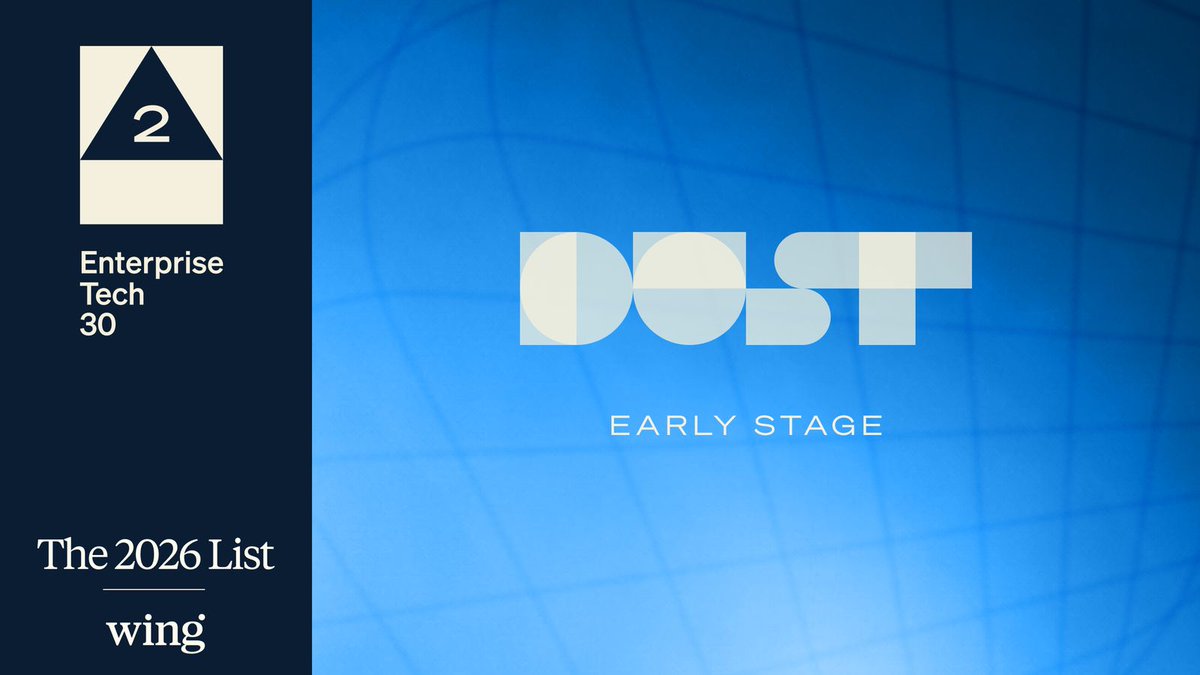
Dust is #2 on the 2026 Enterprise Tech 30, Early Stage!
@spolu and I are so grateful for the team and the customers pushing us to be better, faster, stronger.
Thank you to @Wing_VC and congrats to all the companies honored this year.
biiiiig things coming!
Des maires du Rassemblement National ont décidé de retirer le drapeau européen du fronton de leur mairie.
C’est une trahison de ce que nous sommes.
L’Union européenne, c'est la France qui l'a voulue. C'est nous. Pour garantir la paix. Pour préserver notre indépendance face à la pression grandissante des empires. Et c'est pour nous le moyen d'affirmer une autre vision du monde : la nôtre.
Il n'a aucune dissolution de l'identité nationale dans l'identité européenne, pas plus que nos identités locales ne s'effacent derrière notre identité nationale.
Nos appartenances sont multiples, elles se renforcent, se complètent et s'enrichissent.
La conflictualité entre les superpuissances chinoise et américaine s'intensifie chaque jour. Elle menace notre souveraineté et notre prospérité. Elle risque de nous entraîner dans des guerres que nous n'aurons pas choisies. L’Europe incarne une possible troisième voie à laquelle beaucoup de pays du monde aspirent.
Ce drapeau est celui d’un espoir possible, c’est le drapeau de la liberté, de la justice et de la démocratie. Comme une affirmation de notre volonté farouche de maîtriser notre destin.
Comme un acte de résistance à la brutalisation du monde.
Funny how we standardized on the word "harness" to describe the environment in which agents are executed and the human/agent interface associated with it. The word harness suggests a handle for humans to box and control agents to exploit their power. But when intelligence sits on both ends of the interface, it is no longer a one-way handle but rather a bi-directional medium. Maybe the cold truth is that [...]
https://t.co/H0pfBUwe53