Austin is building housing like crazy.
Rents are down 7%.
But rather than frame this achievement as a win for renters—or for the arg that housing prices respond to supply growth—WSJ frames it pretty clearly as bad news across the board.
#Toronto Homicide 14 & 15 – Benedict Johnson Kongolo, charged following the murder of John Ngoyi Kongolo (Father) and Denzel Didier Kongolo (Son,) in a daytime downtown shooting.
Photo: Gofundme
https://t.co/Jkr2fdqbkn
Tonight at 7 pm it is CoderCamp at Mosaic! Come and drink some craft beer with your fellow techies and maybe discuss how the City could have prevented the ransomware attack. #HamOnt
🇨🇦 Residential mortgage market shares:
🤔Points:
1. RBC holds 20% share of 🇨🇦 mortgage market, poised to increase to 21.7% if it acquires HSBC.
2. The Big 5 banks claim 69% of 🇨🇦 mortgage market.
3. Desjardins & MCAP market shares are close to BMO, exceeds National Bank's.
Notes:
• Similar to CMHC statistics, we didn't consider amortizing HELOC as part of the mortgage portfolios.
• Notably, TD features a substantial $86.9B amortizing HELOC, surpassing other banks and sometimes categorized as a Mortgage.
More:
• 40+ Lenders Mortgage Rates: https://t.co/Y5XVJhkLdu
• Mortgage in Canada: https://t.co/tVJbStjq60
Should We Ban Huge Companies From Owning Individual Homes? YES We Should
They are trying to that in the USA
A bill has been introduced to prevent Hedge Funds & similar organizations from buying up massive numbers of individual homes
This is NOT about Multi-family Rentals
2/
Vimes Boot Theory is a nice little theory that makes people think they're unfairly getting duped by the system. But it's simply not true. I think most people don't know how much it costs to buy and maintain well-made things. Let's do the math:
There are three main ways to produce well-made shoes: handwelting, Goodyear welting, and Blake construction. Let's review some of the costs of each.
- Handwelted bespoke shoes from the West End start around $3.5k. Most are closer to $5k.
- Handwelted ready-made shoes cost about $600 (Vass) to $1.5k (Saint Crispins). Meermin has a limited line produced in China for about $300.
For the purposes of this tweet, I'm lumping Goodyear welting and Blake construction together, as they're basically the same on the ready-made market.
- Goodyear welted and Blake stitched shoes will cost you anywhere from $250 (Meermin) to $1,500 (John Lobb, Edward Green).
So the upfront cost here can range anywhere from $250 to $5k.
Remember you have to double this, as well-made shoes should be given a day of rest between each wearing. If you wear the same pair of shoes every day, you will prematurely break them down beyond repair, as the sweat from your feet will ruin the uppers. So you need at least two pairs of shoes to rotate through. This means your upfront cost is now anywhere from $500 to $10k.
Now you have your shoes. You will have to resole them about every five years, depending on how much you walk (some may get a little more time between each resole, some a little less. But let's say five years).
There are two ways to resole shoes. You can give them to your local cobbler, who will charge about $100. The downside is that this person is unlikely to have the original last on which the uppers were made. When you resole shoes, you are effectively removing the spine. So the uppers can get all floppy and distorted out of shape. On the upside, sending these to your local cobbler means that you only pay $100. But if the shoes have been made on a very well-crafted last (e.g. bespoke) or if you're finicky about quality, you will want to send them back to the original manufacturer.
Sending shoes back to the original manufacturer will also incur some costs. If you're based in the US, this means sending things back to England or even Romania (as I have done). Shipping charges here can be expensive.
A proper recrafting on Goodyear welted shoes can cost anywhere from $150 (Allen Edmonds) to $450 (Edward Green). A proper recrafting of handwelted bespoke shoes can cost as much as $1k. Remember: this is on top of your upfront cost. This is what you pay every five years to replace the sole.
Most people are not even spending $200 on a pair of shoes. They may spend $100 every two or three years. In ten years' time, they've spent maybe $300 on footwear.
The person who's buying high-end, well-made shoes will have spent $250 in upfront costs and about an additional $100 for resoling. Double this because they need to buy at least two pairs of shoes. And add shipping charges if they are sending things back to the original manufacturer. In ten years' time, they've easily spent more.
The main reason for buying high-end, well-made things is not financial. It's because you will love your wardrobe in the end. It feels nice to be able to keep a pair of shoes or boots you've grown fond of, rather than throwing them away (see pics below). They also look nicer in outfits. But the poor are not being tricked into spending more. It's expensive to own nice things!
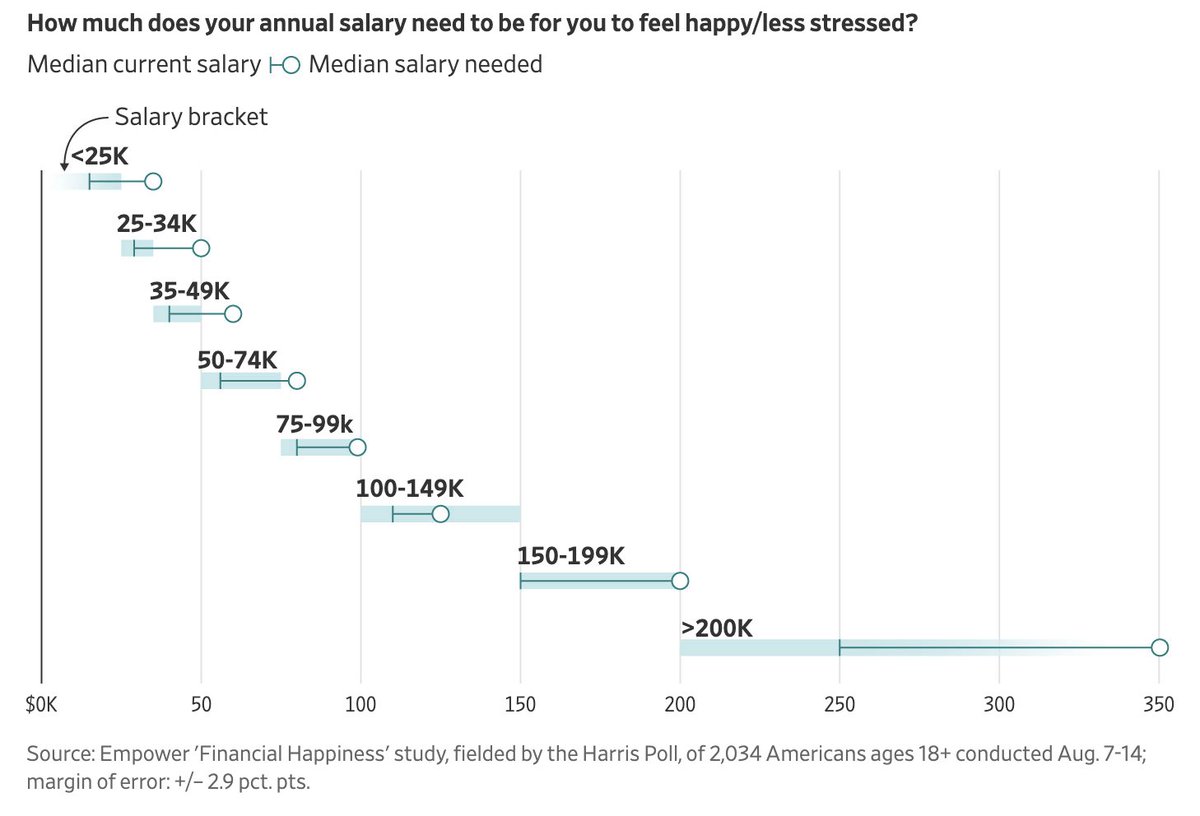
Americans at ~every level of income say they need a 30%-50% raise "to feel happy."
Make $50k? "I need about 75k."
Make $75k? "I need about 100k."
Make $150k? "I need 200k."
Make $200k? "I need 350k."
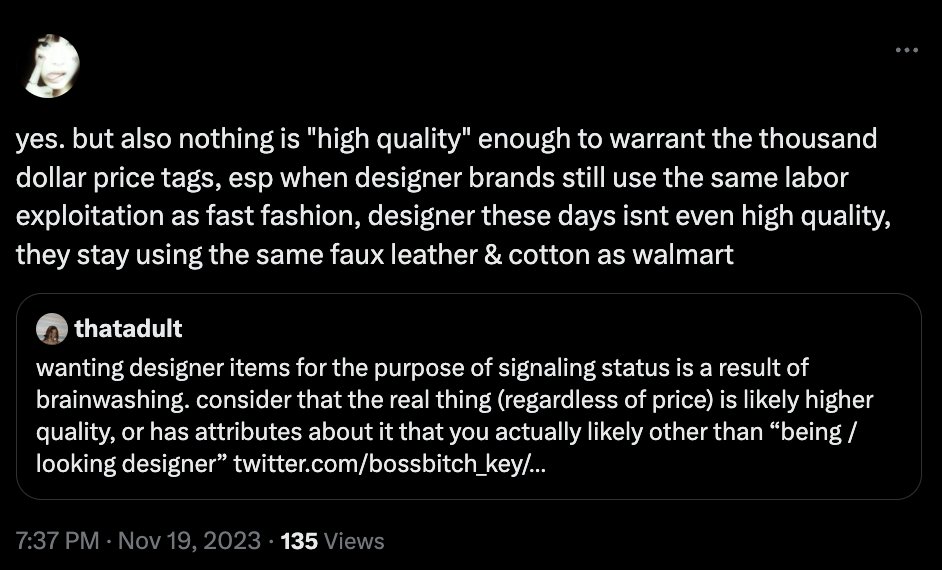
I see this often: the idea that expensive clothes are not worth their asking price, and that these factories use the same labor practices as fast fashion. The idea throws doubt on companies trying to do the right thing, and gives cover to fast fashion. But is it true? 🧵
"In Switzerland, Germany, and Norway, people primarily found jobs through job adverts. In contrast, in Portugal, Italy, Greece, and Spain, which are all higher in corruption, people primarily found their job through friends and family." https://t.co/df9HCdEpsL