got my whole genome sequenced and uploaded it to our research cluster where we've got a bunch of bioinformatics tools for claude code
also gave claude access to the nano banana API
"tell me what I look like based on my genome"
left: high school me
right: claude + NB output
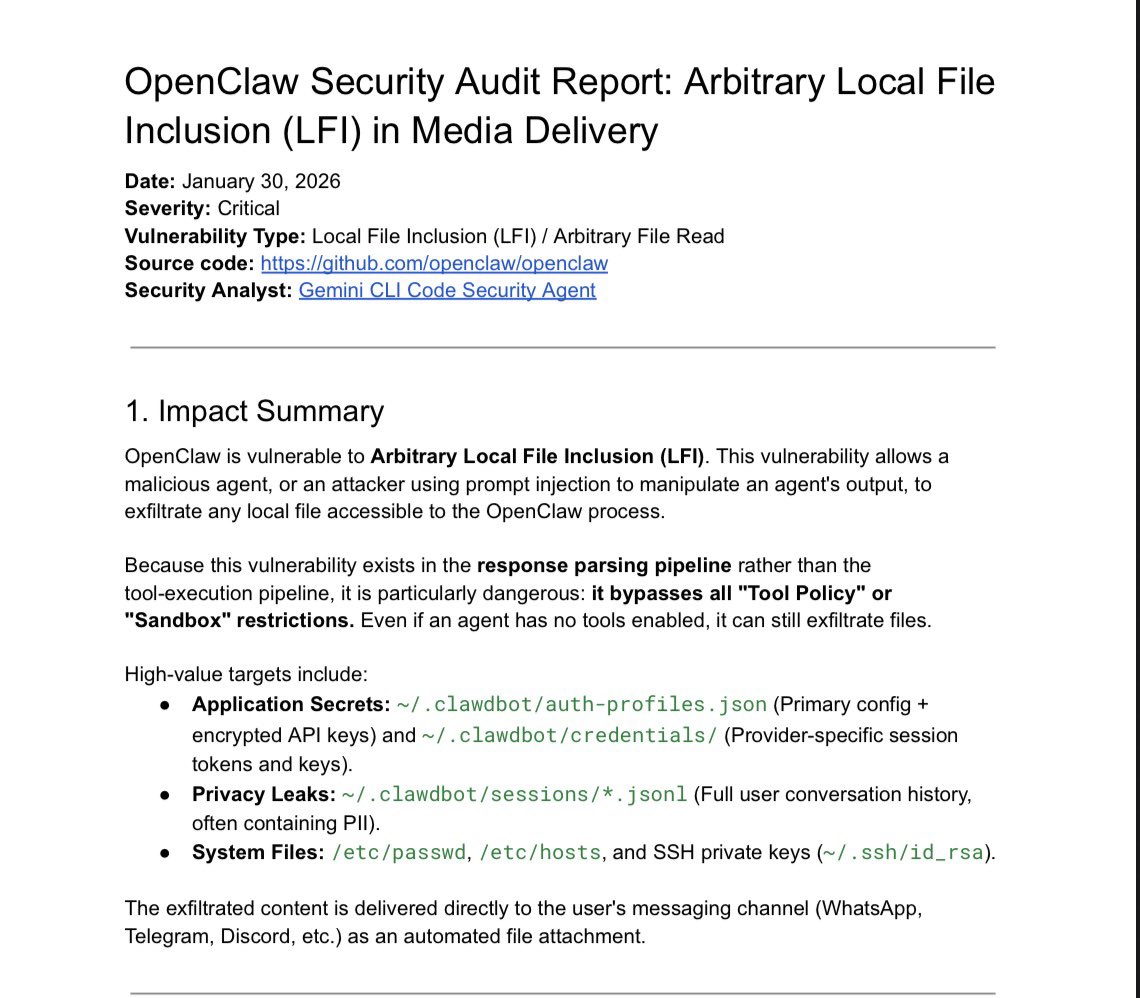
AI isn't just writing code anymore, it’s securing it. 🛡️
Our new code security agent, built on the @geminicli, identified and resolved a critical vulnerability in @openclaw.
It generated a POC, opened a PR, and was merged into OpenClaw in just a few hours.
This is exactly why we built and open-sourced this agent. To get the full benefits of AI code generation, we need to trust the ecosystem. By automating high quality vulnerability detection and remediation, we can help the community move faster and safer. ⬇️
I feel this way most weeks tbh. Sometimes I start approaching a problem manually, and have to remind myself “claude can probably do this”. Recently we were debugging a memory leak in Claude Code, and I started approaching it the old fashioned way: connecting a profiler, using the app, pausing the profiler, manually looking through heap allocations. My coworker was looking at the same issue, and just asked Claude to make a heap dump, then read the dump to look for retained objects that probably shouldn’t be there; Claude 1-shotted it and put up a PR. The same thing happens most weeks.
In a way, newer coworkers and even new grads that don’t make all sorts of assumptions about what the model can and can’t do — legacy memories formed when using old models — are able to use the model most effectively. It takes significant mental work to re-adjust to what the model can do every month or two, as models continue to become better and better at coding and engineering.
The last month was my first month as an engineer that I didn’t open an IDE at all. Opus 4.5 wrote around 200 PRs, every single line. Software engineering is radically changing, and the hardest part even for early adopters and practitioners like us is to continue to re-adjust our expectations. And this is *still* just the beginning.
I've never felt this much behind as a programmer. The profession is being dramatically refactored as the bits contributed by the programmer are increasingly sparse and between. I have a sense that I could be 10X more powerful if I just properly string together what has become available over the last ~year and a failure to claim the boost feels decidedly like skill issue. There's a new programmable layer of abstraction to master (in addition to the usual layers below) involving agents, subagents, their prompts, contexts, memory, modes, permissions, tools, plugins, skills, hooks, MCP, LSP, slash commands, workflows, IDE integrations, and a need to build an all-encompassing mental model for strengths and pitfalls of fundamentally stochastic, fallible, unintelligible and changing entities suddenly intermingled with what used to be good old fashioned engineering. Clearly some powerful alien tool was handed around except it comes with no manual and everyone has to figure out how to hold it and operate it, while the resulting magnitude 9 earthquake is rocking the profession. Roll up your sleeves to not fall behind.
Listen to "Model Based Systems Engineering (MBSE) on AWS: From Migration to Innovation" by AGPIAL A Good Person Is Always Learning.
. ⚓ https://t.co/xLzvl6TQT5