Knowledge is a creative curiosity in nature - full of contradictions - able to knowingly alter events & determine outcomes, unlike the ‘nature known to science’. And it’s not a matter of ‘information being the cause’, or that causes can be known as explanations of their powers.
“Information” portrayed as “the thingness to explain all thingnesses” begs the question of what can come to be “in reality” - in a reality that is evidently more than can be reduced to (found in or equated to) its “building blocks” - hence the continuing drive for an explanation.
Nobel physicist Anton Zeilinger suggests reality and information are the exact same thing.
Information is the ultimate building block of existence, meaning matter is just a byproduct of data.
PROBABILITY: A dynamic (constantly changing) assessment of “the reality” created by an interaction between “events” and their observation - of selections made “in situ” by those observers - in the belief that the outcome will reveal a wholly independent fact.
#NewDevilsDictionary
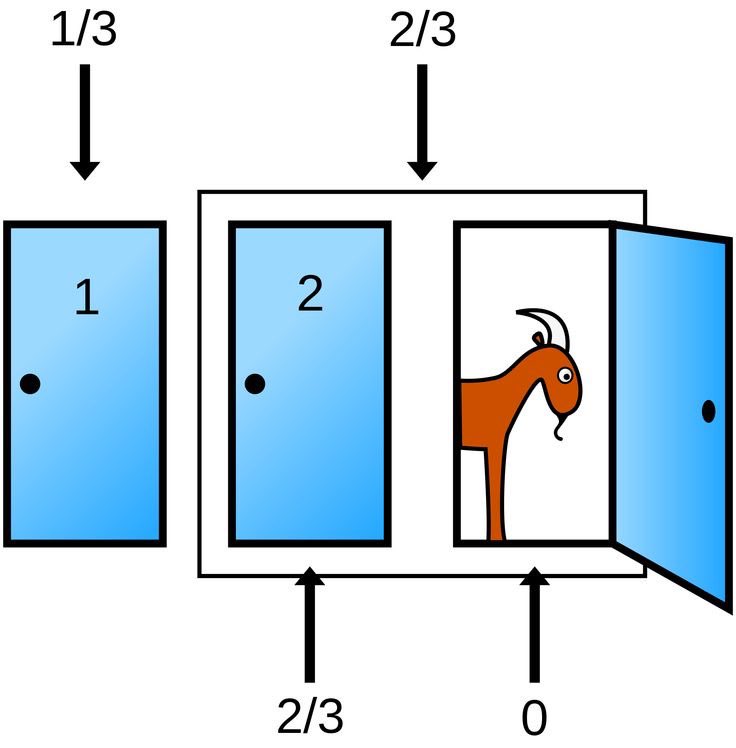
The Monty Hall Problem:
A probability puzzle based on a game show scenario. Given a choice among three doors (with a prize behind one), switching after one non-prize door is revealed increases your chances of winning from 1/3 to 2/3.
Pronouncements of truth don’t necessarily capture the whole truth about the problem of explanation - arising in a known psychological reality that can’t be found in, or remotely identified with, the universe’s “natural causes”.
@nosnow365 All we know of ‘the future’ is that it represents a ‘potential’ (power-to-be) operating through ‘the present’/‘isness of events’ - enabling them to become more than ‘their everything’ - in themselves. Meanwhile, ‘the past’ remains a pale reflection of what ‘might have been’.
No wonder science wants to deal with possibilities as “matters of fact” (by inferring what needs to be proved) - as if the poss of a psychological outlook in nature is proof of nature being itself (because there it is) - as if causes can tell us all we need to know about effects.
The origin of possibility is a complete mystery which we can’t explain by presuming it must already exist somewhere, in some form, in order to be possible. And we cling onto the illusion of expln by surmising that ‘emergent causes’ are the obvious repository of effects yet to be.
The origin of possibility is a complete mystery which we can’t explain by presuming it must already exist somewhere, in some form, in order to be possible. And we cling onto the illusion of expln by surmising that ‘emergent causes’ are the obvious repository of effects yet to be.
Events in/of existence (with or w/o an origin), of which we formulate our theories of cause & effect, yield but a cursory glimpse at the possibilities, yet explanation shifts imperceptibly from views of what is, to what must be - with laws - as if to outlaw any idea of a mystery.
@nosnow365 All we know of ‘the future’ is that it represents a ‘potential’ (power-to-be) operating through ‘the present’/‘isness of events’ - enabling them to become more than ‘their everything’ - in themselves. Meanwhile, ‘the past’ remains a pale reflection of what ‘might have been’.
@ShiningScience In reality:
The reality of thought is thinking. The reality of brain is physiology.
The difference “demands” an explanation.
The reality of explan has the brain explaining thought (C & E).
So “thought” is the brain being itself.
Alternatively, brains aren’t everything in reality.
“The reality (of)” brandishes the trappings of a modern myth, resting on another - that “it” can be found in/ identified by its underlying precursors - and explained there(of).
@leecronin@RichardALJones The difference between cause & effect makes a real difference that cannot be put down to the reality of the cause alone. As such, causal explanations harbour a deeper non-explanation which cannot be avoided by treating change as “evidence of a sameness that must have always been”
@leecronin@RichardALJones The difference between cause & effect makes a real difference that cannot be put down to the reality of the cause alone. As such, causal explanations harbour a deeper non-explanation which cannot be avoided by treating change as “evidence of a sameness that must have always been”
“Metaphysics” gets stigmatised as an irrational alternative to physics, but it may also be seen as a more contemporary resistance to the “irresistible logic” of a “solitary physical nature” being the inevitable solution to the unsolved problem of itself (plus “everything else?”).
“A fierce debate is raging around the slippery notion of consciousness. It retraces a trotted pattern of cultural resistance: We humans are often scared by anything that may disturb our image of ourselves.”
— @carlorovelli
https://t.co/5YcnsqXF70
“Physics first” (implying “first on the scene”) doesn’t prove physics can explain everything, even itself - with a “theory of everything” (implying “physics is everything”) - without the “ethereal metaphysics” of an overview (a putative explanation called “physics”).
Imagine metaphysics being as real as physics in a nature exceeding the boundaries of known physics (i.e. not like ‘nature’ as physics imagines it) - revealing powers to think, imagine and plan ahead with intent - making a real difference (i.e. ‘spooky action with a difference’).
Imagine metaphysics being as real as physics in a nature exceeding the boundaries of known physics (i.e. not like ‘nature’ as physics imagines it) - revealing powers to think, imagine and plan ahead with intent - making a real difference (i.e. ‘spooky action with a difference’).
Science quietly allows the public to believe that ‘the facts’, as selected by its best theories, supply firm evidence of those theories having been selected by the facts.