$FLEX
Flex announced three new products at COMPUTEX last week which directly & indirectly supports Nvidia's AI servers:
Power shelf + conductive energy storage system (CESS) + intermediate bus converter (IBC)
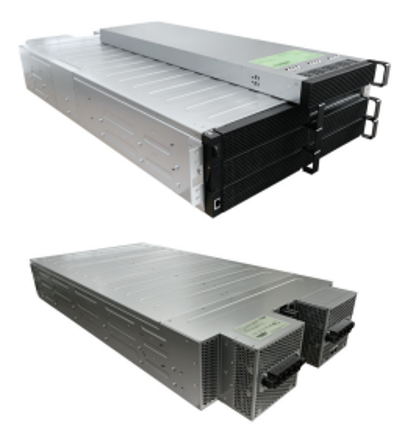
1 / 110kW power shelf for Nvidia Vera Rubin NVL72
Designed to provide rack-level power distribution. Supports modular power architectures, including future 800VDC deployments, as well as power disaggregation strategies
Power shelf is air-cooled, has slots for 1 x power supply controller (PSC) and up to 6 power supply units (PSUs)
PSUs and PSC are hot-pluggable (i.e., no/minimal downtime during maintenance/servicing)
6 PSUs x 18.4kW = ~110kW DC output power (max) with AC operating input voltage range of 345 VAC to 480 VAC. Each PSU comes with a power pulsation buffer device to manage AC input current swing and EDPP non-linearity
Output voltage = 52V at full load that distributes power to rack-level payloads/components through a DC-DC bus architecture
PSC module incorporates power & thermal management functions and telemetry/monitoring through Redfish
$3665.TW BizLink supplies both the input and output connectors (by default)
2 / 30 kW Capacitive Energy Storage System (CESS)
This is designed with $7220.T Musashi Seimitsu’s hybrid supercapacitors (HSCs)
CESS modulates power fluctuations associated with AI/HPC workloads through energy charges/discharges during large electrical transients
Lifespan is longer that existing battery energy storage systems (BESS) with multi-million charge/discharge cycles
This new 30kW variant is an upgrade from the existing 16kW rated version
3 / Intermediate bus converter (BMR317)
This third-gen IBC is a compact power module that steps down high primary voltage (rack/busbar) to lower intermediate bus voltage (from 40-60V input to 5-7.5V output at a 8:1 fixed ratio), and complements voltage regulator modules (for conversion to 0.5-1.8V to power processors) in a two-stage conversion pathway. The two-stage architecture uses less copper and allows shorter high-current paths at the board/package level
Two variants supporting peak capabilities of up to 2kW and 2.5kW are being introduced: the 800W version which is available now, followed by the 1kW version to be released in 2H 2026
(Attached picture of the 3RU power shelf)
$6501.T Hitachi
Within a week, Hitachi has announced two strategic partnerships/collaborative initiatives -
+ Intel: solutions and processes optimization development in foundry tool, quantum computing, energy, custom silicon & edge computing
+ Google Cloud: expansion of their existing strategic alliance to accelerate physical AI deployment, delivery of autonomous next-gen cybersecurity solutions and enhancement of their HMAX platform with the integration of Gemini Enterprise
Given the recent discourse on NPOs, reposting my notes from a NPO expert panel session in early May
In no particular order, the companies represented include:
1. Ciena
2. Coherent
3. Ranovus
4. Alibaba Cloud
5. Tencent
6. Huawei
Founding members of the Open CPX MSA include:
1. Ciena
2. Coherent
3. Marvell
4. Molex
5. Samtec
6. Terahop
Since then, Intel, TE Connectivity, Accton and Nexthop AI have joined this consortium as contributing members
As for NPO commercial adopters, they will be firmed up close to OFC 2027 which is in March next year. From what I gather, the Chinese chip makers/hyperscalers seem to be slightly ahead of the curve
Also, NPO will likely fill a niche of its own and is not going to be a bridge between pluggables and CPO. This provide optionality to all stakeholders in the ecosystem
Over the weekend, China unveiled the world's first energy hub with prefabricated substations and transformers that power data center clusters and computing facilities
https://t.co/Y4ZooaMchP
First launched in Qingdao, the country plans to roll out this power hub model in national-level data center facilities and regional computing power centers in 2H this year
With prefabrication, construction cycle gets cut down to 5 months (from over 12-18 months) with construction costs reduced by 80% and land use by 30%
This new hub also allows for 100% green energy connection, with redundancies that enable each equipment to be connected to 3 independent power sources, ensuring uninterrupted power supply. The systems also integrate advanced control modules that manage electricity-to-compute power matching, computing load and grid transients
Expect this development - coupled with heavily subsidized and excess energy capacity - to drive down token costs even further in China
@LowAlphaHighVol@omercheema These fund flow data points cover only their own PB clients right? And also only US equities (i.e. not counting the many Asian semi/equipment names). I would agree that many of the US names have crazy valuations lol
[Nikkei Asia]
Japan looks to replace up to 5 aging nuclear reactors by 2040s
https://t.co/v5LE5KkNq6
"The plan includes replacing two to five reactors carrying a total capacity of 2,200 to 5,500 megawatts by the 2040s. The high-end figure equals about 20% of the 31,000 MW capacity of Japan's existing reactors, excluding those slated for decommissioning.
The draft also calls for replacing an additional nine reactors by the 2050s, giving Japan 11 to 14 replaced reactors by then, with a combined capacity of 12,700 to 16,000 MW."
Revisiting this post -
Jenbacher is a core brand of $INIO INNIO which has just priced its ~$2.4B IPO at the top-end of the filed range ($24-27) on an upsized base offering of 90M shares (from 75M shares) offered by AI Alpine, an entity co-owned by funds managed/advised by private equity firm Advent and Abu Dhabi Investment Authority (ADIA). This is a partial liquidity event for Al Alpine - i.e., no capital is being raised by INNIO
INNIO originated as General Electric's Distributed Power business which was carved out and acquired by Advent in 2018 for $3.25 B. ADIA become a significant minority shareholder in March 2023
At the final IPO pricing, INNIO's equity market cap is ~$20B, with an enterprise value of ~$22B. This represents a partial exit return of close to 7x for Advent, and an implied EV/adjusted EBITDA multiple of close to 40x (on my calculations)
INIO starts trading later today (June 4)
My takeaways on INNIO are as such:
1 - Unprecedent growth in US electricity demand, with data centers as key driver of load growth, coupled with under-invested grid infrastructure/multi-year interconnection queues, are providing powerful tailwinds for behind-the-meter prime & backup power solutions providers
2 - Scale. INNIO has an installed base of ~44GW across a diversified customer base including data centers (hyperscalers, co-lo operators) and other commercial/industrial users. This provides them long-tailed maintenance and overhaul revenue streams in their high-margin Services businesses. INNIO is also planning to triple production capacity for their flagship products, self-funded, in the coming years. Their manufacturing hubs are in Austria, Canada and the US
3 - Order book momentum. Book-to-bill for their Equipment business stood at 2.8x in FY25, with an order intake amount of $3,884M across their data center (59%), power solutions (35%) and compression (6%) customers. Order intake 2Y CAGR (FY23-25) was 107% anchored by growth in data center customer orders (at 813% CAGR)
4 - Profitability. Overall adjusted segment EBITDA margin (ex corporate overheads) averages around 22% over the last 3 years, with Services being more profitable (at ~29% margin) vs Equipment (at ~15% margin). Data center sales & deployment are expected to continue driving revenue and order growth, with good visibility from a record equipment order backlog of ~$3.6B
My concerns:
1 - Fuel cell-based energy systems (from Bloom Energy), to me, seem to be better modular behind-the-meter power solutions compared to gas engines for several reasons:
a. Ease of maintenance/downtime. Maintenance of Bloom Energy's systems has almost zero downtime (modules can be hot-swapped if needed), as compared to INNIO's (hours for routine servicing, to weeks for major overhauls)
b. Efficiency. Bloom Energy's systems average about 60% electrical efficiency vs INNIO's 43-45%
c. Notwithstanding a higher upfront capex for Bloom Energy's fuel cell systems (at ~2x of INNIO's), the total cost of ownership for INNIO's solutions appears to be higher, after factoring in cost of downtime over the maintenance cycles. On a LCOE basis (subject to capacity factor, etc.), Bloom's solutions (operating on 24/7 baseload) can be competitive with subsidies
d. Fuel cell technology uses no combustion and hence, materially more efficient than gas turbines and reciprocating gas engines. Carbon emissions are also markedly reduced with negligible particulates, nitrogen and sulfur oxides
2 - Balance sheet. Given that there's no capital raised by INNIO in this IPO, the company's leverage (net debt/EBITDA) stands at ~3.2x, which INNIO targets to reduce to <2x in the mid-term with cash flow and EBITDA growth
I am a fan of Hock Tan and he's done a superb job at $AVGO Broadcom
I believe that their Q2 FY26 (ending May 3, 26) revenue and adjusted EBITDA to be announced later today will likely meet/slightly beat the +47% y/y forecasted growth - which is really admirable and remarkable for a company of this scale
Questions would be:
1. Can they sustain the ~68% adjusted EBITDA margin?
2. Can their AI custom accelerator chip revenue still grow at >2x y/y going into the remaining quarters of FY26, and into FY27 (with increasing competition, particularly from MediaTek)?
3. Can their AI networking infra business stand against competition from Marvell, and Nvidia's captive networking solutions? (Note: they are not part of NVLink Fusion)
4. What is the growth pathway they see for infra software (VMWare) in light of AI disruptions? Are they accelerating the build-out of AI capabilities?
5. Are they looking for new acquisition targets? This could link back to Q4 above. This plays into one of Hock's core strengths, in M&A
Also, with a market cap already in excess of $2.2 trillion, the law of large numbers kick in - as we see in Nvidia's trading valuation metrics
Broadcom currently trades at about 2x Nvidia's forward P/E; both stocks are about the same on a P/B basis at 27-28x
Lightmatter joined the @NVIDIA NVLink™ Fusion ecosystem! Frontier AI models are outgrowing electrical links. The integration of Passage photonics with NVIDIA’s architecture enables hyperscalers to build the highest-bandwidth, lowest-power AI factories. #AI#Photonics Read the press release here: https://t.co/hDSURyclGE
Discovered something really interesting when doing work on Marvell's $MRVL recently announced acquisition of Polariton on April 22, that a friend had pointed to me
Link: https://t.co/Nfa49oNOow
Guess who is one of Polariton's longstanding partner?
Lightwave Logic $LWLG
IMHO, the $LWLG bears may be overly focused on downplaying the development agreement Lightwave had signed with Tower Semi $TSEM in March (no revenue, backlog, blah blah)
But they overlook these two key facts - that will play out over time with Marvell's acquisition of Polariton:
1. Polariton is Lightwave's first Stage 3 partner
The partnership between Lightwave and Polariton dates back to 2021, when both jointly developed high-frequency/bandwidth/speed modulator/EOE link using Lightwave's EO polymers (Perkinamine chromophores) in Polariton's plasmonic modulator that achieved world-record performance at ECOC 2021 & 2022
2. Their technical partnership was expanded last year (Mar 2025) to cover 400G/lane solutions and beyond (including 800G/lane)
The partnership transitions from material supply to joint market development, covering fab integration, qualification, reliability testing, and back-end manufacturing. Polariton developed O-band products using Lightwave's EO polymers
In short, Lightwave's EO polymers are not some lab experiment samples, they have been validated - and that partner who validated it has been acquired by Marvell
Their investment case is now building up through customer engagements in Stage 1 and 2 that the CEO had mentioned in the recent March (Q4 25) earnings call:
Tier 1 Customer #1 : focus is on 1.6T transceivers. Tape-out done in January this year, with chip evaluation/testing expected in Q2
Tier 1 Customer #2 : focus is on next-gen thermal-stable CPO materials. Foundry run planned for custom modulator chip design validation
Tier 1 Customer #3 : plans to develop SiPh with EO polymer modulators
In terms of revenue timeline - most of the revenue this year is expected to be from NRE (non-recurring engineering) and material supply. Expect volume production and licensing revenues to start ramping in 2027
Company had also guided that they are funded beyond December 2027 - so not sure what the LWLG bears are on about dilution
Slides from $285A.T Kioxia's Investor Day earlier:
https://t.co/haYT5B6tVh
Highlights for me are those on their BiCS FLASH roadmap and Gen-10
Nikkei Asia had a write-up this morning Asia time about their bonding technology - CBA (CMOS directly Bonded to Array) which bond two wafers, one of memory cell array and the other of CMOS control circuits, together which enhances storage density and performance
For their Gen-10 product, their choice of 332 layers seems like an odd figure (lol) but they claim to have optimize this count that achieves cost competitiveness and better power consumption. Sample shipments are targeted for summer this year
Marvell $MRVL has been dropping clues on what to expect at their COMPUTEX keynote next week
I believe there will be references to the Open CPX MSA, which I have written about in my past notes
In short - it's all about co-packaged connectivity
They are developing specs and standards for integrating NPO and CPO solutions into switches and servers in a scalable, replicable way, in addition to supporting interoperability with co-packaged copper (CPC)
The motivation behind this MSA initiative stems from an expected parabolic growth trajectory in near/co-packaged ports shipments from <1M in 2025 to >100M/year by 2030
Pluggable socket standards and connectors are core to this initiative, and Samtec (the privately held company, not to be confused with Semtech) is leading this
The working assumption for a CPX array is as such:
• CPC/AEC for intra-rack connections (scale-up)
• CPO for rack-to-rack connections (scale-out)
• ZR/ZR+ pluggable modules for coherent/coherent-lite scale-across
Their argument for CPC is premised on:
1 - Range (>DAC but <AEC). Good for short-link connections without the need for retimers
2 - Better signal integrity, lower interference and power budget
3 - cost-effectiveness and scalability
They see CPC deployment in XPU-to-XPU and XPU-to-backplane connections
Looking ahead, they expect 1.6T CPCs within the next two years, followed by 3.2T solutions
In the picture attached - it shows a Marvell board with two XPUs connected by Samtec's CPC Si-Fly cable arrays (in blue), coupled with a custom liquid cooled solution from Jabil/Mikros (enclosure on the left)
This sample board has 14 CPC ports, with each port connected to 32 lanes at 200Gbps, to deliver a total bandwidth of 6.4Tbps per port and 89.6Tbps in total
I've just arrived at the conclusion that Nvidia's RTX Spark is technically a consumer version of DGX Spark which was launched last year
Those who think they can run LLMs and handle AI inference workloads on the likes of GLM-5, DeepSeek V3/4 etc. are likely going to be disappointed because GB10 is consumer Blackwell which uses SM121 instruction set and not SM100 (for data centre Blackwell)
For MoE models, SM100 kernels have TMEM (that supports rapid switching) and tcgen05 (that allows prefetching the next expert's weights while the current expert is still computing). SM121 has neither. SM121 is also absent from the supported architecture list for FlashAttention (FA4), which only supports SM100
Instead, SM121 uses the mma.sync approach. Adding FP4 support, 5th-gen tensor cores and RT cores somewhat reflect this trade-off. However, given the LPDDR5X memory bandwidth (assuming at 273GB/s - which is same as DGX Spark), the bottleneck is getting data from memory to compute
It is also worth noting that transistor budgets for data centre and consumer GPUs are different:
Data centre GPU die area is tilted towards FP compute, HBM bandwidth, NVLink/NVSwitch, etc
Consumer GPU die area is optimized for RT cores, power efficiency, display outputs
That explains why GB10 SoCs run on 140W whereas B200 draws 1000W
With these constraints, I am not sure if running RTX Spark on Windows OS compounds these issues . Maybe it could suffice for agentic workloads - but shall see when the OEMs come out with full specs. I suspect the addressable market for this product is going to be quite niche, and it will have to compete with alternatives - AMD Strix Halo, Apple Mac Studio (M4 Max) or even DIY RTX rigs
A much stronger, competitive product would be the DGX Station that is targeted to roll out in Q4 this year
@aleabitoreddit Konica Minolta 4902
Their hyperspectral cameras are used for the inspection and analysis of potatoes
For optical fiber guides:
https://t.co/4G3GF0Li03