Follow your passion?
Most people get passion completely wrong.
Christ’s Passion wasn’t about doing what He loved—It was about dying for it.
The word “passion” comes from Latin passio: suffering + endurance. That’s the real version. Not comfort. Commitment through pain.
For 2026, here are battle-tested truths to live better:
1. Don’t just set goals—build systems. Ambitious vision + tiny consistent steps. Start with consistency, not results—you’re crossing the valley of latent potential. Use regret minimization: picture 80-year-old you, work backward.
2. Embrace failure as proof you’re moving. Failing means you’re succeeding in progress (Proverbs 24:16). Most choices are two-way doors (bad haircut = grows back). One-way doors (like marriage) are rare—choose carefully.
3. Drop completionism and external validation. Focus on results, not activity or checkboxes. Seek constructive feedback, not praise.
4. Your biases cripple faster than lack of intelligence. Even Peter struggled with preaching to the gentile folk, thank God for the ministry of Paul
5. Health is non-negotiable: sleep, nutrition, movement. Fasting isn’t just spiritual—it’s routine maintenance for body and mind.
6. If you overthink, you have the raw material for genius. Channel it.
7. Your memory is unreliable—don’t treat it as gospel.
8. If you still feel the sting when you remember it, you haven’t truly forgiven (Matthew 6:14-15).
9. Love is the greatest of all (1 Corinthians 13:13).
10. Your words carry creative power—speak life, never speak negatively about anyone. Don’t judge (Proverbs 18:21; Matthew 7:1).
11. You overestimate willpower. Build environments and systems instead.
12. Less is more. Master saying no.
13. You can train your brain to enjoy hard things. The brain adapts.
14. Zeal for God without knowledge is dangerous (Romans 10:2). Seek both.
15. You can’t do it alone—Moses needed Jethro’s counsel (Exodus 18).
16. Do charity on a need to know basis. (Matthew 6:2)
17. Don’t overcomplicate solutions to feed ego. Simplicity is key.
18. The true mark of wisdom is humility (James 4:10). Arrogance fails the test.
19. Emotions tell you intensity (scalar). God’s Word gives direction (vector) (Psalm 119:105).
20. Do the thankless tasks faithfully—you’re God’s steward, not man’s (1 Corinthians 4:2).
21. Hold as few opinions as possible. Anchor to Scripture and proven principles.
22. Call on the Holy Spirit more when you need help (John 14:26).
23. Practice gratitude daily. In trials, hunt the lesson, not the pain (1 Thessalonians 5:18).
24. Activity ≠ productivity. Rest without guilt—God designed recovery
25. Respect everyone (1 Peter 2:17).
26. AI is lowering the bar for mediocrity and displacing task-based jobs faster than expected. Trades (plumber) may soon outearn some desk jobs. We’re at a historic inflection point.
27. You can’t outwork someone who genuinely loves their craft. To hit expertise, learn to enjoy it—or switch.
28. Prioritize upstream habits (ones that make everything else easier). Invest in tools that remove friction—e.g., buy a Kindle if you want to read more.
TL;DR
• Systems + consistency > goals
• Fail forward, stay humble
• Health, forgiveness, love, wise words
• Trust God’s Word over emotions
• Rest, respect, adapt to AI
• Real passion = endurance for what matters
• Lean on the Holy Spirit
🚨🇭🇺 Dominik Szoboszlai has agreed to sign new FIVE year deal at Liverpool, valid until June 2031!
Verbal agreement in place with final details being sorted ahead of signature and official statement.
Szoboszlai stays, fully committed to #LFC new project under Andoni Iraola 🔴🔐
Anthropic is on an unprecedented growth run.
Just in the past year they grew from $1B to $19B ARR. They added $6B in ARR just in *February*. Companies like Palantir and Atlassian took 15-20 years to reach ~$5B ARR. Anthropic is adding that every month.
Amol Avasare is head of growth at Anthropic, and one of the most impressive people I've had on the podcast.
In his first ever public interview, Amol shares:
🔸 How Anthropic is automating growth experiments with Claude (their internal tool called “CASH”)
🔸 Why activation is the single highest-leverage growth problem in AI
🔸 Why Amol is hiring more PMs, not less
🔸 How he uses Cowork to automatically detect team misalignment in Slack
🔸 How the company’s focus on AI coding created a research flywheel that accelerated their models
🔸 How Amol landed his role by cold emailing Anthropic’s CPO @mikeyk
🔸 The brain injury that nearly ended Amol's career
Listen now 👇
https://t.co/YEn8K2xjCQ
This 1 hour lecture from the "Father of Modern Marketing" will teach you more about consumer psychology than 2 years working at a Fortune 500.
Bookmark this & give it 1 hour today, no matter what. It’s the most productive start you can give your week.
bro created an AI job search system for Claude Code that scored 700+ job applications and actually got him a job.
AND IT'S NOW OPEN-SOURCE.
It scans multiple company career pages, rewrites your CV per job, and even fills application forms. The repo has:
> 14 skill modes (evaluate, scan, PDF, ...)
> Go terminal dashboard
> ATS-optimized PDF generation via Playwright
> 45+ companies pre-configured (Anthropic, OpenAI, ElevenLabs, Stripe...)
GitHub: https://t.co/PwrYBOAphi
In 2019, MIT professor Patrick Winston gave a legendary 1-hour lecture called “How to Speak.”
It has 18M+ views for a reason.
His frameworks:
• Your ideas are like your children
• The 5-minute rule for job talks
• Why jokes fail at the start
15 lessons on communication:
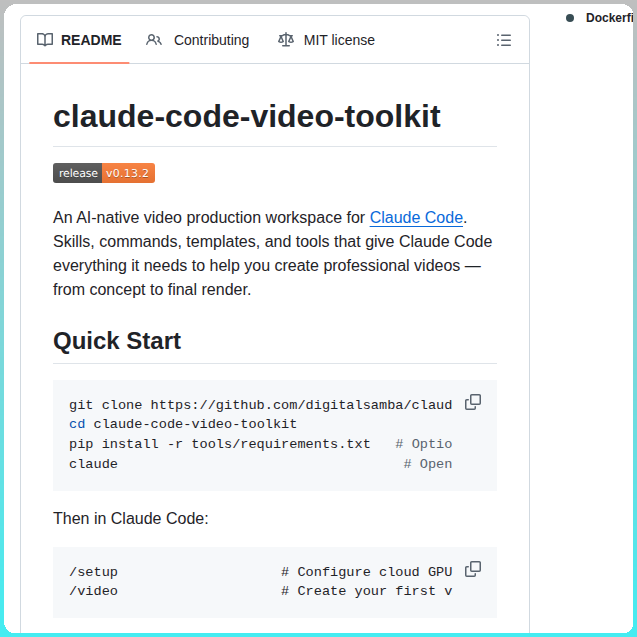
💥NEW AI CODING TUTORIAL: 12 Months of Claude Code Lessons in 46 Minutes
Claude Code just turned 1. So here's 52 lessons on how to get the most out of Claude Code, organized into 3 levels: Beginner, Intermediate, and Master.
TIMESTAMPS
00:00 12 Months of building with Claude Code
02:01 LEVEL 1: Beginner
02:09 Installation and Setup
04:55 Models and Modes
09:04 CLAUDE.md (and what to put in)
10:30 Context Management
11:31 Debugging with Claude
12:22 Version control
14:12 Prompting, Just ask Claude
16:01 LEVEL 2: Intermediate
16:24 Customizations (Skills, Plugins, MCPs)
24:42 Workflows: Plan, Build, Test
29:52 Verifying and Documenting with Claude
33:10 LEVEL 3: Master
34:17 Multi-Agent Development (multi-clauding with git worktrees)
37:07 Self-improving Systems
38:45 Ralph Wiggum Agent Loops
40:11 Async Task Delegation
42:00 Agent Teams, Pre-configure permissions, Hooks
44:42 Continue your learning
Linear algebra starts to make sense when you stop seeing numbers
and start seeing space.
A vector is not just [x, y, z].
It is direction.
It is movement.
That shift changes everything.
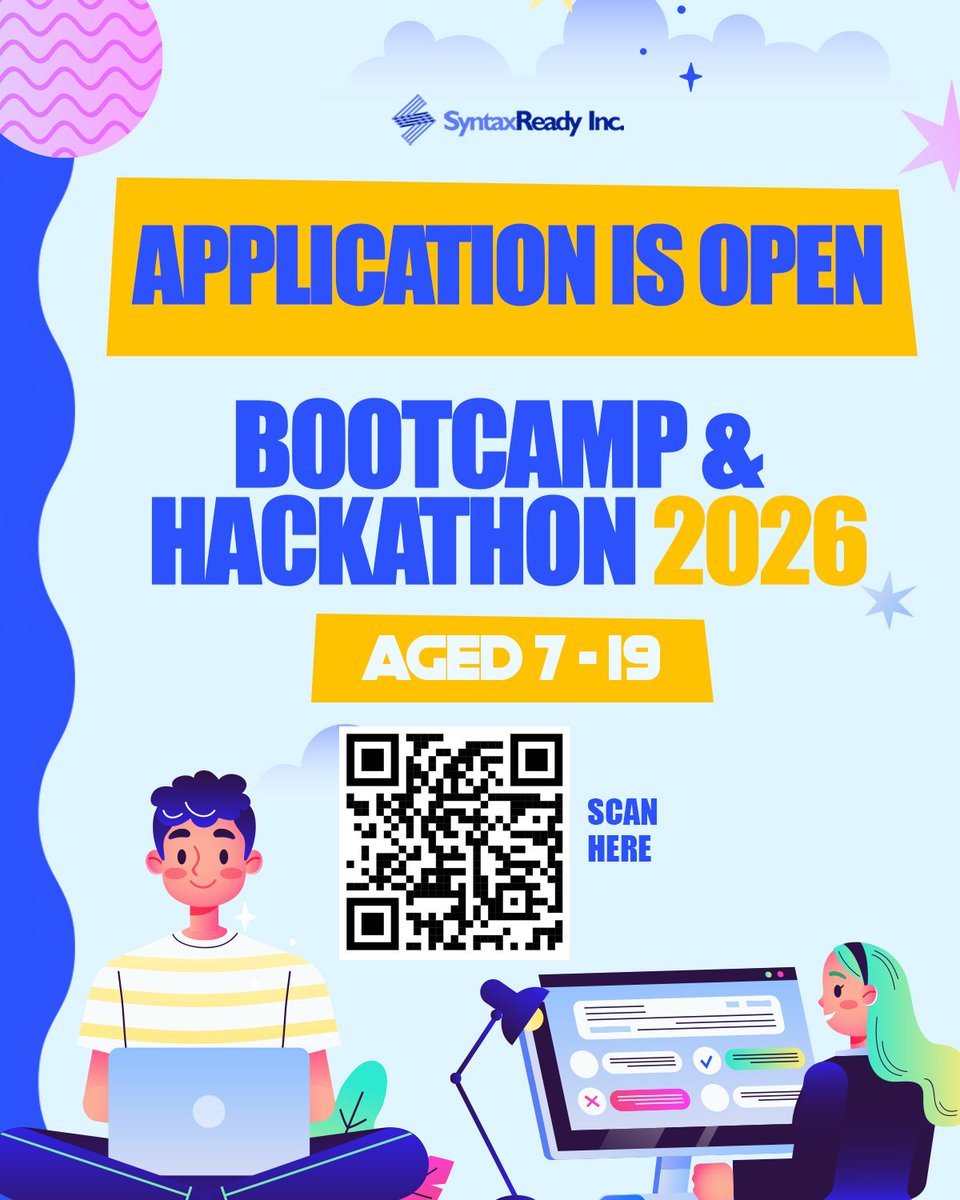
Applications are now open for the SyntaxReady Academy July 2026 Bootcamp
A free learning experience for curious minds ages 7–19 to learn, build, and grow with technology. Slots are limited. Know a child or teen who loves to explore and create?
👉Apply now: https://t.co/iKFXMjBvy5
Not all heroes wear capes. Some volunteer.
This July, help shape the next generation of innovators at the SyntaxReady Bootcamp & Hackathon 2026.
Mentors. Creatives. Organizers. Changemakers.
Limited roles. Real impact.
👉 Apply now
✔ Hands-on learning
✔ Mentor-led sessions
✔ Team projects & showcase
⚠️ Applications are reviewed and slots are limited.
If your child is curious, creative, and ready to learn, we encourage you to apply early.
👉 Apply now: https://t.co/GodX4bd60z
Happy New Month
This month, don’t just set goals, try something new. We built something powerful… and it’s ready for you.
Which of our apps are you exploring first this month? 👇🏽
Tap the link and try it out: https://t.co/aQRICipEn6
🚨 STOP COMPLAINING — IT’S LITERALLY TRAINING YOUR BRAIN TO BE NEGATIVE
Ever notice how some people seem stressed all the time, even over small things? Science says it’s not just their personality — it’s their brain.
Research shows that repeated complaining actually rewires your brain. Every time you complain, your brain activates stress and threat-detection circuits. Do it again and again, and those circuits get stronger. This process is called neuroplasticity — your brain becomes better at whatever you practice most.
So if you constantly talk about problems, frustrations, and annoyances, your brain learns to search for negativity. What starts as a bad day slowly turns into a habit of negative thinking. Over time, the brain treats the world as a dangerous place, even when nothing is wrong.
This is why chronic complainers often feel tense, irritated, or overwhelmed by small issues. Their stress level stays high because their brain is stuck in “alert mode.” Even minor problems feel big, because the brain has been trained to react that way.
The powerful part? This can be reversed. Stanford researchers explain that once you understand how your brain works, you can retrain it. Shifting how you speak — focusing on solutions, gratitude, or learning — builds new, healthier pathways. Your brain can be trained for calm, resilience, and clarity just as easily as it was trained for stress.
What you repeat, your brain remembers.
So choose your words carefully — you’re shaping your mind every day.


![syntax_ready's tweet photo. Linear algebra starts to make sense when you stop seeing numbers
and start seeing space.
A vector is not just [x, y, z].
It is direction.
It is movement.
That shift changes everything. https://t.co/8zLyNBkgpz](https://pbs.twimg.com/media/G-eu2h4WkAAmjga.jpg)