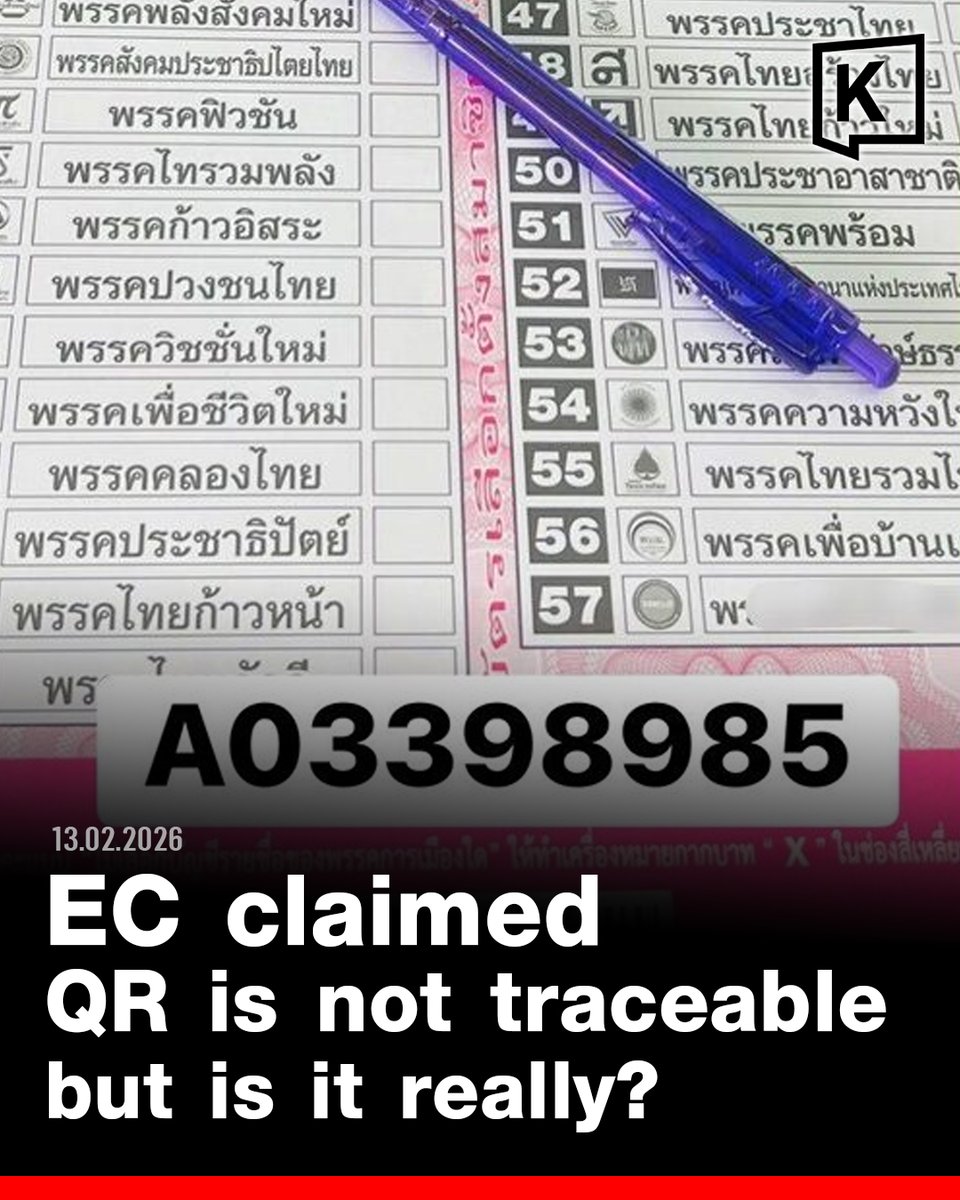
EC Details Security Rationale for Ballot Codes After Secrecy Concerns Raised
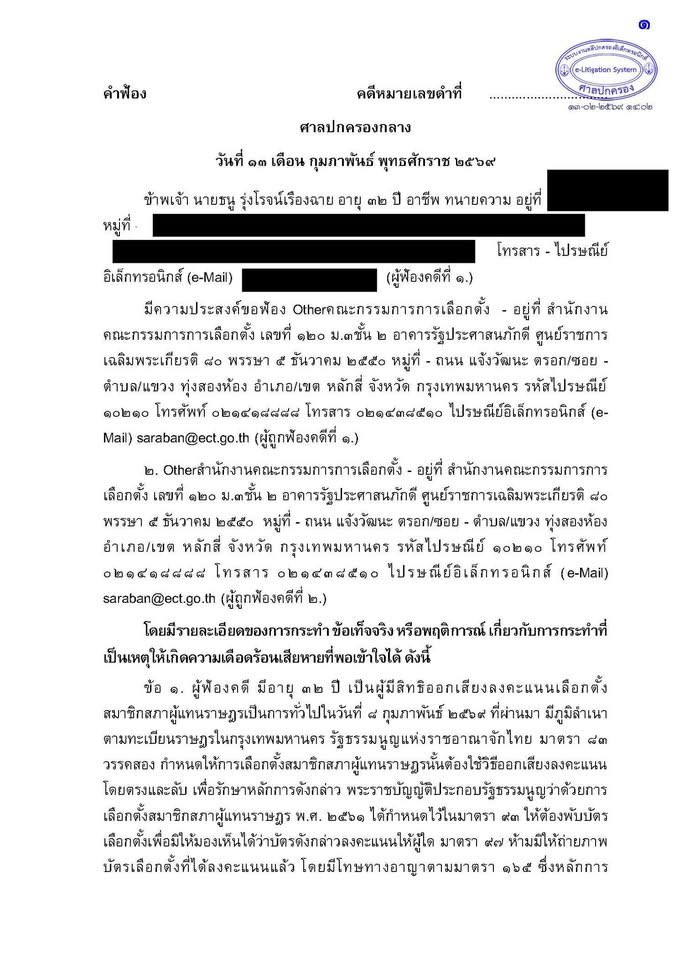
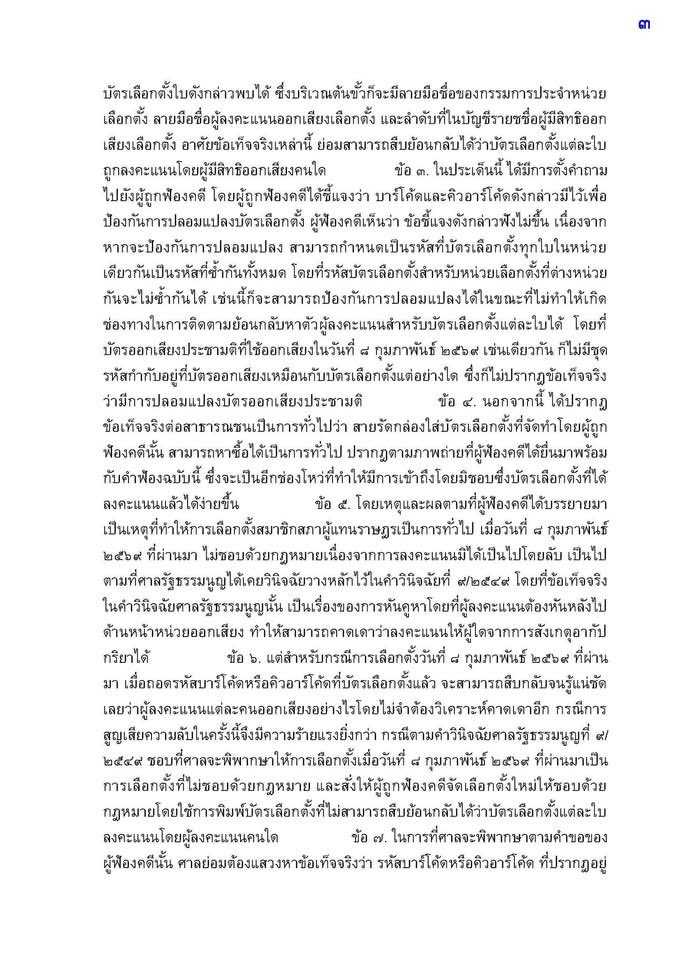
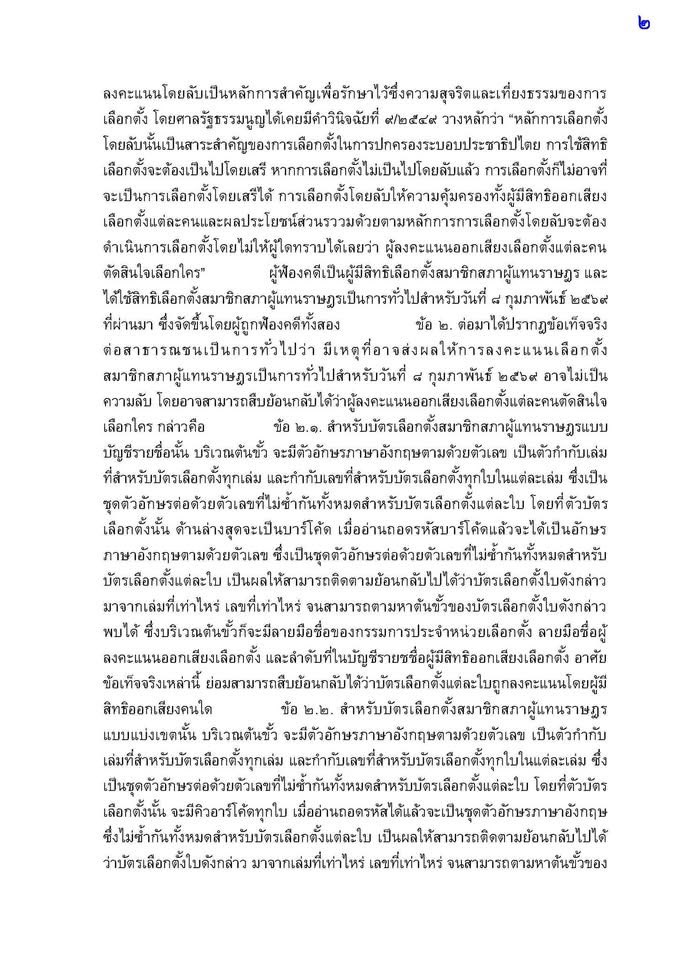
The Election Commission (EC) on Thursday provided a detailed explanation of barcodes and QR codes printed on ballot papers, after separate concerns were raised about ballot secrecy and the structure of the numbering system.
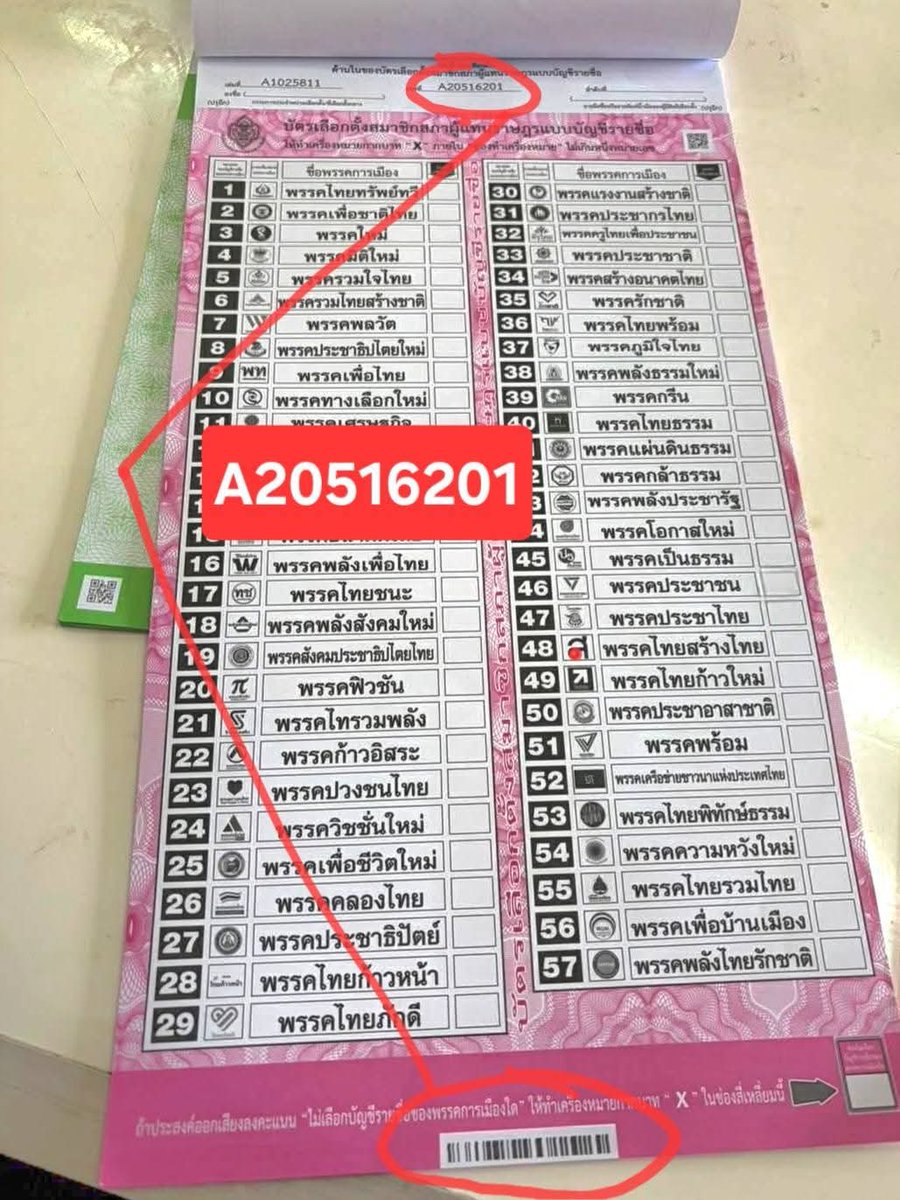
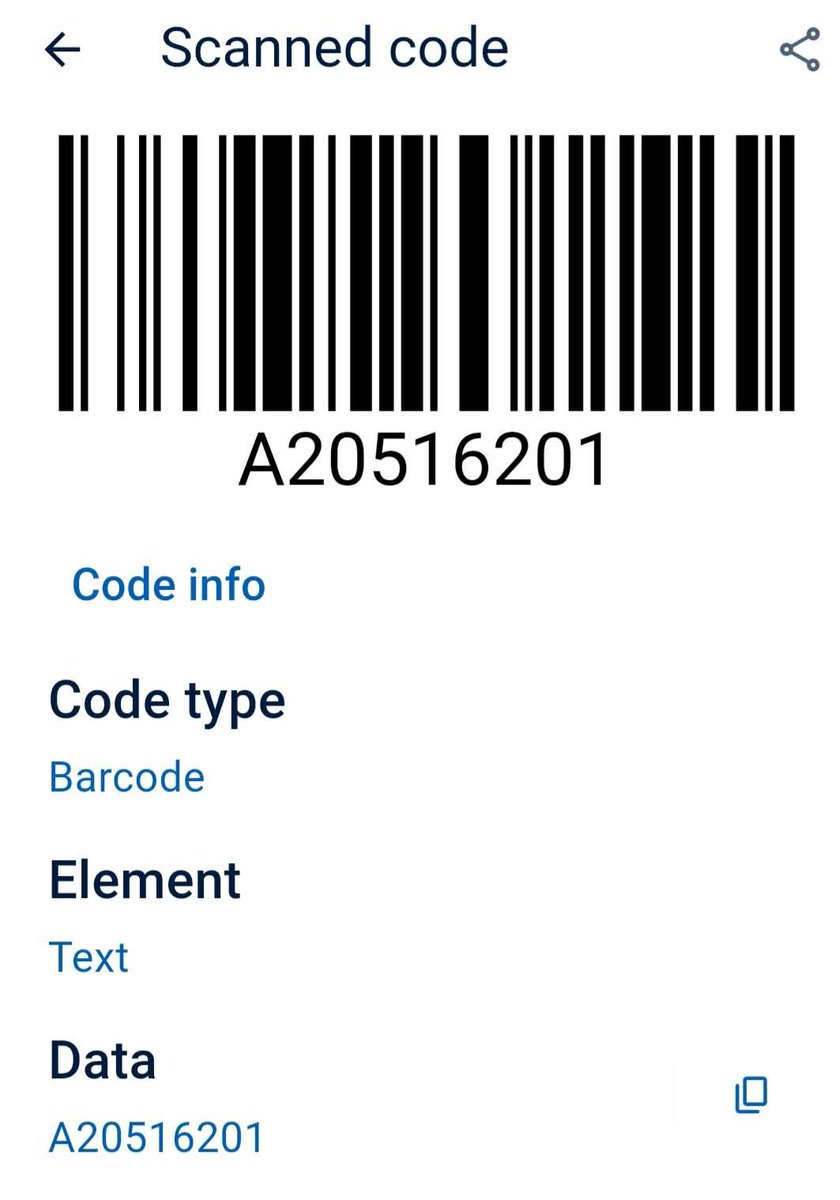
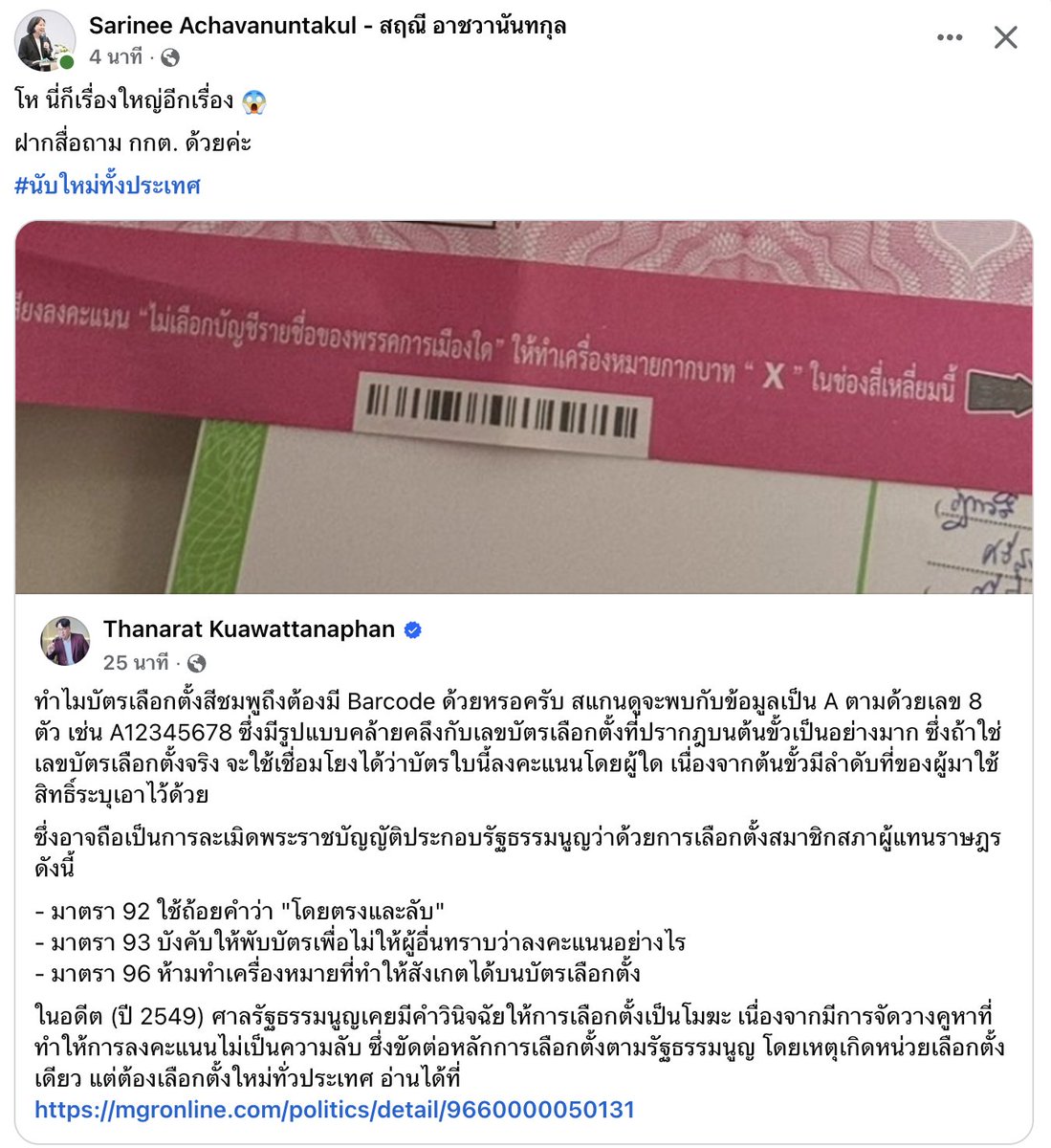
The first concern was raised by Thanarat Kuawattanaphan, COO of DomeCloud, who questioned why pink party-list ballots carry a barcode. He noted that scanning the barcode reveals an alphanumeric code beginning with “A” followed by eight digits, resembling the serial number printed on the ballot stub. Because ballot stubs are linked to the sequence number of voters who cast ballots, he argued that if the barcode corresponds to the stub number and is unique, it could theoretically allow ballots to be traced back to individual voters — potentially undermining the principle of a secret ballot. He cited Sections 92, 93 and 96 of the Organic Act on the Election of MPs, which require voting to be direct and secret, mandate folding ballots to conceal choices, and prohibit identifiable marks on ballots.
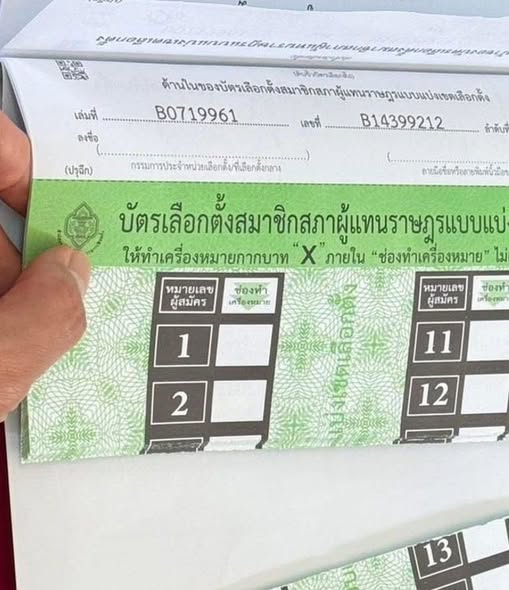
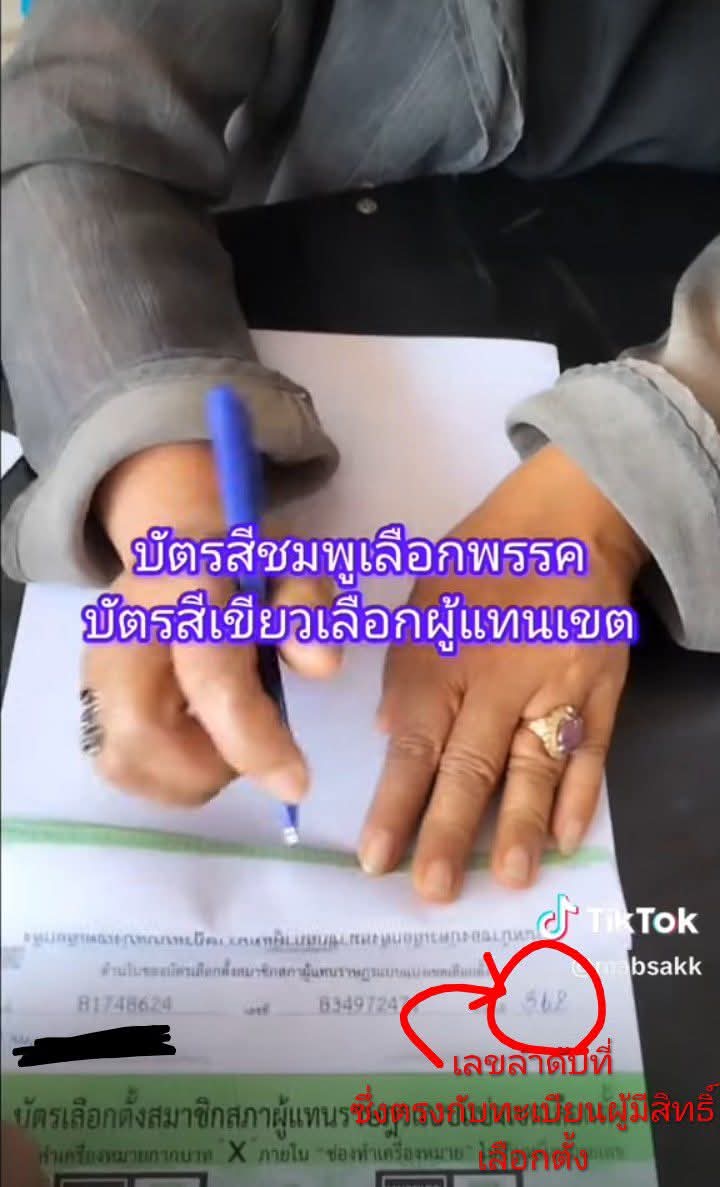
A separate but related observation was made by People’s Party Pathum Thani candidate Prasit Puttamapadungsak. Referring to photos of ballots and ballot stubs circulating online, he said the barcode on the stub matched the barcode on the corresponding ballot and that barcodes differed between ballots. He questioned whether the codes functioned as unique running numbers. Using an example of a booklet numbered A0169950 containing 20 ballots, he calculated that the numbering appeared sequential, suggesting a high likelihood the codes were unique identifiers. His concern focused on whether such a structured numbering system could make ballots traceable.
Questions were also raised about green constituency ballots, which carry QR codes on both the ballot and the stub. Observers asked whether scanning those codes could produce matching identifiers. Yellow referendum ballots do not contain barcodes or QR codes. Some also noted that previously released EC sample ballots did not display such codes.
At a 5 pm press conference, EC Deputy Secretary-General Phasakorn Siripakdayaporn said the barcodes and QR codes are security measures designed to control the production and distribution of ballots. He explained that the codes are used to identify printing batches and to track which sets of ballots were allocated for distribution, allowing the EC to verify when and where ballots were printed and sent.
He initially said the system allows the EC to determine which batch and which polling unit a ballot belongs to as part of internal control procedures. He also clarified that the barcode cannot be used to reference a specific polling unit in a way that would link a ballot to an individual voter.
According to the EC, the codes serve only as internal tracking tools for logistics and security control. The commission maintains that the system cannot be used to identify voters or reveal how any individual cast their ballot.
#Thailand #กกต #กกตหค #กกตมีไว้ทำไม #นับใหม่ทั้งประเทศ #นับคะแนนใหม่ทั้งประเทศ #เลือกตั้ง #เลือกตั้ง69 #เลือกตั้ง2569 #ชลบุรีเขต1
BANGKOK — 13 February 2026, Questions have spread widely online over the presence of barcodes and QR codes on Thai ballot papers, with critics warning they could potentially reveal how individuals voted and may breach election law.
The issue began after a Facebook user, Thuntee RB Sukchotrat, posted about QR codes printed on ballot papers and asked whether they could be used to verify counting errors.
He wrote that pink ballot papers carried a QR code in the top right corner and green ballots displayed one in the bottom left. According to the post, the codes appear to be eight-character alphanumeric serial numbers, possibly in Base32 or Base58 format, intended to prevent forgery or reduce counting errors.
However, the user questioned whether the QR codes might operate on a one-to-one basis or within a limited range, potentially enabling the identification of individual voters — a scenario that could contravene election law.
The post asked whether the QR codes could be used to scrutinise alleged discrepancies in ballot numbers nationwide, amid broader concerns about counting errors or possible ballot irregularities.
The controversy prompted widespread public questions to the Election Commission of Thailand. Acting Sub-Lieutenant Phatsakorn Siriphakdiayaporn, deputy secretary-general of the commission, said the concerns were likely based on a misunderstanding.
He said the barcodes were a security measure designed to identify which batch and polling station a ballot originated from, enabling administrative control. He stressed that the codes were not linked to any political party and were intended solely to ensure traceability of ballot distribution.
Subsequent online examinations, however, claimed that barcodes on pink party-list ballots matched the serial numbers printed on their counterfoils. Critics argued that this could make it possible to determine which number a voter selected.
Such a possibility, they said, could violate provisions of the Organic Act on the Election of Members of the House of Representatives, including Section 92, which requires voting to be “direct and secret”; Section 93, which mandates folding ballots to conceal votes; and Section 96, which prohibits marks that make ballots identifiable.
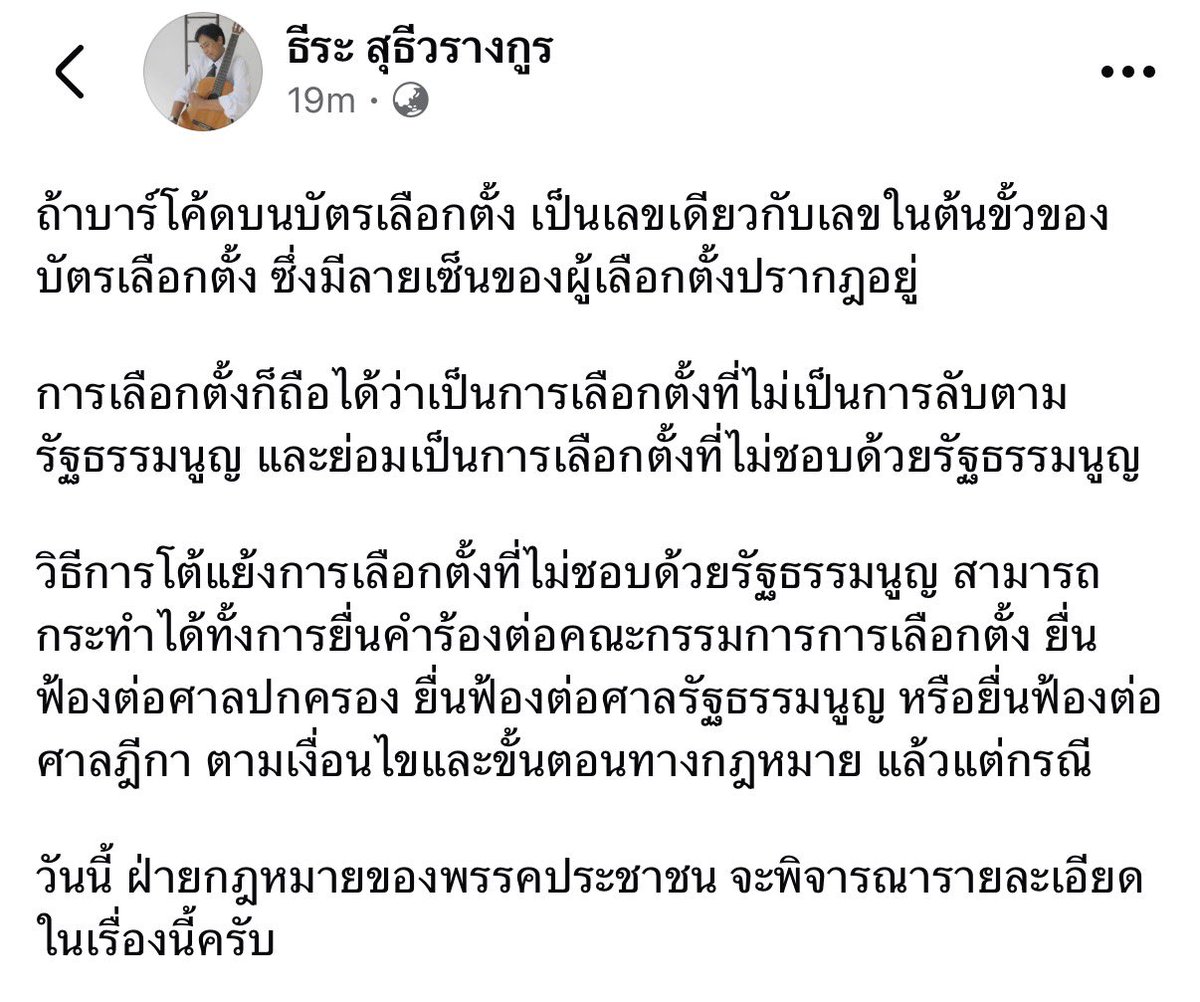
Another Facebook user, Thanarat Kuawattanaphan, posted a mathematical explanation suggesting that knowing a ballot’s barcode could allow someone to identify the corresponding ballot book and trace it back to a voter’s details.
He claimed that each ballot number is generated from its book number, with each book containing 20 ballots. Under the formula he cited, M = ⌊N/20⌋ + 1, knowledge of the ballot number (N) would reveal the book number (M). He further alleged that ballot numbers are uniquely generated and do not repeat, as each book number is multiplied by 20 and incremented sequentially from 1 to 20.
According to the post, this structure could allow a barcode to be traced back to an individual’s national identification number, name and surname.
The Election Commission has not publicly confirmed those claims.
#Thailand #Election2026 #ElectionComission #Ballot #Traceable #Claim #Barcode #QR
Exactly! Two ballots are handed to each voter, and two ballots are completed and handed back - but it looks like the Election Commission of #Thailand mysteriously did not count many of those party list ballots. This stinks to high heaven, and the only way to solve it is a nation-wide ballot recount, with observers looking over the shoulders of the counters at every step! If ECT refuses, they should be forced out! @bhumjaithai_TH@PheuThaiParty@PPLEThai@prd_official
เริ่มโหวตแล้ว CTW Music Community Artist Of The Year Awards 2025 รีบมาโหวตให้ BamBam ใต้โพสต์นี้กันได้เลย!
📢 สามารถโหวตตั้งแต่วันนี้ - 14 พ.ย. 2568
(สิ้นสุดการโหวตที่เวลา 18:00 น. ของวันที่ 14 พ.ย. 2568)
กติกาการโหวต centralwOrld Music Community Artist Of The Year Awards 2025
- สามารถโหวตให้กับศิลปินได้ 4 ช่องทาง ได้แก่ Facebook, Instagram, X และ TikTok ของ centralwOrld
- สำหรับช่องทาง Facebook สามารถโหวตให้กับศิลปินโดยสามารถ Like ใต้ภาพศิลปินนั้น ๆ คะแนนโหวตนับจากยอดรวมของการ Like ใต้ภาพนั้น ๆ ของแต่ละศิลปิน (หมายเหตุ: นับยอดรวม Like, Love, Care, Haha, Wow ไม่นับรวม Sad, Angry)
- ช่องทาง X คะแนนโหวตนับจากยอด Repost รวมกับยอด Like ของแต่ละศิลปิน
- ช่องทาง Instagram คะแนนโหวตนับจากยอด Like ของแต่ละศิลปิน
- ช่องทาง TikTok คะแนนโหวตนับจากยอด Like ของแต่ละศิลปิน
- ศิลปินหรือกลุ่มศิลปินที่มียอดรวมคะแนนโหวตสูงสุด จากทั้ง 4 ช่องทาง ได้แก่ Facebook, Instagram, X และ TikTok ของ centralwOrld จะได้เป็น The Winner ในแต่ละหมวด ทางศูนย์การค้าเซ็นทรัลเวิลด์ จะนำ Music Video, ภาพ หรือเพลงของศิลปินนั้น ๆ ในแคมเปญ centralwOrld Music Community ขึ้นจอ The panOramix , centralwOrld Void Screen, Entrance A,B และ จอ Digital ทั่วเซ็นทรัลประเทศไทย โดยจะประกาศผลในวันที่ 24 พฤศจิกายน 2568
หมายเหตุ:
* โพสต์เพื่อการโหวตทั้งหมดจะถูกตั้งเวลาให้เผยแพร่พร้อมกันในเวลา 11:00 น. ของวันที่ 3 พฤศจิกายน 2568 อย่างไรก็ตามอาจมีความคลาดเคลื่อนในเวลาและลำดับการเผยแพร่เนื่องจากข้อจำกัดทางเทคนิค
** ศิลปินที่มีชื่อร่วมเข้าชิงรางวัลเป็นการตอบรับจากทางค่ายเพลงและศิลปิน เพื่อเข้าร่วม CTW Music Community Artist Of The Year Awards 2025
* Music Video ของผู้ที่มีผลโหวตมากที่สุดที่ใช้ในการออนแอร์ จะเป็นเพลงที่เคยลงในแคมเปญ centralwOrld Music Community เท่านั้น
* การโหวต CTW Music Community Artist Of The Year 2025 นับศิลปินที่เข้าร่วม centralwOrld Music Community ตั้งแต่วันที่ 1 ม.ค. 2568 - 31 ต.ค. 2568
#centralwOrld #CTWMusicCommunity
#CTWMusicNewRelease #CTWArtistOfTheYearAwards2025