News-based sentiment indices built with LLMs closely track hard-data benchmarks, uncover growth and inflation drivers, and improve forecasting performance
https://t.co/0T8PIPE0Dc
Indirect effects through exchange rate shifts, supply chain disruptions and heightened uncertainty could further exacerbate the macroeconomic effects of tariffs.
https://t.co/pnv4XlEGK8
#BISBulletin
Tariffs affect the global economy most directly through trade, threatening to lower output growth globally and raise inflation in some cases.
https://t.co/pnv4XlEGK8
#BISBulletin
A new monetary policy conditions index integrates both conventional and unconventional policy tools. It consistently measures #MonetaryPolicy over time and across regimes, capturing the role of #BalanceSheets even beyond the effective lower bound. https://t.co/a5kSaGwmzD
Exchange rates move the real economy via many channels. New firm-level evidence reveals that near term, it’s firm cash flows – not trade competitiveness – due to sticky dollar pricing. This implies that invoicing-weighted FX matters more than trade weights https://t.co/lbaL7iYw0f
How can central banks use CBDCs as a stabilisation tool, to manage business cycle and capital flow volatility? We explain it in a recent VoxEU column with Michael Kumhof, Andrej Sokol
@asokol_econ, and Phurichai Rungcharoenkitkul
@phurichai. Paper here: https://t.co/8vw32fY4s9
Inspired by the debate between @nfergus and @adam_tooze on the current state of globalisation, I devoted my lecture at Columbia this week to take the pulse on global value chains:
"Global value chains under the shadow of Covid"
https://t.co/Mc1KjWLKMQ
Looking ahead, a continued easing in #Bottlenecks should reduce pressure on #Inflation but risks of more protracted #Bottlenecks or new shocks cannot be ruled out #Bottlenecks or new shocks cannot be ruled out #BISBulletin https://t.co/CGfvGeRMo1
The intricacy of global production networks is one reason #Bottlenecks have taken so long to ease. High market concentration, eg in the chip industry, is another contributing factor #BISBulletin https://t.co/CGfvGeRMo1
🎙️ What will global growth look like once the disruptions of the #Covid19 pandemic come to an end? Find out in the latest BISness podcast with economist @Phurichai Rungcharoenkitkul and host @KristaMHughes#podcast https://t.co/gfM76yPfDu
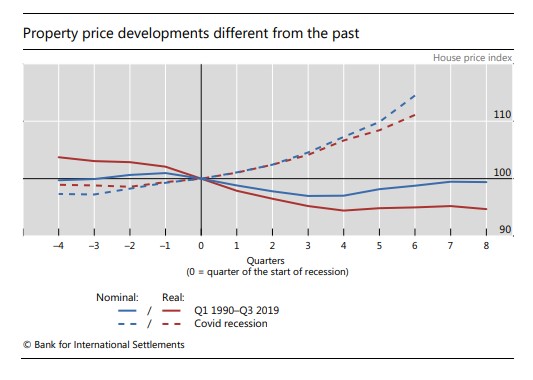
House prices kept rising through the pandemic in advanced economies, breaking with typical post-recession patterns. Various factors have been supporting demand, but pose risks if they reverse #HousePrices#MonetaryPolicy#BISBulletin https://t.co/vsHKcOyG7N
#HousePrices were buoyed in the period through 2021 by rapid economic recovery, fiscal support and negative real interest rates. Support also came from pandemic-induced demand for space, supply constraints and investor demand #MonetaryPolicy#BISBulletin https://t.co/vsHKcOyG7N
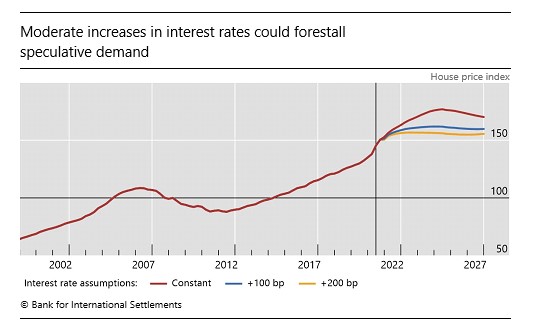
How #MonetaryPolicy responds to inflation will be relevant when assessing #HousingMarket risks. Moderate rate hikes could help dampen speculative demand #BISBulletin https://t.co/vsHKcOh5gf
#MonetaryPolicy may play a role in the secular decline of real #InterestRates, argue Phurichai Rungcharoenkitkul @phurichai and a co-author. The private sector and #CentralBank misinterpret the effects of their own actions, staring into a "hall of mirrors" https://t.co/dYmsxkofq4
Bottlenecks started out as disruptions to supply, but they have morphed into something more
Key point to bear in mind: in aggregate at least, supply has caught up to pre-pandemic levels in key sectors like semi-conductors as well as in raw materials and shipping
The inflation surge has brought #bottlenecks under the spotlight
Today's #BIS_Bulletin takes a closer look at what's going on and what we might encounter going forward
A short thread follows
https://t.co/0NjE72Pd1l