Exercise does far more than build strength or endurance—it activates molecular pathways that help regenerate muscle, heart, and brain tissue.
Understanding these signals could pave the way for “exercise mimetics” that bring regenerative benefits to those unable to exercise. 🧬🏃 #Exercise #RegenerativeMedicine #HealthyAging @WuTsaiAlliance
https://t.co/wRNNzt084y
Viruses and Joint and Tendon Pain
You had a cold two weeks ago. Nothing serious. But now your knee hurts more than it has in months. Your achilles is flaring. Your easy run felt like a half-marathon. You didn't do anything wrong. Here's what's actually happening...
Having been an orthopedic surgeon for 30 years...5 things I wish someone had told you before you walked into my office — in atraumatic joint and tendon pain.
Most of you will present with atraumatic joint and tendon pain... traumatic injuries are far less common in adults. And no... you didn't "sleep wrong."
I know we say this a lot, but I’ll say it again:
🚫 Language MATTERS 🚫
Just saw a lady who was told, based on this scan report, that:
1️⃣ “It’s the worst neck I’ve ever seen.”
2️⃣ She would likely end up in a wheelchair.
3️⃣ Conservative treatment needed to cease immediately
❗️She has spent 3 years living in fear of her neck, restricting activity and avoiding movement.
📄 The scan?
There is cord indentation mentioned, however the patient has no signs of a myelopathy.
A spinal review is recommended.
A Subsequent scan a year later showed only mild/moderate degenerative changes with no cord indentation (see next post)
📈 Outcome
The patient presented today with mild left neck pain only and MSK related shoulder pain.
👉 Points to consider
1. Could this patient have been managed better initially? Did she need to be scared in such a fashion?
2. Radiological reports differ- Hold back on making big statements without seeing the actual image unless serious pathology is actually evident and clinical signs match up.
@GregLehman@PhysioMeScience@aaron_physio Apologies, not saying you're doing that at all, but is the title of the paper itself at odds with its own findings? The fact that there was no difference surely isn't the same as there's no effect?
@GregLehman@PhysioMeScience@aaron_physio Am I misreading something though? The paper doesn't say it has no effect...it says it has a small effect, just not superior to sham. Therefore was it compared to a no treatment group? Not condoning it but is this misrepresenting the findings?
#WorldSuicidePreventionDay today guys..
If we are ever gonna start a conversation make it today
Please remember if you feel you can’t talk to your nearest and dearest there’s loads plenty of amazing organisations ready to help
Check out our website below to join a walk
There is hope.
I once struggled with 24/7 severe #chronicpain.
Then I stopped fighting it.
Today, I don't take pain medication.
I hurt, but I often don't notice the pain, and the pain doesn't control me or worry me.
Learn more in this interview: https://t.co/UpYVVL8UbD
URGENT APPEAL!
The incredible Val Jones has been in an accident.
Her family are fundraising to get her ventilation at home. Her GoFundMe page is here: https://t.co/6J9dLYAxgb
If you aren’t yet aware of Val’s amazing work then here’s the ‘Val Jones Upper Limb CPD Bundle’ containing everything we have ever made with her and more: https://t.co/0sme2Jo2Lt
9 webinars
2 podcasts
1 MSKMag
Access provided 01/09/2025 and will NOT expire. All donations to Val’s care.
How do we enable behaviour change? These authors synthesised findings from 147 meta-analyses to identify which determinants of behaviour are most impactful & which should be targeted for change interventions. Many of the studies focus on large-scale, health-related, environmental or consumer behaviours but the conclusions are also worth reflecting on for organisational change.
What leaders of change should do:
1) Remove barriers & make desired behaviour easy: Focus on changing the environment & systems so that the desirable behaviour is simple, convenient, & supported; e.g, provide direct access to resources, streamline processes & foster social support.
2) Build social structure: Facilitate a culture where positive behaviours are the norm. Engage peers & create opportunities for team encouragement & collective participation.
3) Enable habits & provide ongoing support: Support repeated practice & help people make the new behaviour part of their routine. Reinforce changes with reminders, prompts, & positive reinforcement.
4) Prioritise practical changes over persuasion: Rather than trying to shift attitudes or beliefs, invest in changes that directly enable & reinforce the desired actions.
What leaders of change should NOT do:
1) Don’t rely solely on information or education: Simply telling people what to do, increasing knowledge or launching awareness campaigns has limited impact on actual behaviour.
2) Avoid focusing mainly on changing attitudes or beliefs: Programmes that target broad mindset change, general skills or even trustworthiness are less effective than those that address practical barriers.
3) Don’t overlook structural support: Failing to provide the physical, social, or material support needed for people to act makes adoption less likely, even if people know it’s important.
The article reinforces the importance of creating the conditions for change: making the “right thing to do” the easy, supported, default option, across multiple dimensions: https://t.co/D7HgPB9Dzn
Original manuscript version: https://t.co/g8qfgWtRa4. By Dolores Albarracin (@socialactionlab) & colleagues.
I accessed this article via @ReubenRusk who also created the graphic.
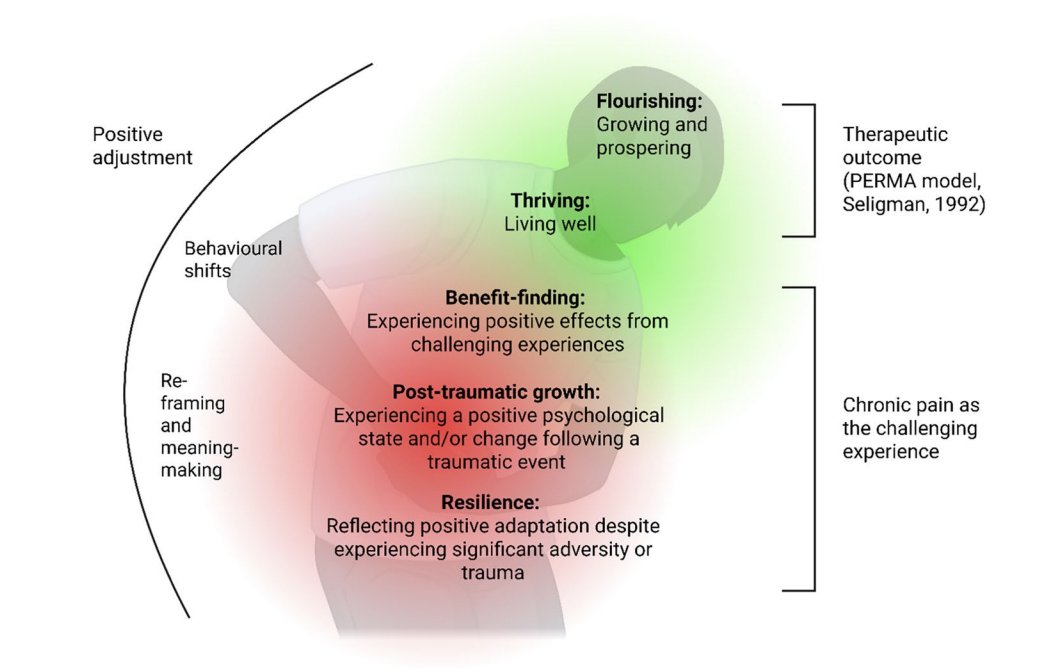
🔥Thriving with chronic pain🔥
4 key themes based on experiences of individuals living with chronic pain
1 - Attitudes towards pain & impact on life
Embracing pain acceptance, reframing the experience, & choosing to focus on life beyond pain were crucial for thriving
1/4 👇