For “dangerous” or weakly-guarded open source models, hold the hosts liable.
Of course the end user holds liability as well if they are jailbreaking models to do harmful things.
Dubai wrote rules for digital assets before most of the world knew it needed them.
Harshil Agarwal (@picaz_eth) of @TLPAdvisors joins @afscott on Solana is Global to walk through the UAE tokenization landscape and where stablecoins fit in the Middle East.
Full episode 👇
Crypto Cards with no KYC: how they work and what you risk
I read the contracts behind 16 cards sold as no-KYC. Here is what you should know before you use one
So how do they work?
- the provider does not issue anything. A company registers, passes KYB, the business version of KYC, and gets the right to open cards for its "employees"
- you are one of those employees on paper. You pay the provider, top it up in USDT, and get a card number out of that company's program
- the bank behind it sees one business client, not you. Nobody checked you, and nobody can vouch for you either
- one card is listed as no-KYC while the provider's own page says "KYC is required everywhere we operate"
- another opens with "no photo ID needed" and hangs an asterisk on it: subject to AML and regulatory requirements
How do no-KYC cards make money?
- one charges 5% on the email-only tier and 0% on the tier that checks your ID. The discount is for showing documents
- top-ups run 2% to 5%, opening a card costs $5 to $168, and one contract takes $0.25 for every authorization attempt, approved or declined
- another takes 3% of every declined transaction
- one reserves the right to charge 10% of your remaining balance per month after 90 days with no login and no spending
And what do you risk?
- when funds get frozen, the contract says you are the bank's counterparty, not the service. Help getting them back is offered as a courtesy
- that same provider discloses that in February 2026 a banking partner locked accounts and caught part of customer balances. It says it refunded most of them voluntarily, with no obligation to
- your card can die for how you spend rather than what you buy: decline and refund rates above their limit, and one bans Steam and Uber as platforms that trigger the bank's risk controls
- three of them have no terms, no privacy page, nothing legal on the site at all. One of those still points buyers to a token presale page that has been switched off
You are not skipping KYC here. You are using someone else's
Do you use no-KYC cards, and why?
🚨 The SEC and CFTC have issued joint digital asset guidance - introducing, for the first time, a formal token taxonomy.
Key takeaways:
• Clear classification framework
– Digital Commodities → not securities
– Digital Collectibles (NFTs) → not securities
– Digital Tools (utility tokens) → not securities
– Payment Stablecoins → not securities
– Digital Securities → remain under SEC
• Lifecycle recognition
“Investment contracts can come to an end.”
→ Tokens may transition out of securities status as networks decentralize.
• Core network activities clarified
Staking, mining, airdrops, wrapping → not securities transactions
• Startup relief incoming
A proposed safe harbor (up to $5M over 4 years) signals a shift toward capital formation, not enforcement.
Source: https://t.co/gBSIL6TCz7
Tokenized stocks, bonds, etc. = still securities
(Jan 2026 SEC statement)
Tokenization doesn’t change the legal nature of the underlying asset.
Similar to UAE
See TLP’s piece: https://t.co/jAUZeNyib5
There’s a lot of noise around “the US just declared most crypto NOT securities.”
That’s… not quite right.
What is happening: a gradual shift toward clearer crypto market structure 👇
Important clarification from the Central Bank of the United Arab Emirates on the scope of Federal Decree-Law No. 6 of 2025.
The distinction between regulating financial activity vs. regulating technology is now much clearer.
#UAE#Fintech#Crypto#DeFi.
Technology service providers can breathe easier. The Central Bank of the United Arab Emirates (CBUAE) has clarified one of the most debated provisions of Federal Decree-Law No. 6 of 2025.
#crypto#payments#UAE#CBUAE#Dubai#Fintech#TLPAdvisors
To be very clear - until they add fraud proofs - all the ~$3b that are in the Optimism and Base bridges can be taken out any time, and users can do nothing about it.
Not sure under what definition this is called non-custodial.
🚨 Needless to say, regulating digital assets through enforcement only had a dreadful day in court last week.
In the wake of the resounding decision out of the SDNY Ripple case, @SECGov must reassess its continued assault on the crypto industry.
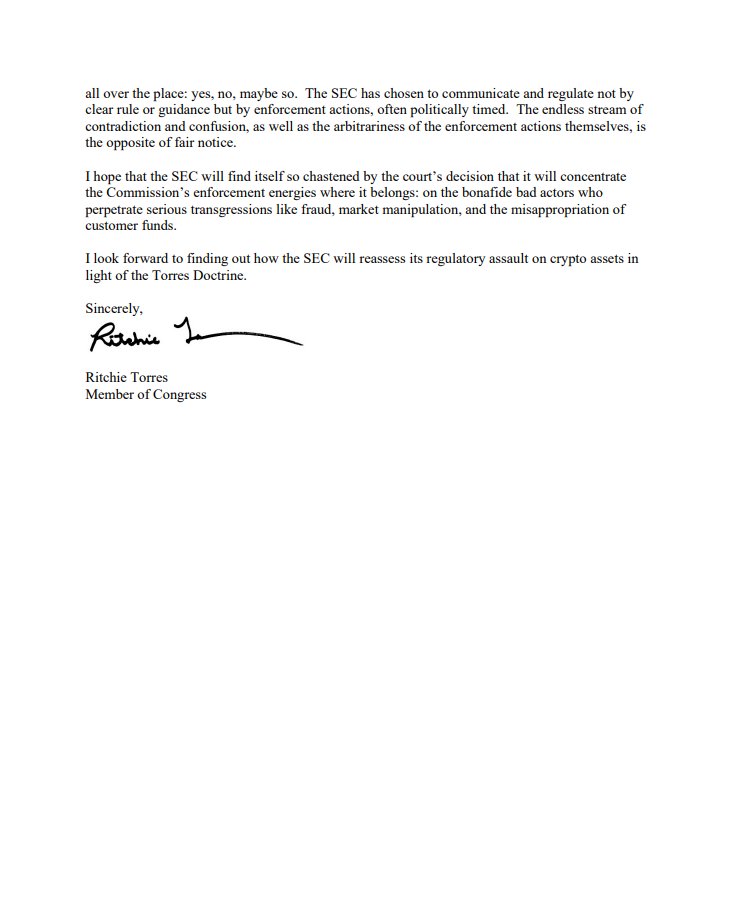
My letter to Chair Gensler:
Agree that our amicus does not line up perfectly w/ Torres' opinion, but its not fair to say the opinion came out the way it did "despite" our amicus
The core point we made is that Howey focuses on contracts, transactions or schemes, not assets, and that there is no precedent for holding that an asset sold in an IC is itself a security. The opinion clearly adopts this.
Yes, we focus on implications to "common enterprise" prong, while Torres focused on "expectation of profits" prong, but she bases her analysis on the fact that buyers in programatic sales were not purchasing directly from Ripple, which is very close to saying they dont have any privity with Ripple
Also the language from our brief (left) that was largely mirrored the opinion (right) shows a clear impact
https://t.co/DNmyV3G2Vn
Ripple won *despite* every legal theory asserted by Ripple and its amicii...
The amicii, especially with @NYcryptolawyer 's help, deserve tons of credit for getting the judge to think deeply and side with Ripple, but the judge did not agree with their legal theories... she ended up in the same place ("tokens are not intrinsically securities") for different reasons..
Instead of the 'predicate contract' theory advocated by Ripple and others, the judge leaned on a relationship b/w "investment of money" and "efforts" within Howey that none of the parties pleaded.
PSA for other crypto defendants-- check out footnote 20 where the Court makes it clear that the SEC’s theories (other than to Institutional Sales) are potentially very much subject to a Fair Notice defense. 👀
Don’t be misled that Judge Torres ruled that sometimes XRP is a security and sometimes it isn’t. That’s exactly the opposite of what she ruled: XRP itself is NEVER a security. “ Page 15: "XRP, as a digital token, is not in and of itself a ‘contract, transaction[,] or scheme’ that embodies the Howey requirements of an investment contract."
future of work - AI
future of money - crypto
future of finance - defi
future of education - AI & VR
future of Hollywood - web3
future of music - web3
future of ownership - NFTs
future of real estate - tokenization
future of nations - network states
future of corps - DAOs
40-something wall street corporate lawyer who spent years confidently assuring their tradfi hedge fund client not to buy tokens because they're all illegal securities