The Cancer Episode
> My diagnosis and prognosis
> What this means for How to Take Over the World
> A few thoughts on death
> See below for links to GoFundMe, etc.
New podcast on AI (full episode). Links below.
A Motorcycle for the Mind
0:00 If you want to learn, do
2:13 Vibe coding is the new product management
6:49 Training models is the new coding
10:13 Is traditional software engineering dead?
13:07 There is no demand for average
14:12 The hottest new programming language is English
18:36 AI is adapting to us faster than we are adapting to it
22:56 No entrepreneur is worried about AI taking their job
26:46 The goal is not to have a job
29:49 AIs are not alive
32:55 AI fails the only true test of intelligence
36:49 Early adopters of AI have an enormous edge
39:37 AI meets you exactly where you are
43:02 Always leverage the best intelligence
44:37 If you can't define it, you can't program it
49:37 The solution to AI anxiety is action
On Scott Adams.
A man finds, to his astonishment, that he exists. After the elation of childhood wears off, he asks, who am I, why am I here, how does this work? These are hard questions, so after a brief struggle, he selects a readymade answer and goes about the motions of life.
Scott Adams was not such a man. He was a live player, ever curious, intent on figuring out this simulation that he found himself in. From first principles, Scott unraveled, understood, and ultimately controlled his own reality. He hacked himself with affirmations, others with persuasion, the world with simultaneous sips. He explained people as moist robots, two movies happening on one screen, his world as Gods’ debris. He carved a personal mission to “be useful,” and made us all better writers, public speakers, and persuaders. He preached the footwear theory of motivation, the Adams Law of slow-moving disasters, the skill stack, systems over goals, and of course, the Dilbert Principle.
Besides cartooning, philosophizing, and teaching, Scott rose to the occasion and displayed, “the one virtue that cannot be faked” - courage. Scott had the courage to speak honestly as he saw it - about Trump, about his nation, and about his time, even though it cost him friends, audience, money, and his ticket to polite society. Scott had true courage, the kind that makes you unpopular, the kind that is always and everywhere in short supply,
At the end, as any hacker of reality, Scott covered all of his bases - he left as a Buddhist, a Christian, and a player in the Simulation.
Scott, we didn’t get enough time with you, but you were a mentor and a marvel. You were useful and you were courageous. You were incompressible and indivisible. One of a kind, and generous with your drawing, writing, and speaking. Unlike your squealing critics in the chattering class, you will be read generations from now.
On this earth there are many long-lived hells but no lasting heaven. Each heaven must be created and nurtured, ex-nihilo, from mind and from mud. Scott, you created a small heaven for us all, and to a larger heaven you go.
A man finds, to his astonishment, that he no longer exists. He asks why, what it was for, and how will the new reality work? When the rest of us get there, we’ll find Scott, ever useful, ready to explain, having figured it all out.
Notes:
• First line paraphrasing Schopenhauer.
• Courage quote via Taleb.
The Black Swan, by Nassim Taleb
The triplet: rarity, extreme impact, and retrospective predictability.
We can have negative black swans, where you are hurt by uncertainty, and positive black swans, where you are benefited from uncertainty…
https://t.co/xnv3wOQ5OS
@pickingnuggets your latest video on the black swan is amazing!
No doubt in my mind if you keep going you’ll be as big as though who inspire you. Your platform is Lindy!
Happy holidays!
Elon Musk: “Anyone who wants to make more than they take has my respect”
Elon is asked for his advice for entrepreneurs, to which he responds:
“I’m a big fan of anyone who wants to build. Anyone who wants to make more than they take has my respect. That’s the main thing you should aim for: to make more than you take and be a net contributor to society.”
He compares it to the pursuit of happiness:
“If you want to create something valuable financially, you don’t pursue that. It’s best to pursue providing useful products and services. If you do that, money will come as a natural consequence of that rather than pursuing money directly. You can’t pursue happiness directly. You pursue things that lead to happiness — fulfilling work, study, friends, loved ones.”
Elon continues:
“It sounds very obvious, but generally if somebody is trying to make a company work, they should expect to grind super hard and accept that there’s a meaningful chance of failure. Then just focus on having the output be worth more than the input. Are you a value creator? That’s what really matters: making more than you take.”
Video source: @nikhilkamathcio (2025)
I want you to hate me.
I want you to read my tweets and seethe.
To think, "God, he's just THE WORST," as you hate-scroll.
Or mutter "fucking tool" when I say something obnoxious on a podcast, white-knuckling the steering wheel.
Not all of you. Just some.
Maybe 2-3%—that's the sweet spot.
Ten years ago, this would have struck me as insane. I would have wanted the opposite.
Because in 2013 I read a quote that changed my life:
"It takes 20 years to build a reputation and five minutes to ruin it."
This is a famous line by Warren Buffett—someone many of us have modelled our lives after.
This advice, while valuable in moderation, became toxic when I took it to the extreme.
Why?
Because it's impossible.
After reading it, I became obsessed with how I came across to others.
I thought that everyone—online and off—had to walk away from every interaction liking me.
One negative article, one misstatement, one failed commitment, and I'd be toast.
I had to do exactly what I said and follow through. My behaviour had to be consistent and predictable.
After all, that's how a reputation is built. Brick by boring brick. Until one day, you die, honourable and forgotten forever.
This idea crystallized one afternoon at a pub with my dad. He had recently retired from architecture, so took him out for a celebratory drink and asked what he wanted to do next.
"You've always wanted to build your own buildings," I said, taking a sip of my beer. "Why not become a real estate developer? With all your contacts, you could get up and running in no time."
"Andrew," he replied, leaning back in his chair. "Once people put you in a mental box, they punish you for leaving it. In their minds, I’m in the 'architect' box. If I suddenly called them up and pitched a real estate development, it would hurt me more than starting fresh. Everyone hates it when you change boxes."
My stomach dropped—I knew he was right. I'd felt it a million times, though I hadn't quite put my finger on why.
Nothing made me cringe harder than the restaurateur friend pitching me on his tech startup. Or my yoga instructor getting their real estate license and trying to sell me a house. Or my lawyer announcing they're becoming a psychotherapist.
I’m ashamed to admit it, but my gut reaction was always: “Stay in your lane.”
Which is particularly hypocritical given how often I want to flip flop through everything myself: hobbies, businesses, communities, opinions—you name it. I hate in others what I secretly hate about myself.
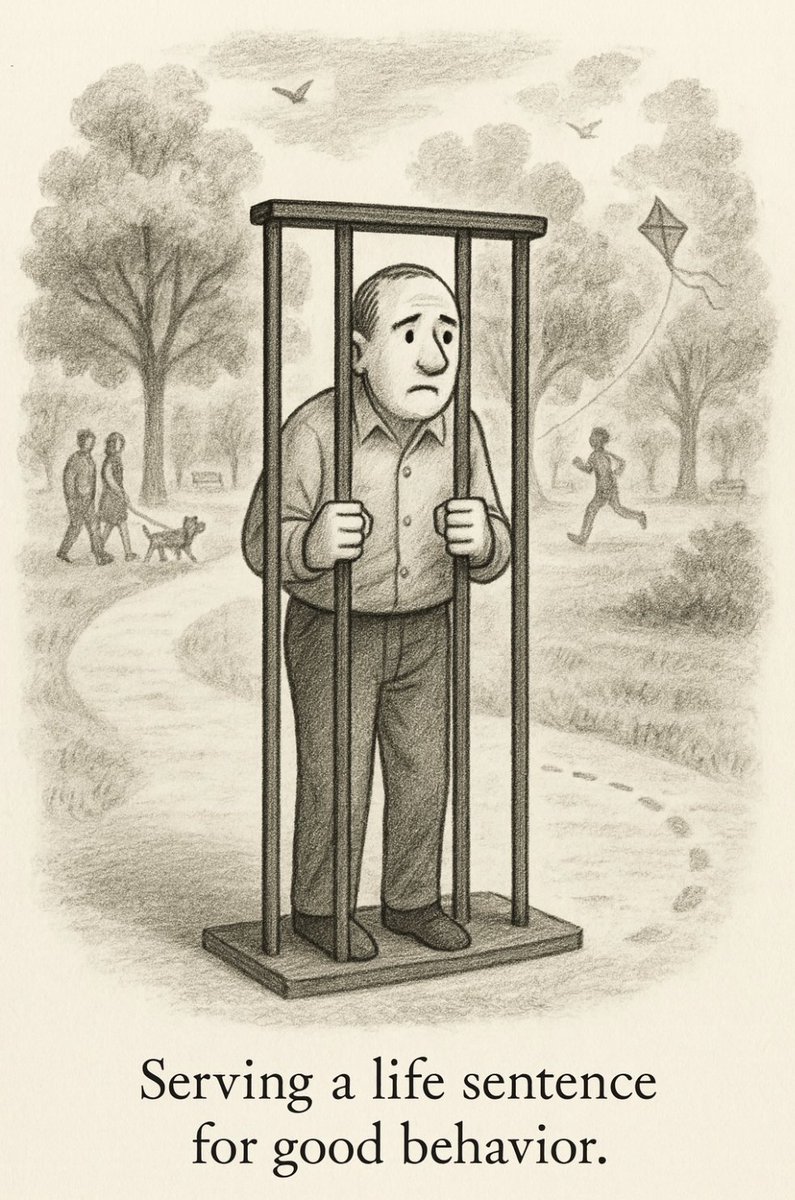
We're all desperate to put one another in these boxes. I often get labeled "investor" or "entrepreneur". But even within that, there are sub-boxes. Tech investor, not real estate. Software businesses, not physical products. Bootstrapped, not venture. Crypto skeptic vs. crypto bull. Each label becomes another bar on the cage.
And we love punishing people for leaving it…
David Solomon runs Goldman Sachs, but when word got out that he DJs on weekends? The financial press went apoplectic (I can't imagine they would have said the same if he was golfing).
Jonah Hill starts surfing? Instant meme fodder.
Kim Kardashian passes the bar to fight for prison reform? A vanity project.
Michael Jordan wants to play baseball? Abject betrayal.
We're all prison guards, basically. Making sure everyone stays in their assigned cells.
Why? Because our brains are prediction machines. They get upset when people behave in a manner that doesn't meet their predictions. Thus, step out of your box, and people (and their brains) won't like it.
This happens to me often.
There are people who know me based on my public business persona. They know me as a Buffett wannabe, building a holding company using value investing principles.
This is true. But I also love learning by jumping into random new projects that don’t fit this mold.
My portfolio includes all sorts of businesses that would give Warren Buffett hives. I’ve lost my shirt starting restaurants. Acquired failing newspapers. Invested in companies with a 1 in 100 chance of working.
Tiny continues to buy wonderful businesses at fair prices (the Warren Buffett playbook), but the rest of my life doesn’t fit neatly into that “value investor” box.
I am both a disciplined value investor and a creator of chaotic startups across dozens of industries. These two things aren’t supposed to coexist.
It's not just me. I recently polled a group of close friends and asked them what they would do for work if they couldn't do their current job.
One response struck me in particular:
A friend runs a huge industrial holding company, but he told me that if nobody was watching, he'd sell it and start his own restaurant.
And better yet, he wouldn't just be the owner. He'd be the chef, sweating it out behind an oven in the back.
His true, authentic passion is cooking, but he feels like he could never step out of the life and reputation he'd established for himself to follow his passion.
What would people say?
That he'd lost his mind, left his successful business in a completely different industry, and gone off to start…a restaurant?
Imagine the gossip and judgement he'd face.
You might think charitably of yourself. That you'd hear that he'd started a restaurant and think, "good for him." But let's be real: you'd likely delight in the gossip and think "stay in your lane," just like everyone else.
Deep inside, you might even subconsciously hate him for it, or want him to fail. Because he did the thing you're too scared to do yourself.
He'd have escaped the same prison you're in. Against the rules. Not fair!
So instead, he continues to do what we all do: shrug and continue to live in society’s reputational cage.
I'm sure way too many of you are nodding along. Most of us do this to one degree or another.
I've lived in a cage like this for decades.
This applies to many things. Legal degrees. Bad marriages. Letting down your parents. Moving away from the city you swore you'd never leave. The industry you've spent 20 years building credibility in.
Each, a promise or commitment made by a different person—the person you were before you changed in whatever way it is you've changed. A sort of reputational quicksand, each step out harder than the last.
For me, this obsession with maintaining reputation—playing by these inflexible rules—was a recipe for misery.
If I continued playing the game, I had three equally terrible options:
Terrible Option 1: Hide and say nothing. Fly under the radar. Be a cipher. (Impossible, for an extreme extrovert like me.)
Terrible Option 2: Become a caricature of myself. A personal brand instead of a person. Avoid doing anything controversial.
Terrible Option 3: Live a double life. Perform one thing and do another in secret. The world wouldn't catch on and give me the corresponding social beating, but I also wouldn't get to share my passion with others.
For a long time, I chose Terrible Option 3. I toned down the things I mentioned publicly and didn’t talk about many of my projects because they didn’t fit the template.
It felt inauthentic. Like, with every passing day, a little piece of me was dissolving.
I realized it had gone too far when I found myself deleting a tweet for the fourth time. Not because it was wrong or offensive, but because someone, somewhere, might misinterpret it.
I was slowly drifting towards becoming what I'd always mocked.
A corporate politician. A beige person. Human vanilla extract.
Then, in January, I came across a book called The Courage to Be Disliked.
I needed this book. So much that I actually felt personally attacked by it.
The core message is that seeking recognition from others is a trap.
We bend ourselves into pretzels trying to meet everyone's expectations, but it's impossible. You literally cannot make everyone happy. And trying to do so means living someone else's life, not your own.
The book argues that having the courage to be disliked is the only path to freedom. Not by being an asshole, just accepting that living authentically means some people won't like you.
Reading it felt like someone finally handed me the keys to my own cell.
It gave me permission to start breaking the rules. I was done with the likability game. I was going to have the courage to be disliked. Hated, even.
To live authentically, I would do what I wanted to do, and talk about what I wanted to talk about, so long as it didn't hurt anyone else in an unfair way.
Change my mind. Be unpredictable. Jump around. Say the thing.
That became my 2025 resolution.
Now, to be clear, we're talking about a very specific type of reputation. What the public at large thinks about you.
Should you maintain a reputation as a fair and ethical partner, whether it's romantic, social, or business?
Absolutely.
But should you obsess over what the world would think, as Mr. Buffett puts it, imagining every action appearing on the front page of The New York Times?
In most situations, absolutely not.
I stopped playing for universal approval. I chose the courage to be disliked. That means I’ll say things some people won’t like, and I’m okay with that.
Disappointing people is the price of an authentic life.
So here's my dare:
Let someone down today. Say the thing that's been rotting in your chest.
Start small. Post your anime fan fiction. Tell your gym bros you love Pilates.
Then, go bigger. End the relationship everyone thinks is perfect but is actually miserable. Admit what you thought was your dream job is a nightmare. Tell your business partner you want out. Stop pretending you enjoy the thing that's slowly killing you.
Watch what happens: 90% won't notice or care. 8% will respect you more. 2% will hate you.
And you'll feel free for the first time in years.
Because here's what I learned: The cage only exists if you believe in the bars.
I'd rather have 2% hate the real me than 100% applaud a performance.
PS: Thanks to all you hate-scrollers. I couldn’t do it without you.