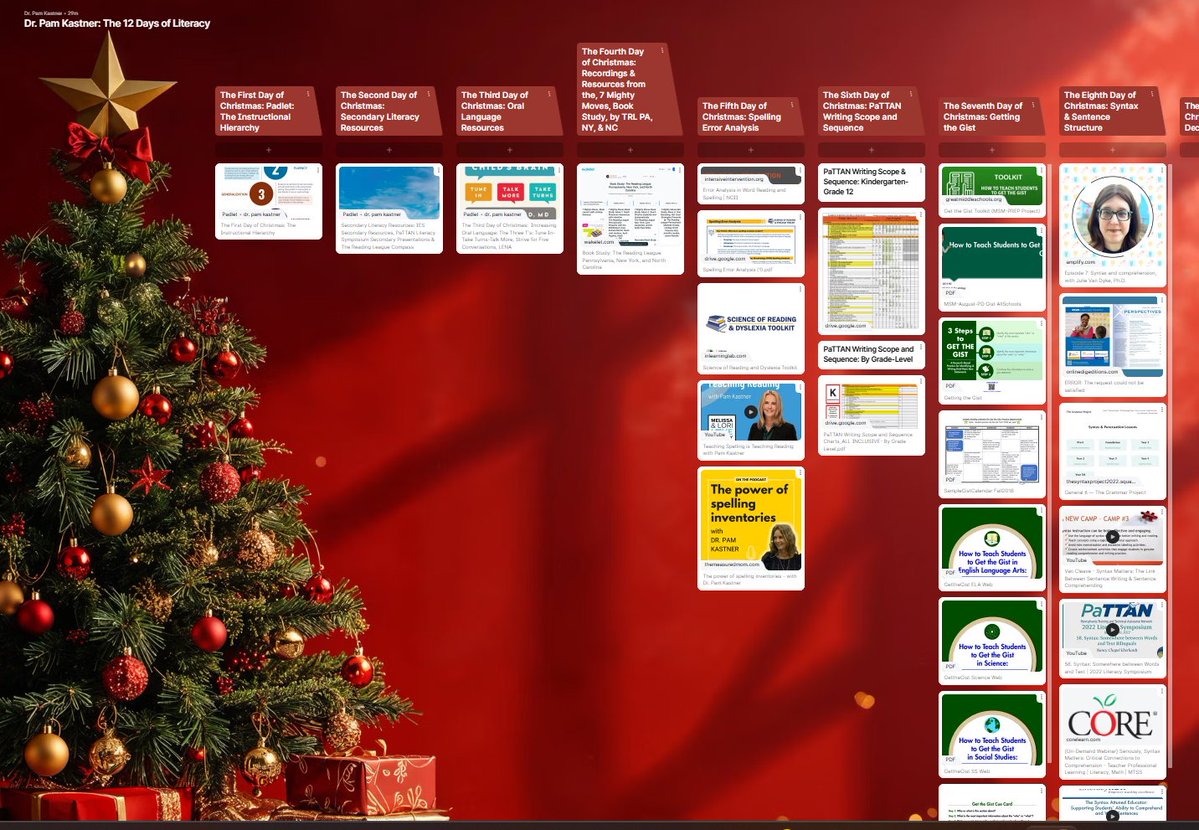
🎄 Dr. Pam Kastner’s 12 Days of Evidence-Aligned Literacy: Day 12: 47 Curated Literacy Resources!🎄
On the twelfth day of Christmas, I’m closing out these 12 Days of Literacy with something truly special, The Kastner Collection of comprehensive Wakelets featuring 47 carefully curated, evidence-aligned literacy resources designed to support teachers, coaches, and leaders across the full continuum of reading development. The Kastner Collection of Literacy Wakelets have already been accessed over 181,000 times!
This final collection brings together tools and resources that span:
• Foundational skills and word-level instruction to Adolescent Literacy
• Literacy Book Studies
• Open Mic Nights
• Instructional Routines
• Vocabulary, morphology, and language comprehension
• Fluency, syntax, and meaning-making
• Instructional decision-making and implementation support
• And soooooooooooooo much more!
Each resource was selected to help bridge research to practice, ensuring instruction is not only grounded in the science of reading, but also actionable, practical, and responsive to student needs.
Thank you to everyone who followed along, shared resources, and engaged in conversations throughout these 12 days.
My hope is that these collections continue to support thoughtful instruction, informed coaching, and strong leadership long after the season ends.
📌 Explore ALL 12 days of literacy here: https://t.co/pXD63OBHKF
Here’s to continued learning, collaboration, and evidence-aligned literacy in the year ahead. 💙
Warmly,
Dr. Pam Kastner
🎄 12 Days of Evidence-Aligned Literacy : Day 10: Vocabulary Routines That Build Meaning 🎄
Day 10 of our 12 Days of Evidence-Aligned Literacy Resources highlights a powerful set of vocabulary instructional routines designed to support teachers, coaches, and leaders in strengthening word learning across grades and content areas.
These vocabulary routines are grounded in what the research tells us about how students learn words best. Rather than relying on memorization or isolated definitions, the routines emphasize:
• Explicit instruction of word meanings using clear, student-friendly language
• Active processing through discussion, examples, and application
• Multiple exposures to target words across time and contexts
• Intentional connections between vocabulary, comprehension, and oral and written language
• Consistent instructional structures that can be embedded into daily Tier 1 instruction and intensified as needed
The routines provide teachers with clear, repeatable instructional moves that help students develop deep, flexible word knowledge, supporting both comprehension and expression.
Strong vocabulary instruction is not an “extra.” It is a core component of skilled reading and learning across all content areas.
Day 10 reminds us: If we want students to understand complex text, we must intentionally teach the words that carry the meaning.
📌 Explore Day 10 resources and every day after, here: https://t.co/pXD63OBHKF
🎄 12 Days of Evidence-Aligned Literacy | Day 8: Syntax & Sentence Structure 🎄
This season, I am sharing 12 days of evidence-aligned literacy resources, one per day, to support teachers, coaches, and leaders in strengthening instruction from foundational skills through skilled application.
Day 8 focuses on syntax and sentence structure—a critical, and often under-taught, component of reading comprehension and writing. As we move beyond individual words to meaning, syntax—how sentences are structured—plays a pivotal role in helping students make sense of text.
📘 Why Syntax Matters for Comprehension: Amplify: The Science of Reading Podcast
A powerful conversation with Julie Van Dyke, Ph.D., and Dr. Susan Lambert that explains why syntax may be the missing link in comprehension—and how syntax is rule-governed and systematic, much like phonics.
📗 IDA Perspectives: Syntax (Professional Reading)
A research-informed examination of sentence structure and its role in literacy development, grounding syntax instruction firmly in the evidence base.
🎁 The Syntax Project (Australia)
An extraordinary, freely shared collection created by expert teachers and leaders, including:
• FREE downloadable syntax lessons (Pre-K–Grade 6)
• A complete Syntax Scope & Sequence
• Templates aligned to The Writing Revolution
• Clear implementation supports
A true example of research-to-practice done right.
🧠 Syntax Matters: Sentence Writing & Sentence Comprehension
The late William Van Cleave’s enduring work reminds us of the essential link between writing sentences and comprehending them—and the lasting impact of explicit sentence-level instruction.
🌍 Syntax: Somewhere Between Word and Text
The brilliant Nancy Chapel Eberhardt shares: Syntax: Somewhere Between Word and Text from the PaTTAN Literacy Symposium. Nancy explores how syntax bridges word-to-text comprehension, particularly for bilingual learners, with attention to morphology, word order, and meaning. Nancy Chapel Eberhardt
🔗 Research to Practice: Seriously, Syntax Matters
A clear explanation of how sentence structure supports understanding who did what to whom, and why syntax becomes increasingly critical as texts grow more complex, from the incomparable, Nancy Lewis Hennessy.
📚 Classroom Application: The Syntax-Attuned Teacher
The one-and-only, Dr. Margie Gillis, offers practical routines that build teacher knowledge of syntax and support comprehension across the instructional day.
📌 Bottom line: If we want stronger comprehension and writing, we must intentionally teach students how sentences work. Syntax is not “extra”—it is essential.
📌 Explore Day 8 and every day after, here: https://t.co/pXD63OBHKF
🎄 12 Days of Evidence-Aligned Literacy – Day 5 🎄
Day 5 highlights spelling inventories and spelling error analysis tools, a critical yet often underutilized diagnostic tool to inform instruction and intervention.
Spelling inventories and error analysis moves us beyond identifying what students get wrong to understanding why. When educators analyze spelling errors through a phonological, orthographic, and morphological lens, instruction becomes more precise, responsive, and effective, for ALL students, but especially for students with reading challenges.
Spelling Inventories and the process of error analysis support educators in:
• Interpreting student errors as diagnostic information
• Identifying underlying linguistic gaps
• Designing targeted, evidence-aligned instruction
For Day 5, I am sharing:
- Two specific spelling error analysis tools, one from the National Center on Intensive Intervention and one from the Indiana Department of Education
- A Science of Reading & Dyslexia Toolkit where I accessed one of the spelling error analysis tools from the Indiana Department of Education. The Science of Reading & Dyslexia Toolkit site is a rich and robust science of reading site, and this is just one of the numerous resources that are not-to-be-missed!
- I have been a bit obsessed with spelling for a while now😊 and was honored to join The Measured Mom and Melissa and Lori podcasts to talk about spelling and specifically spelling error analysis. I have included those two podcasts in hopes of enticing you too, into this spelling obsession of mine.
📌 Explore Day 5 and every day after, here: https://t.co/pXD63OBHKF
🎄 12 Days of Evidence-Aligned Literacy: Day 2 🎄
Today’s resource spotlight focuses on secondary and adolescent literacy, an area where instructional precision and alignment to evidence are especially critical.
Day 2 features a curated Padlet of secondary literacy resources, including:
• 67 (yes 67!), curated presentations from the PaTTAN Literacy Symposiums (2020, 2022, and 2024).
• The Institute of Education Sciences (IES) Practice Guide: Providing Reading Interventions for Students in Grades 4–9
• REL Southwest Toolkit entitled, Providing Reading Interventions for Students in Middle School (PRISMS). The toolkit offers video demonstrations of instructional routines from the evidence-based recommendations in the Providing Reading Interventions for Students in Grades 4–9 practice guide.
• A direct link to The Reading League Compass for Adolescent Literacy
Together, these resources support educators, coaches, and leaders in strengthening literacy instruction beyond the primary grades, connecting research to classroom practice for older students who still need explicit, systematic support.
📌 Explore Day 2 and every day after, here: https://t.co/pXD63OBHKF
🎄 12 Days of Christmas: Building Better Literacy Instruction 🎄
Over the next 12 days, I’ll be sharing curated, evidence-aligned literacy resources designed to help educators move from research to instructional precision. Each resource is selected to support teachers, coaches, and leaders in making informed, effective decisions about instruction, practice, and intervention.
🔹 Day 1: A Padlet of resources related to The Instructional Hierarchy (Haring & Eaton, 1978), Types of Practice, and Cognitive Load Theory
I started here intentionally. The Instructional Hierarchy provides a critical decision-making framework that helps educators determine:
- What type of instruction students need
- When practice is appropriate—and when it is not-
- How fluency, generalization, and maintenance fit within MTSS
- Why mismatched instruction leads to stalled progress
When we ignore where students are in the learning process, even strong materials and good intentions fall short. This resource supports implementation fidelity and instructional alignment.
🔗 The Day 1 resource and all others to follow can be found at this link: https://t.co/pXD63OBHKF
Follow along for the next 12 days as together we unpack practical tools that strengthen literacy systems and classroom practice.
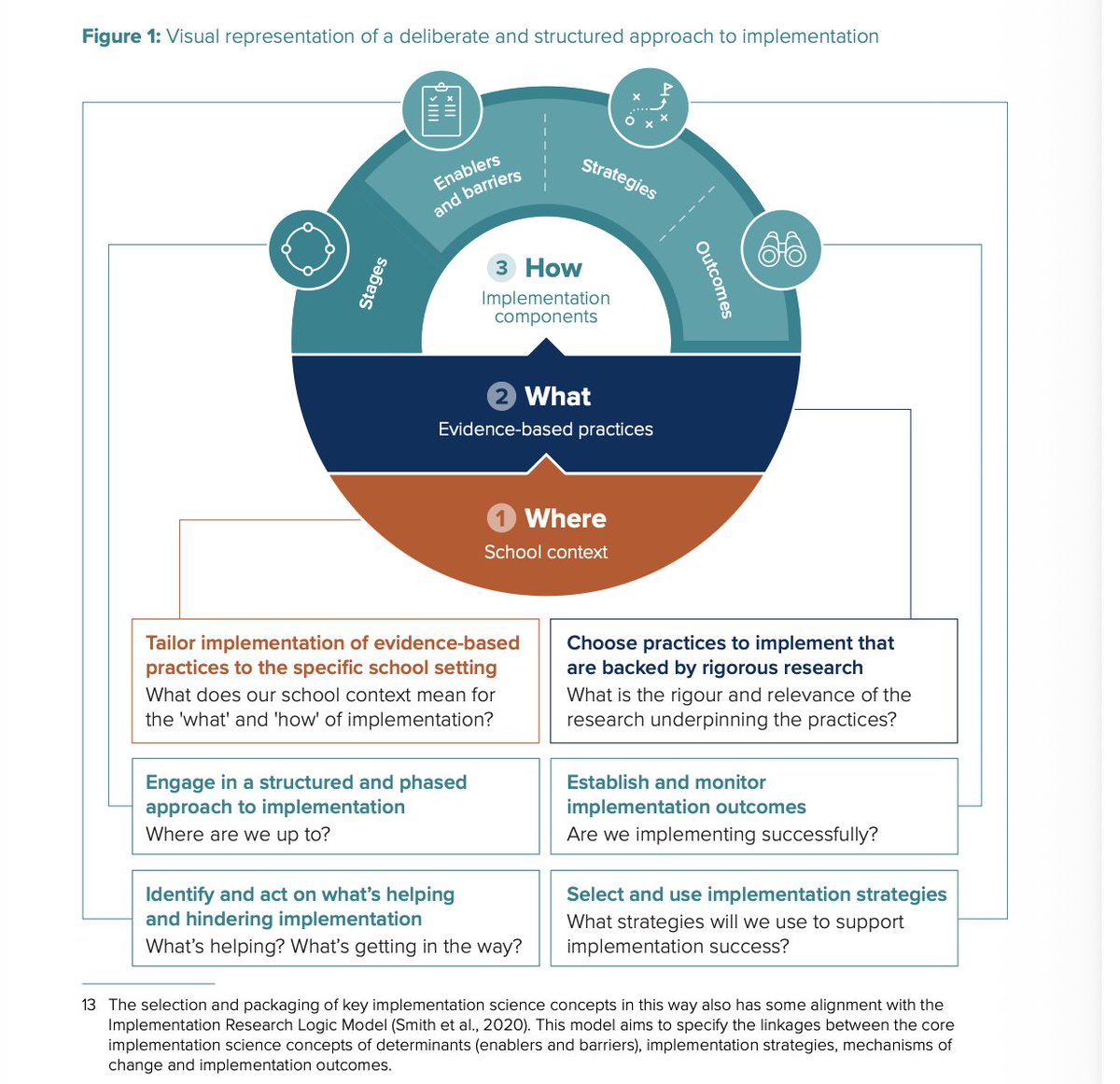
This new paper from @EdResearchAU is very welcome. It highlights something I have been concerned with for a long time now which is the implementation problem.
The main barrier to better teaching in many schools is not a lack of evidence but a lack of any kind of serious implementation. The same approaches that can thrive in one school can fail in another, depending on the quality of implementation, not the quality of the research. Some very useful guidance here: https://t.co/iArttJtZsY
Here’s a critical point about the success of the viral UFLI program:
It’s just 30 min per day.
That’s right… the runaway success story in phonics/foundational skills instruction takes just 30 min per day.
For years, we have been struggling with the perception that foundational skills will Hoover up the whole ELA block and crowd out other aspects of reading instruction.
UFLI proves all those fears wrong.
If you want to make sure you have ample time for other aspects of reading instruction, use UFLI.
If you are in a school where they are overdosing on foundational skills instruction and spending 60 or more minutes / day (because those schools do, in fact, exist in the Science of Reading era), consider switching to UFLI.
The efficiency and precision and usability that @HollyLanePhD@burnsmk1 have brought to this program enables all of the above.
And they have the RCT to prove that it’s really working. In case you didn’t believe the teacher testimonials that are truly everywhere you look.
I caught part of Dr. Shanahan’s webinar yesterday. He made a key point: leveling systems often leave parents in the dark about their child’s reading skill level in relation to grade-level standards and expectations.
If I had kids in K–6, one question I would ask at the November PTC would be: What is my child’s reading benchmark score, and what is the expected score for this time of year? If my child were below benchmark, I’d ask: What specifically did the score show? Was the issue, was it PA, phonics, comprehension, fluency, or sight words? And then I would ask how specifically my child can be helped through the school day?
Not to be accusatory—just to ensure the issue is understood and being addressed.
WHY? Because the statistics that Patrick shares below are alarming, and when it comes to reading development, "the gift of time" is a myth.
Every article, study, interview shows the 1st step to improve reading results for kids: adults have to be tired of failure enough to reflect and make tough changes. But many refuse to slaughter their sacred cows.
"We just have to keep doing this/that."
Then you get what you get.
The biggest trick being played on the public is convincing us that our own children are incapable of learning to read.
Gorrilas can learn sign language, cars drive themselves, and we're building a permanent space colony but our kids can't read bc of "Poverty + Trauma"?
Stop it
Kids from broken homes misbehave because they’ve never had and been held to behavioral expectations
Schools won’t help such students by continuing that mistake, lowering standards for them and holding them to no expectations
They need high standards just like every other kid
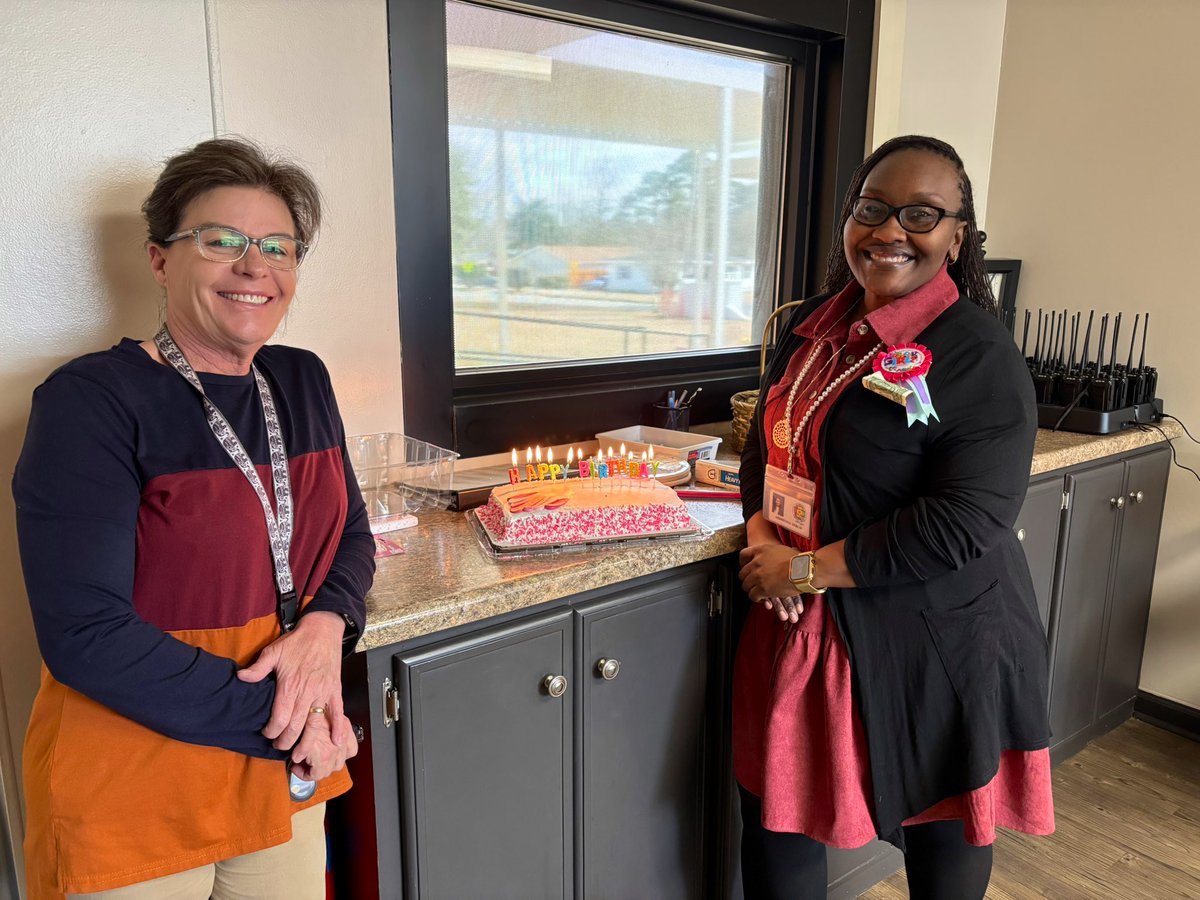
You know you’re special when the school you serve throws a party for you! Happy birthday to @ArdrinniaS and thank you for the relationships you build with your schools. Much appreciation to the Faine Elementary admin for allowing us to be part of your team! ❤️