Contributing Faculty Member, Mount Saint Joseph University, Reading Science Doctoral Program. President, The Reading League PA. Passionate advocate for the SOR
“Due to the fact that there are many ways a child can fall through the cracks,this makes the first 3 years of school the most important in the child’s life. It also means the K, 1st& 2nd grade teachers are the most important teachers in the entire system.”Mc Guinness,1997, p.211.
Chenoweth's EdTrust podcasts about schools and districts beating the odds should be required listening for school and district officials. People like Emily Hanford credit her work as a foundation of their own. Books, interviews, podcasts that walk you through it step by step.
@educationweek The evidence shows that problem-solving then instruction (i.e., discovery learning, i.e., productive failure) does NOT work in elementary school.
https://t.co/nzSifVvKF2
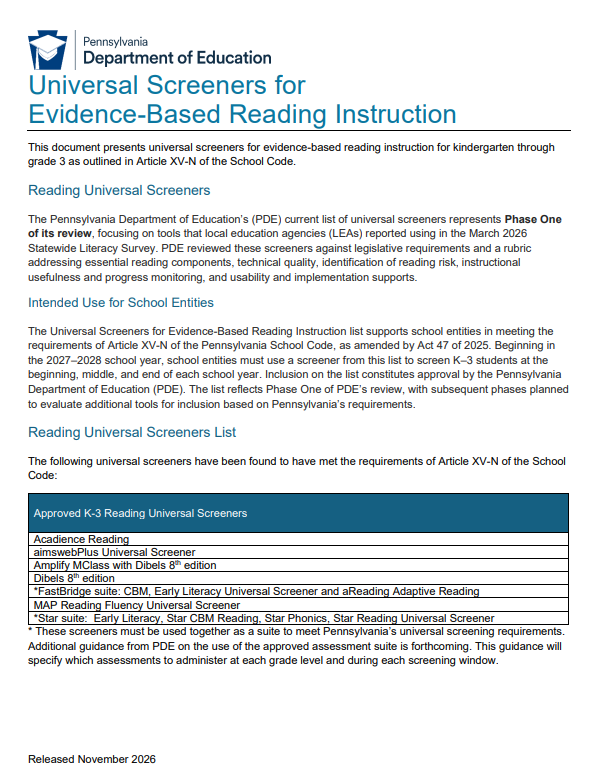
The Pennsylvania Department of Education has released Phase One of its review of universal screeners.
The Pennsylvania Department of Education’s (PDE) current list of universal screeners represents Phase One of its review, focusing on tools that local education agencies (LEAs) reported using in the March 2026 Statewide Literacy Survey. PDE reviewed these screeners against legislative requirements and a rubric addressing essential reading components, technical quality, identification of reading risk, instructional usefulness and progress monitoring, and usability and implementation supports.
One important thing to note. Computer adaptive tests appear only inside a required suite alongside teacher-given measures.
Access the current list here: https://t.co/zkhgre04T3
Summary one page I created with Claude can be found here: https://t.co/u5rZX010Nf
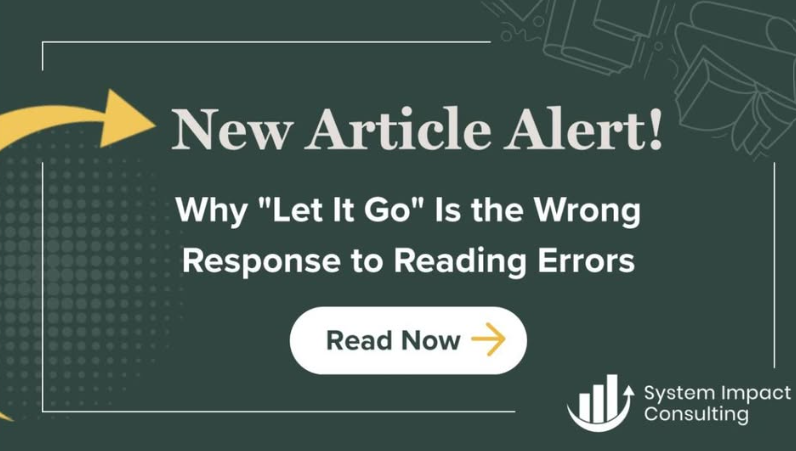
The brilliant Dr. Sarah Brown's recent blog, "Why "Let It Go" Is the Wrong Response to Reading Errors", about IMMEDIATE error correction is a quick read and a do-not-miss!
Here is a bit of a teaser to entice you to read this brief blog in its entirety. Dr. Brown opens the blog, "Why "Let It Go" Is the Wrong Response to Reading Errors" with the following,
" Think about how a GPS handles a wrong turn. It says "recalculating," gives you the next correct turn, and keeps you moving. The whole thing takes a couple of seconds.
That's what strong feedback should feel like during instruction. The best error correction is immediate, brief, and ends with the student saying the right answer.
The teacher models the correct response, the student repeats it, and the lesson continues. Research on corrective feedback has pointed to this pattern for decades."
Do not miss the specific guidance that follows and the supporting research citations.
Read it all- here: https://t.co/yJuaGKPs2E
Resharing this incredible opportunity to take a deep dive book study of, Routines for Reading Results, with Dr. Stephanie Stollar, Dr. Kelly Powell-Smith, Dr. Sarah Brown, and Beth Madden!!
If you are seeking instructional reading routines that get results and provide cohesive, unified instruction across core instruction and tiered support then THIS is THE book to integrate the science AND the practice.
Learn more here: https://t.co/yXbriZkO1E @sstollar6
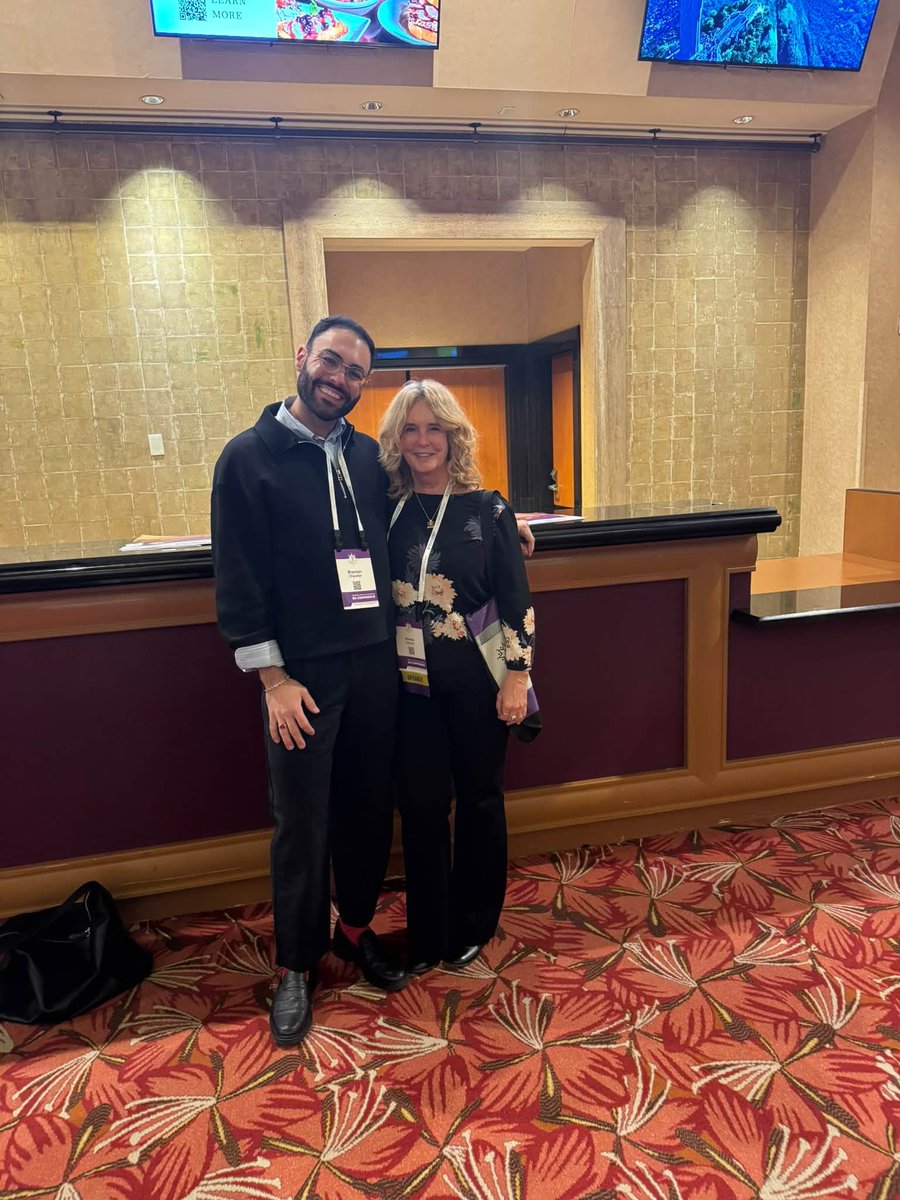
I am so grateful to Lynn Kuhn and the IDA conference team for such an inspiring and impactful literacy conference!
What an honor it was to co-present with the brilliant Sue Hegland at the conference this week.
Our conversations and collaboration during the process of creating our presentation were among the most significant learning opportunities of my professional career.
Reconnecting with literacy leaders committed to the right ALL children have to be literate made this conference all the more impactful. @bchandlerphd
An honor to join the Amplify team and an enthusiastic group of Washington educators in Seattle today for a deep dive into the foundational skills aligned with the Science of Writing.
I was also able to reconnect with Dr. Eugene Greenfield, a Mount Saint Joseph University Reading Science Game Changer graduate 🧑🎓 who I had the honor of serving on his dissertation committee!
Now it’s a flight ✈️ to Las Vegas to co-present at the International Dyslexia Association Conference with the brilliant Sue Hegland! ❤️
Both groups reached mastery. The kids who got new facts in small cumulative chunks got there in a third of the time — fewer responses, fewer errors, less frustration. Most programs still pile on too much at once.
👇
In this incredible, Meet the Expert, Reading Rockets video Dr. Louisa Cook Moats shares that,
"Spelling is a visible record of language processing. It is language written down. If we know how to look at a child’s spelling, we can tell what a child understands about speech sounds, about how we use letters to represent those and, as it turns out, anything that is going to cause trouble with a child’s reading will show up even more dramatically in the child’s spelling and writing." (You can watch the video here: https://t.co/FJfQ1ezSrv
Language written down! I love that statement! Spelling, whether a correct, or incorrect spelling, is a linguistic window offering us the opportunity to engage in effective, efficient, informed instruction and intervention.
Which is why I am so honored to spend an entire year with Michigan educators focused on spelling!
Today we finished our third session, and I could not be more grateful for the commitment, dedication, and enthusiasm the Michigan educators joining me for this year-long series have embraced this series!!
A big thank you to Dr. Kim St. Martin and the MiMTSS team for this honor! @MiMTSSTACenter
This is a power house group of education leaders sharing and discussing vocabulary and language instruction in the classroom.
Definitely one I will listen too many times!
The first lesson I ever taught was based on the structures in Bringing Words to Life and the work of Margaret McKeown. Twenty years later I get to talk about vocabulary with her. The indirect effects she has had on the hundreds of students I've taught is immeasurable.